


What Is Return On Ad Spend (ROAS)?
Return on advertising spend (ROAS) is the proportion of revenue to the cost associated with advertising initiatives. It serves as a quantitative indicator of a particular advertising initiative’s profitability. The performance of advertising projects is presently estimated using ROAS as a metric.
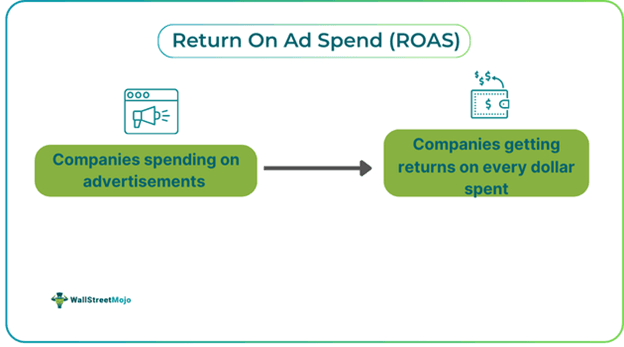
The goal of ad spending is to assess how well a given advertising effort performed. ROAS can assess the health of the company as a whole. There is a focus on capital efficiency. In times of economic uncertainty, ROAS is a metric businesses can consider maintaining or raising their marketing budget.
Key Takeaways
- Return on advertising spend (ROAS) is the proportion of revenue to the cost associated with advertising initiatives.
- It serves as a quantitative indicator of the profitability of a particular advertising initiative.
- RSOA helps businesses understand how much money they are making back on advertising expenditures.
- The business then can use that information to determine which initiatives are succeeding and which should be discontinued.
- The ROAS can be evaluated using the following formula: ROAS = revenue from the ad campaign/cost incurred in the ad campaign
Return On Ad Spend Explained
Return on ad spend (ROAS) is a metric used to assess the success of marketing campaigns. The income from advertising, compared to the expense of advertising, is used to calculate the ROAS. Usually, a ratio or percentage is used to describe it. When a company’s ROAS is high, it gets a decent return on its advertising expenditure. On the other hand, a poor ROAS might indicate that the advertising expenditure is not as successful or efficient.
Advertising goals are one of many variables that affect ROAS. If brand awareness is the primary objective, ROAS may be low since brand awareness typically does not result in instant conversions. Similarly, the definition of a strong ROAS varies by industry. Some sectors demand a higher ROAS, so such factors, among others, must be considered.
RSOA helps businesses understand how much money they are making back on advertising expenditures. The business then can use that information to determine which initiatives are succeeding and which should be discontinued. Businesses can employ a number of techniques to maximize ROAS. One such strategy is to conduct several campaigns simultaneously while performing ROAS calculations for each.
While more funding is allocated to the higher-performing ads, the low-performing campaigns can be curtailed. In addition to it, the knowledge gained from measuring ROAS can be used to enhance ad spend effectiveness and determine future marketing strategies.
Formula
The calculation of ROAS is simple, and there is little or no use for the return on ad spend calculator required.
The ROAS can be evaluated using the following formula:
ROAS = revenue from the ad campaign/cost incurred in the ad campaign
Examples
Example #1
ABC Ltd. spends $100,000 a month on online advertising for its new line of cosmetic products. During that period, the company gathered revenue of $50,000. Calculated by the return on ad spend calculator, the value arrived is as follows.
We get revenue/cost: $50000 / $10000 = $5, which means the ROAS is $5 or 5:1.
Simply put, the company gets $5 in revenue for every $1 it spends.
Example #2
As per an article published on Jan 27, 2023, slashing advertising budgets in companies can have serious negative consequences on profit. Similarly, on a larger scale, low ad budgets in 2022 affected most ad-tech stocks. Ad budgets were continuously slashed; this time, it caused 50%–80% of the layoffs in the industry.
While the industry looks promising, the U.S. advertising market is anticipated to grow slower than in 2022. The current percentage is 5.9% as opposed to the 9% in the previous year. The global market also has a slowdown, resulting from a complex macroeconomic environment. Other factors that contributed to it included rising inflation, recession, political uncertainty, and interest rates.
With the above data and the recession looming, companies may have to rethink their strategies, especially ROAS.
Return On Ad Spend Vs. ROI
Listed below are the differences between these concepts:
Frequently Asked Questions (FAQs)
What is a good return on ad spend?
The desirable ROAS differs considerably depending on the industry, type of company, size of the business, etc. Generally speaking, a ratio of 3:1 is considered good. It means that for every dollar spent, there are three dollars in return.
How to increase return on ad spend?
Increasing the return on ad spend is different for every business. It needs an analysis of the ads, a review of the target audience, a review of keywords, an advertisement cost review, etc. All related aspects must be analyzed to check their suitability for the business. The unsuitable ones shall be discarded or improved.
Is a 100% ROAS good?
A 100% return means the company gets back $1 for every $1 invested. This gives no profit or loss; it can ideally cover the costs incurred, so the profit received is zero. Hence, a ROAS return of at least 200% is recommended.
What is a negative ROAS?
Negative ROAS means the advertisement campaign or project is making less money. It indicates that the project is not profitable and the company is losing money.