


What Is A Hawk?
Hawk, in economics, refers to an individual who favors contractionary or tight monetary policy to control inflation through a rising interest rate. It is an economic term used for policymakers, economists, and advisors. The hawks prioritize controlling inflation over economic growth, employment, and consumer spending, thereby facilitating more savings than borrowings.
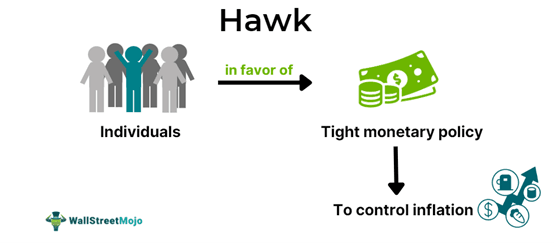
Such individuals believe in maintaining fiscal discipline while encouraging economic price stability. Upsurging interest rates result in a limited money supply in the economy, a decline in consumers’ disposable income, and, correspondingly, in their spending. When there is less buying of goods or services, the economy is said to slow down, easing inflationary pressures.
Key Takeaways
- A hawk in economics refers to the individual who suggests upsurging the interest rate and implementing restrictive monetary policies to decrease the inflation rate and ensure price stability in the economy.
- These economists, advisors, and policymakers believe in limiting the money supply in the economy to decrease borrowing,
- investment, and consumer spending such that trade and commerce activities slow down, and the inflationary pressure suppresses.
- They often emphasize achieving sustainable economic growth above lessening the unemployment rate.
- The Hawks are the opposite of Doves, who believe in quantitative easing and interest rate reduction to foster economic growth and check unemployment.
Hawk in Economics Explained
Hawk is an individual who believes in taking stricter steps to ease inflation. They favor tighter monetary policy, advocating for raising interest rates, which ultimately increases the cost of borrowing, thereby reducing borrowing and encouraging savings. This, in turn, slows economic growth but indicates a stabilizing inflationary scenario.
Hawks are primarily concerned with controlling inflation and maintaining price stability. Their primary focus is on achieving low inflation rates. Hence, they believe in higher interest rates, reduced government spending, or other measures to mitigate inflationary pressures. They generally support tighter monetary policy to restrict excessive borrowing and spending, thereby controlling inflation.
Dove is the term opposite to hawk in economics. Both the terms draw upon the analogy of birds, indicating the nature of the individuals that these categories of birds specify. Hawks are associated with their aggressive nature, while doves are known for their peaceful and gentle disposition. These terms are often utilized in central banking and monetary policy discussions, where policymakers make decisions regarding interest rates and money supply to manage economic growth and stability.
Hence, economists, policymakers, and advisors with hawkish attitudes focus on long-term economic stability instead of short-term economic boosts or bringing down the unemployment level.
Characteristics
Below are some features of a hawk:
- Zero Tolerance For Inflation: Hawks prioritize the control of inflation as a central objective of monetary policy. They accept the potential risks associated with rising prices but are less tolerant of inflationary pressures.
- Favor Contractionary Monetary Policy: They encourage more restrictive monetary policy, such as increasing interest rates, reducing the money supply, or implementing other measures to combat inflation.
- Emphasize Fiscal Discipline: They focus on fiscal discipline and responsible government spending, balanced budgets, or reduced government deficits since they believe excessive relaxation can lead to inflationary pressures.
- Focus on Price Stability: Hawks are mainly concerned with maintaining price stability in the economy. They believe stable prices are crucial for sustainable economic growth and consumer confidence.
- Less Concerned About Unemployment: While hawks prioritize price stability, they argue that temporary increases in unemployment may be necessary to curtail inflationary pressures.
- Follow Conservative Approach: These individuals favor gradual changes and closely monitor economic indicators. They are skeptical of aggressive stimulus measures and prefer a more restrained policy response.
- Aim At Long-Term Economic Stability: Hawks have a long-term perspective and are concerned about potential imbalances or risks arising from loose monetary policies. Thus, they are willing to accept short-term economic slowdowns to prevent future economic instability.
Examples
Let us consider the following instances to understand the concept better:
Example #1
Suppose nation A records an inflation rate of 5.97%. Given the situation, a set of hawks propose raising the short-term interest rates by 0.5% so that the borrowing costs are high enough for the citizens to borrow an amount from banks or other institutions. The other policymakers and advisers, comprising doves, criticized the move, highlighting the negatives of taking such a step. However, the authorities approved the hawks’ ideas, which reflected long-term benefits.
As a result of implementing such measures, people started saving more and spending less, thereby bringing down the inflationary pressure.
Example #2
Federal Reserve Chairperson Jerome Powell, in May 2024, indicated non-acceptance of allowing more restrictive monetary policies for the moment, refuting suggestions coming from the Hawks. Powell’s decision came following his expectations of controlled inflation rates over the year. He said that the inflation rate might not have reached the 2% goal of the Fed, but then the rates would be under control very soon, given the latest policies implemented. If there is solid evidence that these policies fail to control inflation rates, only then would the Fed favor the Hawks’ suggestions.
Dove vs Hawk
Dove and hawk are the terms commonly used in politics and international relations to describe different military intervention and conflict resolution approaches. However, they have equal implications in economics and finance, where the doves and hawks differ in the following ways.
Frequently Asked Questions (FAQs)
Why are hawks important?
Hawks are essential for the economy since they check excessive quantitative easing and monetary policy relaxation to avoid inflationary pressure. High inflation has various adverse consequences in the long run, as it can reduce purchasing power, erode savings, and bring inequality to the nation. Hence, such a perspective is essential for economic growth in the long run.
Is a hawk good or bad for stocks?
The hawkish economic perspective hurts the asset markets, including the stock market, since hawks discourage investments by limiting the money supply in the economy and reducing the consumers’ purchasing power and spending.
Can hawks turn into doves and vice versa?
Hawks and doves merely represent individuals’ perspectives and approach toward the economy. Hence, depending upon changes in personal perception, economic conditions, political ideologies, geopolitical situations, or any other unforeseen event, a hawk can convert into a dove and vice versa.