

Limit Down Meaning
Limit down refers to a significant decrease in the price of a futures contract or stock, which causes trading restrictions according to exchange rules. These rules are designed to prevent excessive market swings. Moreover, it gives traders time to react to major news.
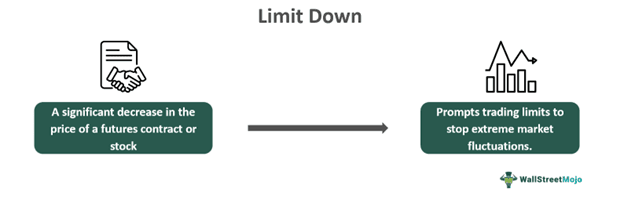
It keeps the financial market stable during times of high volatility. By setting a maximum allowable loss for a single trading day, it prevents sudden crashes that could cause major financial instability. This mechanism ensures that the market remains orderly and balanced, even in turbulent conditions.
Key Takeaways
- Leg out is to unwind or close out one individual position of the existing options trading spread or combo and not the entire strategy.
- A leg is one single position taken. So, buying shares of a company is a trader’s first leg, and then selling the same shares later indicates the second leg.
- Leg out refers to taking a short position selling the underlying securities. Conversely, when a trader takes a long position, it is called leg in.
- Although it sounds like a simple technique, it demands trading discipline, trend interpretation knowledge and decision-making skills.
Limit Down Explained
Limit down is a term used in trading, indicating the most a stock or commodity price can drop in one day of trading. The specific limit varies and is set by the exchange where the asset is traded. It aims to prevent sudden sell-offs and excessive market swings.
It is meant primarily for futures and equities trading. These mechanisms act as safeguards against sudden market collapse driven by panic selling. Limit down stock market regulations provide a sense of predictability and control as they set predefined limits on the maximum price drop within a single trading day This helps mitigate extreme price swings that could destabilize the entire market.
When the limit down price threshold is reached, trading restrictions are automatically triggered. This action temporarily halts trading activity. This pause allows market participants to reassess their positions, evaluate market conditions, and make informed decisions. This reduces the likelihood of knee-jerk reactions and further exacerbates market volatility. Additionally, by preventing prices from rising uncontrollably, this mechanism helps maintain investor confidence and overall market integrity. Furthermore, it helps maintain a conducive situation for fair and orderly trading.
In essence, these mechanisms serve as vital safeguards against the adverse effects of market panics and irrational behavior. Moreover, they promote stability, resilience, and confidence in financial markets. By putting down the restrictions on extreme price movements, they contribute to the maintenance of a well-functioning and orderly trading situation, which ultimately safeguards against the risks of financial instability and ensures the efficient allocation of capital.
Examples
Let us look at these examples to understand the concept better:
Example #1
Imagine a scenario where Company X, a popular tech stock, experiences a sudden wave of negative news, causing widespread panic among investors. As a result, many shareholders rush to sell their shares, causing the price of Company X’s stock to increase rapidly.
However, due to the implementation of limit down rules, the stock hits its price threshold. As a result, trading of Company X’s stock is temporarily halted. This gives investors a chance to pause and assess the situation without further aggravating the market turmoil. This brief pause in trading helps calm things down, stopping a possible big drop in the stock price and keeping the market stable.
Example #2
In Oct 2008, there was a halt of limit-down on shares of Russia’s Sberbank on both major stock exchanges in Moscow. This happened after the automatic trading halt was initiated due to a stock decline of more than 10 percent. On the MICEX platform, Sberbank’s shares dropped 10.45% to 20.30 roubles. On the other hand, on the RTS exchange, they dropped 10.71% to $0.75.
Consequently, trading was halted on the MICEX at 0706 GMT and on the RTS at 0700 GMT for one hour. Furthermore, single deals resulted in halts for Sberbank and Norilsk Nickel preference shares on the RTS exchange. The suspension was put into place per exchange regulations to preserve market stability in times of severe volatility.
Importance
Understanding limit down stocks is essential for investors as they serve as a safety net. It sets limits on how much a stock’s price can suddenly go up or down during a single trading session. This helps to prevent wild swings in prices that could catch investors off guard and protect them from taking on too much risk. This mechanism gives investors more confidence to make decisions, knowing that there won’t be any sudden surprises, as it makes the market more stable and predictable.
Moreover, it helps investors feel more secure about their investments. It creates a level playing field by reducing the chances of big price changes caused by mistakes or unfair practices. This transparency and predictability make it easier for investors to understand and manage the risks involved in trading stocks.
Frequently Asked Questions (FAQs)
What is the difference between limit down and limit up?
These are price thresholds in trading. The former is the maximum decrease permitted in the price of a stock or commodity during one trading session. In contrast, limit up is the maximum increase allowed. These limits aim to curb extreme price volatility and maintain orderly markets. They prevent prices from swinging too dramatically in either direction within a single trading day.
Are there any exceptions or special circumstances under which a limit-down suspension may not be implemented?
These suspensions may not occur under certain exceptions or unique circumstances. For instance, during pre-market or after-hours trading when liquidity providers are limited or when regulatory authorities grant trade exemptions due to extraordinary market conditions.
How do limit-down rules differ across various exchanges and financial markets?
Different financial markets and exchanges have varying policies for the percentage decrease required to activate limit-down regulations. Additionally, the duration of trading halts following such events may differ among these markets and exchanges.