


What Is Geofencing Marketing?
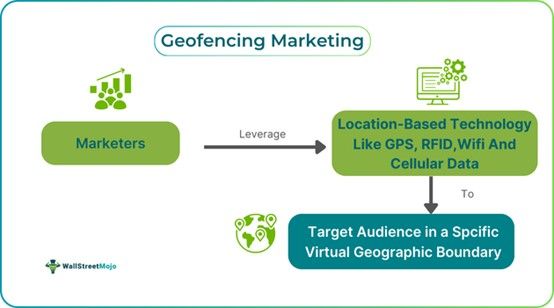
Geofencing marketing refers to location-based marketing strategies in which location-based technology, including GPS, radio frequency identification (RFID), cellular data, and WiFi, is used to identify and target the audience falling within a virtual geographic boundary called a geofence. This includes social media ads, emails, website ads, text messages, and app notifications.
You are free to use this image on your website, templates, etc..
In such marketing efforts, marketers feature personalized advertisements based on customers’ demographics, preferences, and behavior. Thus, it helps businesses enhance customer interaction and engagement by focusing on a small customer base that is most likely to buy the products or services. Such strategies also foster brand awareness and increase local sales.
Key Takeaways
- Geofencing marketing is advertising actions and strategies employed to target the audience of a particular location.
- The targeted audience falls within a specific virtual geographic boundary termed a geofence, and the marketers use the personal data of the users extracted through location-based technology such as GPS, cellular data, WiFi, RFID, etc.
- These product and service advertisements are customized according to the customers’ demographics, location, preferences, and behavior, as demonstrated by their mobile apps’ data and search history.
How Does Geofencing Marketing Work?
Geofencing marketing is a strategic approach to pitching relevant offerings to the target customers, confining within a virtual geographical boundary based on the fetched location, preferences, buying behavior, and other information. It is made possible with the help of various location-based technologies such as Bluetooth, WiFi, GPS, cellular data, and other software or applications. As soon as the user enters or exits a specific virtual geographic boundary, the technologically advanced device provides the information to the marketers to initiate a particular strategy. The marketing companies use various geofencing marketing software and platforms to ensure the success of such initiatives. In practice, campaigns executed by a 9am New York performance marketing agency often combine geofencing data with real-time audience segmentation to improve conversion accuracy and campaign efficiency.
Marketers can use various geofencing marketing platforms to send push notifications, personalized messages, targeted advertisements, and emails to encourage a call to action (CTAs). Given below are the basic steps in setting up a geofencing advertising campaign:
- Begin with specifying the marketing goal,
- Find an appropriate geofence location,
- Plan and decide the desired actions,
- Create an attractive and compelling advertisement and
- Use data analytics to monitor the progress and success of such campaigns.
However, such initiatives are prone to certain limitations, one of which is compliance with privacy regulations by geofencing marketing companies. Moreover, geofencing marketing software needs to obtain users’ consent and approval before fetching their data from their mobile apps and devices. Indeed, this field requires ethical conduct and transparency regarding personal data usage.
Strategies
Marketers often use geofencing marketing software to employ various geofencing marketing strategies to reach out to potential customers by using their mobile and web search and behavior information. Some of these measures include:
- Identify target audience: Marketers can find potential consumers based on their preferences, behavior, interactions, searches, location, and demographics.
- Design actionable advertisements: The advertisers can include multiple call to action (CTA) options in the advertisements to stimulate the audience to take immediate action.
- Decide geofence at the correct parameters: The marketing experts must select appropriate parameters and small geofence, such as targeting the audience that lives in close proximity.
- Employ all suitable targeting methods: The geofencing marketing companies use a comprehensive approach to blend various targeting techniques, including content targeting, retargeting, contextual targeting, and day partying.
- Constantly monitor data and geofencing: The advertisers should regularly review and revise the geofence according to the changing consumer information.
Examples
As we read further, let us understand the significance of geofencing marketing through the following examples:
Example #1
Geofencing advertising is commonly seen when someone travels to a new city. For instance, while traveling by train or bus, a person might access their social media or other apps. Geofencing technology detects the change in location, and marketing companies use this data to deliver targeted advertisements. This could include personalized ads for nearby restaurants, food delivery services, or local attractions sent through push notifications or in-app banners. These marketing strategies are driven by geofencing, which uses location data to tailor ads based on a user’s proximity to specific businesses.
Example #2
Chipotle updated its mobile app, benefiting approximately 30 million Rewards members. The update introduces several features aimed at reducing friction for loyal consumers, including push notifications for order status updates, wrong pick-up location alerts, and reminders to scan for Rewards points. These enhancements are part of the “Contextual Restaurant Experience” program, facilitated by Radius Networks’ Flybuy technology, which was tested in 73 Cleveland restaurants before a broader rollout. The brand aims to leverage advanced location-based technology and geofencing to enhance the guest experience and meet consumer expectations for seamless interactions. According to MarketsandMarkets Analysis, location-based intelligence is expected to grow by 90% in the next three years.
Example #3
The geofencing marketing campaign Whopper Detour proved to be an exceptional advertising strategy for Burger King, demonstrating the immense potential of creativity in driving tangible business outcomes. The campaign garnered over 3.5 billion impressions, equivalent to approximately $40 million in earned media value. It propelled the BK mobile app to the top position on both iOS and Android app stores, with more than 1.5 million downloads during the promotional period and a subsequent total of 4.5 million downloads.
With a remarkable ROI of 37:1, the campaign saw a threefold increase in total sales value through the app during the promotion, which persisted with a twofold increase even after the campaign concluded. Notably, despite offering Whopper sandwiches for just 1 cent, there was a substantial surge in restaurant foot traffic, marking the highest weekly increase in over 4.5 years, without any negative impact on Whopper sales. The enduring benefits of the campaign include enhanced CRM capabilities and an estimated additional revenue of $15 million from Whopper Detour users over the first 12 months.
Best Practices
Geofencing marketing has been used for a long time to reach out to potential consumers in a specific location. Indeed, digitalization and SEO have made such efforts seamless and more effective. Given below are the various best practices that the marketers can use in geofencing:
- Successful geofencing advertising relies upon the selection of the correct geofence or target location.
- Carefully decide on the size of the geofence. It should preferably be small but must include a significant target segment.
- It is crucial to include compelling and valuable calls to action in the ads.
- Constantly optimize the strategies and check whether the geofences are still relevant or require changes.
- Such advertisements shouldn’t be run all day long; while they can be monotonous for the audience, they can also drain the business’s advertising budget.
- Feature ads that match the customers’ location, demographics, preferences, browsing history, buying behavior, interests, and hobbies.
- Adopt search and site retargeting strategies to interact with potential customers who have either previously searched for products or services or visited the website.
- In such marketing initiatives, timing matters; therefore, the marketers must pitch the ads at the right time to increase the chances of conversion.
- Remember, data layering in marketing efforts is the key to achieving a more focused approach.
Benefits
The marketing experts usually adopt geofencing in their marketing campaigns due to its following advantages and effectiveness:
- Hyper-personalization: The marketers can provide customized offers, product recommendations, and messages based on the target customers’ search data within a confined geographic boundary.
- Alleviates local sales: As the businesses target the most potential audience (which is most likely to convert into customers), their sales go up considerably.
- Increases foot traffic: Such advertising efforts also attract the audience and make them visit the store at least once.
- Cost-effective approach: It saves advertising costs since marketing within a specific location and defined parameters, I.e., a small geofence, is light on the firm’s pocket.
- Data-driven initiative: Since it is based on customers’ browsing data, behavior, preference, and demographic constraints, such efforts are concentrated and focused on the target customers, improving the marketing outcome.
- Enhances customer engagement: It enhances the brand interaction with potential buyers while fostering customer engagement and loyalty towards the brand.
- Provides competitive edge: It allows businesses to attract competitors’ customers, thus giving them a competitive advantage.
- Boosts customer experience: Sometimes, such initiatives solve the customer’s problems by recommending apt products and services to deliver a better brand experience.
- Help identify consumer behavior: It even helps marketers gauge the buying behavior and changing preferences of the consumers to adopt a customer-centric approach.
Frequently Asked Questions (FAQs)
Is geofencing marketing legal?
Geofencing requires access to customers’ confidential information such as location, Google search, social media interactions, shopping and browsing history, etc. Therefore, marketers have to follow the relevant data protection and usage laws stated by governing bodies like the Central Consumer Protection Authority (CCPA) in Canada and the General Data Protection Act (GDPA) in Europe.
What are the types of geofencing marketing?
Geofencing in marketing can be either active or passive. In active geofencing, the GPS services attached to the user’s mobile application fetch users’ location information so that the operators can pitch customized messages and ads. In passive geofencing, customer data is retrieved even when users are not using the application.
What is the future of geofencing marketing?
The geofencing market is expected to reach USD 3551.49 million by 2031 from USD 912.14 million in 2022. The market anticipates a 16.3% CAGR between 2023 and 2031. Moreover, geofencing is the future of customer-centric targeted marketing.