


What Is Real Estate Asset?
Real estate assets refer to an asset class that allows for direct or indirect investment in land or improvements, such as real property, REITs issued debt instruments, mortgages, or interest in real property. Such assets are rented, sold, or bought to generate returns.
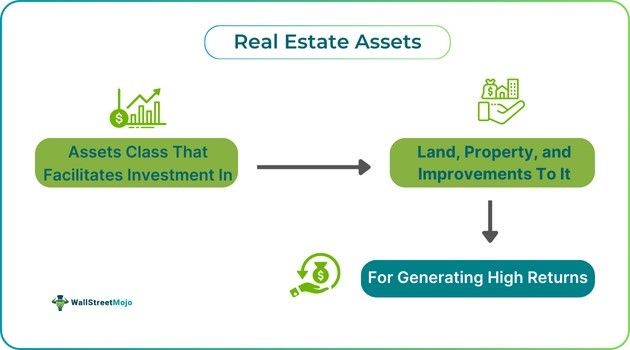
You are free to use this image on your website, templates, etc..
Due to a surge in their value, these assets have the potential to reap huge returns on investment. Moreover, the rental income and returns on REITs and other indirect real estate investments allow investors to generate passive income. Further, they serve as a hedge against inflation and help investors diversify their portfolios.
Key Takeaways
- Real estate assets are investments that comprise real properties like land or buildings and improvements made to such real estate.
- The different types of real estate assets are residential, commercial, industrial, land for special use purposes, raw, and indirect real estate investments.
- These assets require management to ensure long-term capital preservation, high returns, and value appreciation. Moreover, these investments hedge against inflation and diversify the investment portfolio
- Real estate asset preservation methods include estate planning, limited liability companies, insurance, homestead exemption, and REITs..
Real Estate Asset Explained
The real estate asset is an investment class that includes all the real properties and improvements made to such land or premises for sale, purchase, or renting out. Such investments can be made in residential, commercial, or industrial real estate, indirect real estate investment, raw land, and special-use purpose land. Hence, such an asset has a long-term value, both natural and added, by making improvements, constructing, or building something over land or property. The investors can also make indirect investments in such assets through REITs and other such arrangements.
Real estate companies often use real estate asset management software and tools to actively manage, mortgage, and generate returns from the real estate assets under management. Many firms also work with a real estate virtual assistant to handle administrative tasks, tenant communication, scheduling, and day-to-day operational support more efficiently. It is crucial since these investments have the potential to offer long-term returns and can provide a hedge against inflation due to rising property prices. Moreover, these assets involve a lot of capital investment, which is mainly arranged through debts, making it even riskier. However, the owners or investors may find these assets illiquid compared to equity. Also, these assets are vulnerable to local issues, climate changes, and natural disasters; therefore, they need careful consideration.
Types/Classes
The real estate assets under management can be categorized into the following different classes:
- Residential Real Estate includes duplexes, apartment buildings, townhouses, condos, single-family homes, multi-family housing, student housing, and cooperatives.
- Commercial Real Estate: This real estate comprises retail shops, offices, grocery stores, nursing homes, hospitals, storage units, shopping centers, theatres, restaurants, shopping complexes, gas stations, parking lots, etc.
- Raw Land: Such property includes any agricultural, underdeveloped, or barren land, such as farms, ranches, orchards, or timberland, that is rented, sold, or bought by individuals or firms.
- Industrial Real Estate includes premises such as factories or plants used by companies for business purposes such as production, manufacturing, storage, distribution, or research and development.
- Special Use Purpose: The buildings and land used for specific public use, such as temples and other places of worship, government offices, cemeteries, parks, libraries, schools, universities, etc.
- Indirect Real Estate Investments: These assets comprise all other real estate investments made through securities or indirect assets, such as real estate investment trusts (REITs), REIT debt instruments, interest in real property, and interest in mortgages.
Examples
Let us understand the significance of such real estate assets through the following examples:
Example #1
Suppose Mr. Wilson owns a mansion worth $2 million where he lives with his family. He also owns a leather bag manufacturing business. In 1995, Mr. Wilson registered his mansion under the homestead law as his primary residence or homestead. In 2023, Mr. Wilson faced a massive loss in business and became bankrupt. The creditors claimed to recover their losses from Mr. Wilson’s mansion; however, the court denied their claim since the homestead exemption protected the property.
Example #2
Blackstone has obtained an 80% stake in Burstone’s €1 billion European logistics portfolio, which comprises properties across Germany, France, and the Netherlands. This acquisition aligns with Blackstone’s strategic focus on the logistics sector, which is driven by the rise of e-commerce. It is one of the largest property deals in Europe in 2024 and signals a rebound in the commercial property market following a downturn.
Compared to other real estate sectors, European logistics properties have experienced smaller value declines and a quicker recovery. Blackstone expanded its UK logistics investments through several acquisitions and will now integrate this new portfolio with its existing assets. Burstone will retain a 20% stake and continue to manage the portfolio.
Source – https://www.ft.com/content/cbde3481-0415-429b-865d-ee2c4428da48
How To Protect?
Real estate asset management becomes even more crucial since the real estate sector involves a considerable investment. Below are some of the ways to protect these assets:
- Limited Liability Company (LLC): The landlord can form a limited liability company (LLC) to control the property, handle its mortgage, and bear its operating expenses.
- Estate Planning: Individuals can make a real estate trust, will, charitable donation, or other arrangements to properly plan the distribution of their estate among the designated beneficiaries after their demise.
- Domestic Asset Protection Trust: The owners or grantors can create a domestic asset protection trust to shield the assets from litigation proceedings or separate them from the gross real estate subjected to claim proceeds.
- Insurance: Landlords should get a property insured before renting it out to protect themselves against any claims arising from third-party injuries at the property, damage to or caused to the respective premises, and non-payment of rent by the tenants.
- Real Estate Investment Trust: Small investors who cannot afford substantial real estate ownership can choose REITs, which are investment vehicles pooling funds into income-generating properties.
- Homestead Exemption: Under the homestead law, an individual or family can protect their primary residence from creditors’ claims by registering real estate as their homestead.
- Risk-Avoidance: The investors should perform due diligence on the property owners and their ownership rights in the real estate and also on the tenants to ensure minimal risk in any such dealings.
- Equity Stripping: Landlords often use debts to limit their real estate equity by maintaining a significant share of the property as loan-to-value (LTV).
Frequently Asked Questions (FAQs)
How to calculate real estate assets?
The valuation of real estate assets differs depending on the type of investment. The most common method of evaluating a property’s value is through the return on investment. Other calculations involve gross income multiplier, capitalization rate, debt service coverage ratio, and capitalization rate.
What are digital real estate assets?
With the increased popularity of digital assets, the significance of digital real estate couldn’t be overlooked. Digital real estate is the virtual investment in properties like websites, social media accounts, URLs, domain names, etc. Such assets are appreciated over time due to their popularity and brand name, and they have the potential to generate considerable returns.
How to buy real estate assets?
The best way to directly invest in real estate assets is to buy commercial or rental properties with high return potential. Other investment methods include owning shares in real estate investment groups (REIGs) or real estate investment trusts (REITs). Also, experts in housing market valuation can benefit from house flipping by selling undervalued real estate within 6 months of purchase to make huge profits.