


What is the Deadweight Loss Formula?
The deadweight loss formula calculates wasted resources due to inefficient allocation of an excess cost burden to society due to market inefficiency. When the two basic economic supply and demand forces are not balanced, it leads to deadweight loss.
Download FREE Deadweight Loss Formula Excel Template and Follow Along!
Download Excel TemplateMarket inefficiency is when consumption (demand) or allocation (supply) of goods and services will be high or low, leading to deadweight loss.
The formula is given below: –
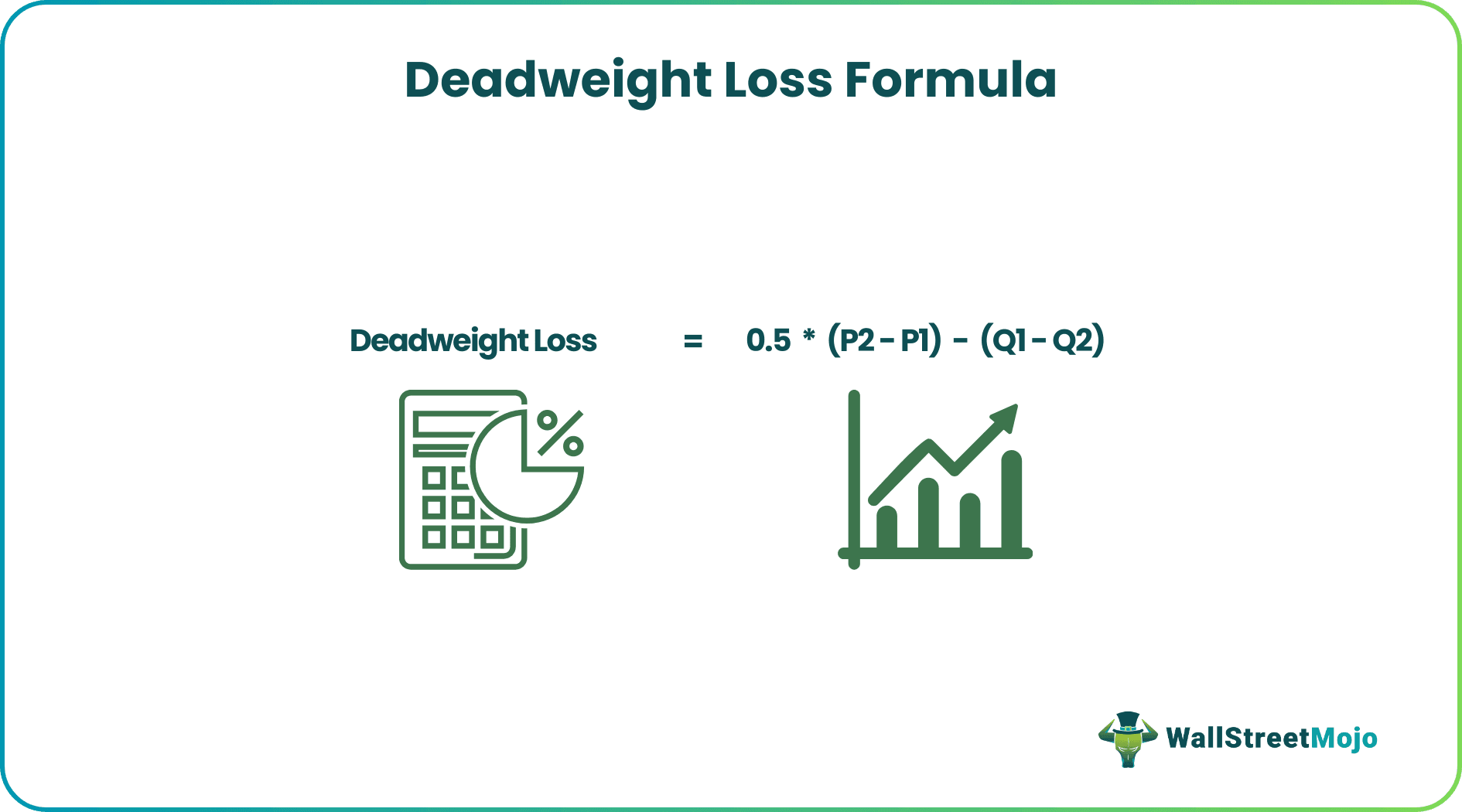
Deadweight Loss Formula = 0.5 * (P2 – P1) * (Q1 – Q2)
Where,
- P1 – Original price of goods/service
- P2 – New Price of goods/service
- Q1 – Original Quantity
- Q2 – New Quantity
Key Takeaways
- The deadweight loss formula measures the wasted resources due to the inefficient allocation of a surplus cost burden to society due to market inefficiency.
- When economic supply and demand forces, which are two fundamentals, are not balanced, it leads to deadweight loss.
- The factors which lead to deadweight loss are price ceiling, pricing floor, monopoly, taxation, and government intervention.
- The government can determine the market by calculating deadweight loss, which is higher than the value relative loss in revenue.
Explanation
The deadweight loss can be derived using the following steps: –
Step 1: First, you need to determine the Price (P1) and Quantity (Q1) using supply and demand curves as shown in the graph; then, the new price(P2) and quantity(Q2) have to be found.
Step 2: The second step derives the value of deadweight loss by applying the formula in which 0.5 is multiplied by a difference between new price and old price (P2-P1), new quantity, and old quantity (Q1-Q2).
Deadweight Loss = 0.5*(P2-P1)*(Q1-Q2)
Factors Leading to Deadweight Loss
- Price Ceiling
- Pricing Floor
- Monopoly
- Taxation
- Government Intervention
Calculate Deadweight Loss with Examples
Below are the examples -.
Example #1 (With Pricing Floor)
Let us consider A is working as labor in D’s company for a wage of ₹100/day if the government has set a pricing floor for wages as ₹150/day, which leads to a situation where A will not work for below ₹150, or the company will not pay above ₹100. Hence, leading to a loss of tax from revenue from both of them is a deadweight loss to the government.
Example #2 (With Taxation)
Let us consider the cinema ticket sold by a theatre is ₹120. So, it would sell around 500 tickets per show. However, the government has increased the entertainment tax to 28%, so the tickets that are not sold are considered a deadweight loss as some people would not spend much on a show.
Solution:
Use the given data to calculate deadweight loss: –
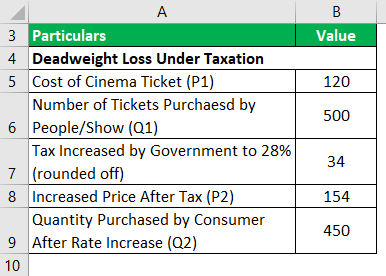
The government has increased the entertainment tax to 28%, which has led to an increase in and decrease in tickets sold. The price increase is calculated as below: –
Tax increased by the government to 28% which is calculated as = 120 * 28 / 100 = 34(rounded off)
Hence, the New Price =120+34=155 (rounded off to nearer amount) (P2)
And the New Quantity is=450(Q2). Calculation of deadweight loss can be done as follows: –
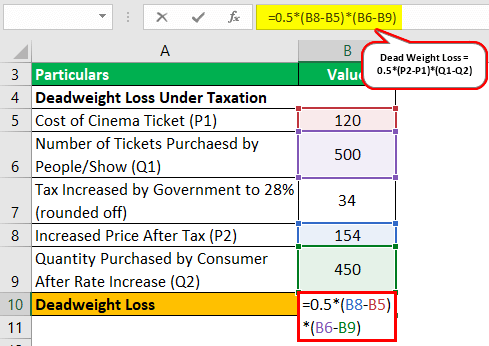
Deadweight Loss = 0.5* (154-120) *(500-450) = 0.5 * (34) *(50)

Value of Deadweight Loss is = 840
Therefore the deadweight loss for the above scenario is 840.
Example #3 (With Monopoly)
In the below example, a single seller spends ₹100 to create a unique product and sells it for ₹150, and 50 customers purchase it. However, once he decides to increase the selling price to ₹200, the demand for quantity reduces to 30 units; hence, he loses the customers below the purchasing power, considered a deadweight loss.
Solution:
Use the given data for the calculation of deadweight loss: –

Calculation of deadweight loss can be done as follows:
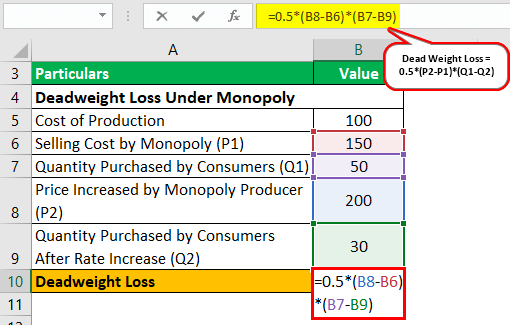
Deadweight Loss = 0.5 * (200 – 150) * (50 – 30)= 0.5 * (50) * (20)
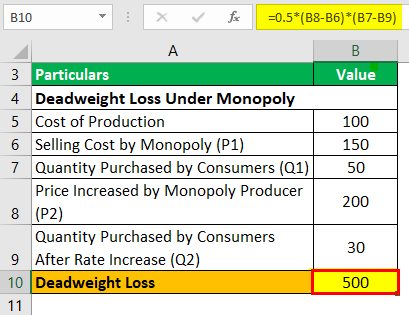
Value of Deadweight Loss is = 500
Therefore, the Deadweight loss for the above scenario is 500.
Deadweight Loss Calculator
You can use this deadweight loss Calculator.
Relevance and Uses
One can calculate the deadweight loss for any deficiency due to imbalanced market equilibrium, tax, or mentioned above.
Deadweight loss is used to calculate the value of the deadweight loss at various stages. For example, let us consider if the government imposes more tax, which affects production and purchase in a market, reducing the government tax revenue. In this case, the government can judge the market by calculating deadweight loss, which is higher than the value relative loss in revenue.
Frequently Asked Questions (FAQs)
How to calculate deadweight loss on a graph?
The deadweight loss is plotted on a graph as the shaded portion between the demand curves and supply. The demand curve denotes the value of the goods to the consumers, and the supply curve represents the cost for producers.
Is deadweight loss a negative number?
The deadweight loss can be zero but never a negative number. Society must pay the financial price of deadweight loss. A mismatch between resource allocation and consumption is the root of this market inefficiency.
What is no deadweight loss?
The no deadweight loss refers to the tax that raises no revenue for the government. In order to attain the best or allocative efficiency, there must be no loss of financial efficiency in terms of value for consumers or producers.
How to calculate deadweight loss from a table?
To calculate the deadweight loss from a table, one must know the price change and change in quantity demand.
Recommended Articles
This article has been a guide to the Deadweight Loss Formula. Here, we discuss deadweight loss calculation using its formula and examples of deadweight loss and a downloadable excel template. You can learn more about financial analysis from the following articles: –