

Difference Between LLC and Corporation
LLC means Limited Liability Company, a kind of company in the United States corporate Structure where the entity owners are not personally liable for the Entity’s debt. That can also combine the partnership and sole proprietorship features. In contrast, Corporation is a macro that consists of a group of companies to act as one entity and recognized legally with a wider meaning.
Choosing the right form of business is one of the many important decisions that are required to be taken by the Entrepreneur. The unique form of businesses is Sole Proprietorship, Partnership, Corporation, LLC, etc. These different forms offer their benefits and shortcomings, which must be assessed before a decision is made.
What is a Limited Liability Company (LLC)?
Limited Liability Company (LLC) is a new-age form of business that combines the privileges of both a partnership firm and a company form of business. This form of business limits the liability of the members and separates the debts held by the business. In other words, members of an LLC aren’t held personally liable for the business’s debts.
- Limited Liability Company usually has ‘LLC’ to its end name. Examples include Chrysler LLC etc. LLC can begin its operation with a minimum of a single member, and there is no limit on the maximum number of members. Rules and regulations about LLC depend upon the country of incorporation, and as such, there is no uniformity in the same.
- LLC is a good form for small-scale and early-stage startups with minimal legal requirements and fast incorporation benefits. LLC is run by the Board of Directors, which its Members appointed under its Memorandum of Association and Articles of Association.
What is a Corporation?
A corporation is a type of Legal Entity having a different legal status which is different from its owners and is a more suitable form of business for Large Enterprises. It is an extensive, complicated form of business as it requires a lot of record-keeping about accounting, taxation, and compliance formalities.
Corporations usually have the word ‘Incorporated’ to their end name. Examples include Amazon Inc, Facebook Inc, etc. The owners of the corporation are known as shareholders, and they elect the board of directors responsible for the overall policy-making and decision framework of the Corporation. Popular types are:
- C Corporation, also known as C Corps, is a separate taxpaying legal entity. These entities file their separate income tax returns, and their shareholders’ income is subject to Double Taxation. (Double Taxation means that firstly the Income earned by a C Corp is taxed at the rates applicable to it as per the jurisdiction in which it is operating. Then dividends distributed to shareholders are also taxed as per the Tax rates applicable Personal Income).
- S Corporation, also known as S Corps, enjoys the benefits of Pass-through taxation, which implies that all the Income and expenditure, deductions, and any credits are the direct responsibility of its Shareholders. As such, this form is not subject to Double Taxation. It restricts the maximum number of shareholders to 100.
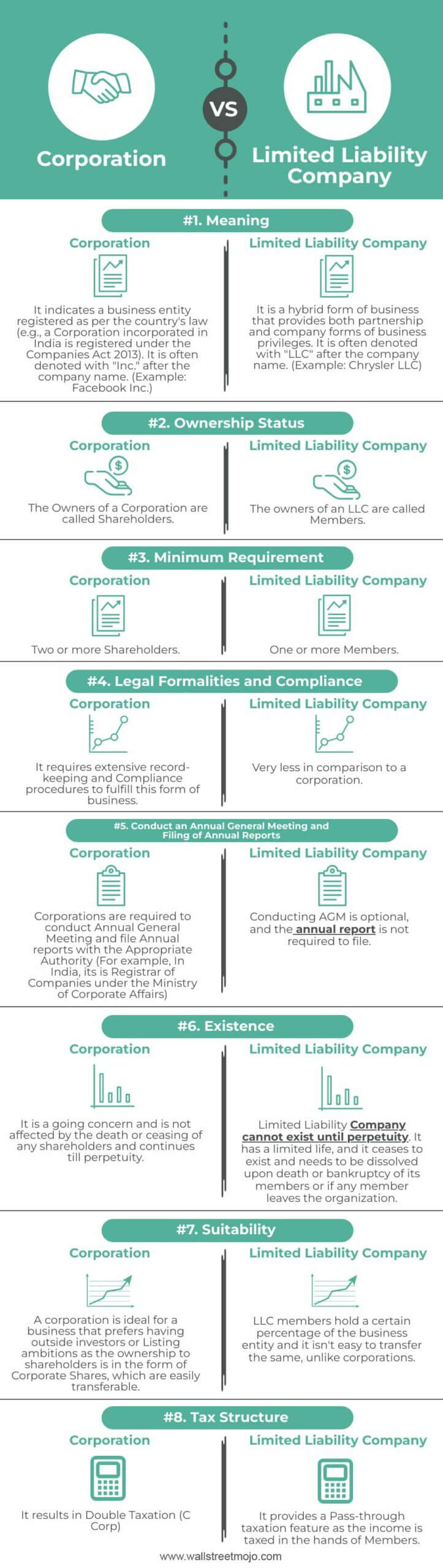
Corporation vs LLC Infographics
Let’s see the top differences between corporations vs LLC.
Key Differences
The key differences are as follows –
- The corporation form of business involves stringent legal formalities and record-keeping, which has many compliance costs, then LLC Full Form has minimal legal formalities and lenient recordkeeping requirements.
- Corporation results in Double Taxation (except in case of S Corp, which suffers from other limitations in terms of the maximum number of members etc.) whereas LLC offers pass-through taxation benefit, which means the income of LLC is taxed as per the personal tax rates applicable to its members instead of corporate tax rates.
- A corporation is an ideal choice of big business with listing ambition and offers the opportunity to tap funding from varied sources; however, LLC is a good format for small businesses, but it results in limited further growth and expansion avenues.
Corporation vs LLC Comparative Table
Conclusion
Both forms of business offer their unique benefits along with certain similarities. Choosing one form over the other depends upon the entrepreneur as all the legal formalities before and after the business setup lies in the form itself. Cost-benefit must be done before choosing between the two to ensure business goals are achieved in the best possible manner.
Recommended Articles
This has been a guide to LLC vs Corporation. Here we discuss the top differences between them and infographics and a comparative table. You may also have a look at the following articles –