


What Is A Brain Wallet?
Brain wallet in crypto refers to a phrase given to a user instead of a digital or software wallet for trading purposes. The main intention of this wallet creation is to provide a passphrase to crypto traders that does not exist on paper. Instead, it has to be stored in the brain as a memory.
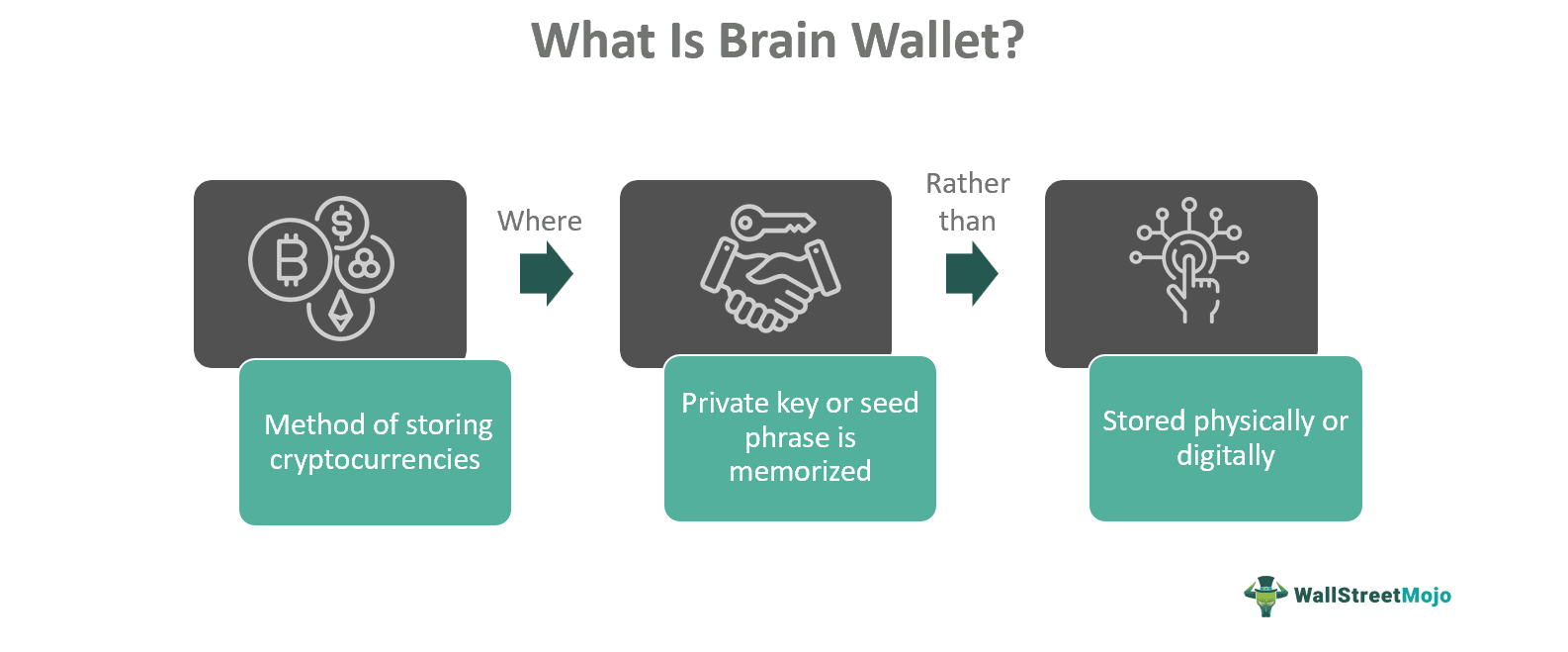
Brain wallet generators have been present in the Bitcoin blockchain since its inception. However, they function differently from traditional digital wallets, operating as a code that users must commit to memory. Nevertheless, accessing funds can become challenging if the user needs to remember this code.
Key Takeaways
- Brain wallets are digital wallets that exist independently of physical devices. Instead, users can generate a passphrase through specialized applications.
- Originating alongside Bitcoin’s development, most brain wallets are compatible with Bitcoin.
- Users memorize this passphrase to access their wallet, as it enables the generation of both the private and public keys.
- Prime applications include Brain Wallet io, Electrum, Armory, and similar platforms.
Brain Wallet Explained
A brain wallet in cryptocurrency involves a passphrase, akin to a mnemonic phrase, used to generate a cryptographic private key. Unlike traditional digital wallets, which store keys electronically, it relies on users to memorize their passphrases rather than writing them down or sharing them. This passphrase is crucial for accessing the associated funds. However, relying solely on memory poses risks, as forgetting the passphrase could result in permanent loss of access to the funds. While these offer an alternative to physical or digital storage, they do not eliminate the risk of hacking. Weak passphrases or insecure usage can expose users to potential theft. Therefore, while it provides a unique approach to cryptocurrency storage, users must prioritize security measures to safeguard their funds effectively.
Its life expectancy depends on the brain and the mnemonic seed generator. There are various applications like Brain Wallet io, Mycelium, Electrum, Armory, and others. With the help of them, users can generate a code and use it to store the funds. For instance, a person can drop any file on Brain Wallet io and generate the passphrase. Then, the application utilizes the SHA 256 and HMAC-SHA512 hash algorithm to provide a Bitcoin private key pair. Later, crypto users can log in and trade with this code.
Here, the hash algorithms and crypto keys play significant roles in its development. They help in creating private keys. Through the SHA 256 hash, the passphrase acts as an input and evolves into a 256-bit hash. Further, this hash value acting as a private key can derive a public address as well. As a result, crypto users can easily log in to their brain wallets with this code. In short, it acts as a root phrase for public and private keys.
Examples
Let us look at some hypothetical and real-world examples to understand the concept better:
Example #1
Suppose Sazzy is a portfolio manager handling her clients’ investments. After transitioning to the crypto market, she chose Bitcoin as a primary investment option but worried about the security of her funds. To mitigate this risk, she decided to use a paperless wallet solution. Using a brain wallet generator, she obtained private keys and a public address.
Sazzy’s passphrase, “sense quick giant powerful bring field valley has been carry seem weakness alas,” allowed her to create a mnemonic and remember her code. With around 100 BTC in her wallet, she accessed her tokens for trading as needed by inputting the generated private key.
However, as Sazzy attempted to access her wallet on subsequent occasions, she mistakenly entered “gaunt” instead of “giant,” resulting in her wallet becoming inaccessible. Despite multiple login attempts, she was unable to regain access. Fortunately, after some time, she recalled the correct passphrase, allowing her to access her funds. This example underscores the importance of securely storing brain wallet passphrases and the potential consequences of forgetting or mistyping them.
Example #2
In an experiment by a BitMEX Researcher, brain wallets—Bitcoin wallets secured by memorized passphrases—proved vulnerable. Despite using phrases from famous literature and even Satoshi Nakamoto’s Bitcoin whitepaper, funds associated with these brain wallets were swiftly drained by hackers. The researcher speculated that hackers maintain servers constantly scanning the blockchain for vulnerable brain wallets, exploiting passphrases derived from published materials. While brain wallets offer a potentially convenient storage method, the experiment underscores significant security risks, prompting caution and exploration of more secure alternatives for cryptocurrency storage.
How To Secure?
Although brain wallets can be a fruitful thing for crypto users, there are specific ways to secure them from attacks. Let us look at them:
- Creating a strong keyphrase – The foremost step is to develop a strong phrase that is difficult to guess yet easy to remember. It can be a lengthy code with a mix of upper-case and lower-case characters. As a result, the access remains secured with wallet users.
- Using memorizing techniques – Another method to secure is to implement different techniques. It will help in retaining the phrase in the memory for a longer time.
- Having a solid storage plan – If users are skeptical of their memory power, they can try physical methods. One of the best ways is to write down the code in a safe mode where the access remains with the owner. It can be either a digital or a physical copy. However, it must be stored safely.
- Adding multi-factor authentication (MFA) – In addition to the above methods, MFA also plays a vital role in brain wallet login. Users can add an extra code as a layer of security to the crypto funds.
- Updating and reviewing the phrase – Lastly, wallet users can update their passphrase for security reasons. Alternatively, they can review the code and check their wallet funds.
Advantages & Disadvantages
Following are the advantages and limitations of the concept in the crypto world. Let us look at them:
| Advantages | Disadvantages |
|---|---|
| It saves from the different hacking elements and malicious actors. | Any mental condition can lead to the loss of this wallet. |
| There is no need to trust any other device; brain memory itself is enough. | If a user forgets the phrase, the private and public keys also face extreme risk from hackers. |
| Such vaults do not have a digital presence, unlike traditional wallets. | Hackers may still crack this issue with their private systems. |
Brain Wallet vs Paper Wallet
Although brain and paper wallets are different from traditional vaults, they have distinct features. Let us look at them:
Frequently Asked Questions (FAQs)
How to import a brain wallet?
The following are the two possible ways to import it. Let us look at them:
- The first method is to create a new wallet and click on restore.
- Next, type the private key and import the address. However, they should only type private keys and not the seed.
- Also, users can make a new transaction to access the funds.
What is salt in a brain wallet?
It refers to the additional or final passphrase added to the wallet for more collaboration. As a result, advanced security is enabled, making it difficult for hackers to guess.
Which hash algorithm is best for brain wallets with balance?
Although SHA 256 hash is mainly used, there is one more algorithm that is preferable. The BIP32 generator creates a hash that is slow and hard to hack. Therefore, the wallet remains secure and far away from a cyber attacker’s exploit.