

What Is A Book Transfer?
Book Transfer refers to the movement of funds or assets between accounts within the same institution, marking the change in ownership of the assets. This process makes it smooth for two parties having accounts in the same institution to undergo instant and document-free ownership changes, eliminating transaction delays and optimizing operational efficiency.
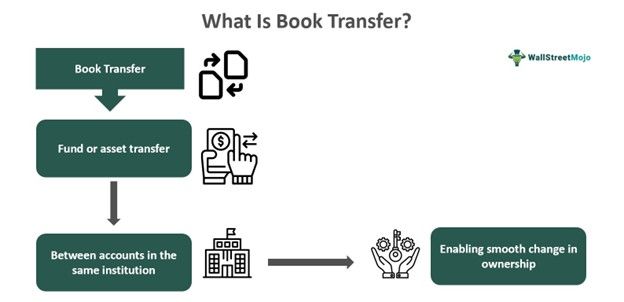
It expedites financial transactions within a bank, ensuring instantaneous movement of funds or assets between accounts. This method streamlines banking operations, reduces transaction times, and enables prompt asset ownership changes without the need for physical document transfers, benefiting both institutions and customers simultaneously.
Key Takeaways
- Book transfer refers to the movement of funds or assets between accounts within the same bank or financial institution, enabling quick and immediate transactions without involving the physical movement of documents or checks.
- It marks the change of ownership of the funds or assets in case of transfers concerning money market accounts.
- While book transfers are more streamlined and convenient for internal transactions within a single bank, wire transfers offer a broader reach and facilitate transactions between different banks or entities.
- Book transfers occur within a single financial institution, allowing for quick and immediate movement of funds between accounts owned by the same individual or entity.
- In contrast, ACH transfers involve the movement of funds between different financial institutions or accounts and are processed through the Automated Clearing House network.
Book Transfer In Banking Explained
Book transfer in a bank is concerned with the transfer of funds from one account to another in the same institution. For example, when an individual moves their funds from a checking account to a savings account, it is considered an instance of such a process. On the other hand, in the realm of finance, the process marks the movement of assets from one owner to another in the same financial institution.
Book transfer in banking reduces or removes float time, which marks the delay between the deposit of a check and the funds being actually cleared by the institution. During this time, the paying bank might utilize these funds to earn interest before the check is officially cleared. This delay can lead to a form of double counting since both the payer and the bank are considering the funds available.
However, book transfers help eliminate this float time. When customers transfer funds between their own accounts within the same financial institution, it is a more instant process, which bypasses the delay that occurs in the case of the traditional check clearance. As the process takes care of the float time, it benefits both customers and the bank, as it removes the lag time and ensures immediate availability and accuracy of funds.
Book transfers commonly occur between various deposit accounts—savings, checking, or money market accounts—streamlining internal transactions. By doing so, they enhance operational efficiency, minimize the float time, and provide customers with prompt access to their funds, ultimately optimizing banking processes.
Examples
Let us look at the scenarios below to understand the book transfer meaning better:
Example #1
Consider Sarah, who holds $600 in her checking account and intends to allocate $300 to her savings account within the same bank. Opting for a book transfer, Sarah instructs the bank to electronically move $300 to her savings account. She does so to avoid waiting for a traditional check to clear. The process facilitates the swift transfer of funds to her savings account, making it available for use instantly, without any delay or involving any kind of processing time.
Example #2
Think of a scenario where an investor, Alex, wants to diversify their portfolio by transferring ownership of stocks between two accounts within the same brokerage firm. Alex initiates a book transfer, moving 50 shares of a particular stock from their individual account to their retirement account. Through this process, ownership of the stocks seamlessly shifts without the need for physical stock certificates or other documents, ensuring a swift and hassle-free adjustment in their investment allocation.
Book Transfer vs Wire Transfer
When it comes to transferring funds, there are two ways in which the purpose can be achieved. One is a book transfer, while the other is a wire transfer. Let us check out the differences between the two in brief below:
| Parameters | Book Transfer | Wire Transfer |
|---|---|---|
| Definition | Book transfers primarily involve the movement of funds or assets within the same financial institution. | Wire transfers facilitate the movement of funds between different financial institutions or banks. |
| Speed | These transactions are typically quick and often instantaneous. | Usually faster than book transfers, often within the same day, but can take longer for international transfers. |
| Type of account | Checking accounts, savings accounts, and money market accounts. | External accounts |
| Cost | No cost involved | Involves transaction charges |
Book Transfer vs ACH Transfer
Besides wire transfer, book transfer also exhibits differences from Automated Clearing House (ACH) transfer. Let us check out a few of the differences below:
| Parameters | Book Transfer | ACH Transfer |
|---|---|---|
| Definition | Book transfers involve the movement of funds or assets within the same financial institution, allowing for immediate or near-instantaneous transactions between accounts owned by the same individual or entity. | ACH transfers operate within the Automated Clearing House network, enabling electronic transfers between different financial institutions or accounts. |
| Cost Involved | They typically do not incur fees and are ideal for quick adjustments like transferring money from a checking account to a savings account within the same bank. | While ACH transfers may involve lower fees compared to other types of transfers like wire transfers, they might still have associated costs depending on the financial institutions involved. |
Frequently Asked Questions (FAQs)
What is a book transfer credit in banking?
Book transfer credit in banking refers to the process of adding funds or a positive amount to an account within the same financial institution, often done electronically. It involves crediting or increasing the balance in an account.
Is a book transfer an ACH?
No. Book transfer is a type of electronic transfer, but it’s different from an Automated Clearing House (ACH) transfer. The former involves the movement of funds or assets between accounts within the same financial institution, while ACH transfers involve electronic transfers between different financial institutions or accounts using the ACH network.
What is the difference between a book transfer and a domestic fund transfer?
While a book transfer is a payment made between two accounts in the same banking institution, the domestic fund transfer (DFT) refers to the payments made electronically to a beneficiary in the latter’s bank through a local processing system that facilitates that transaction.