


What Is Amortized Cost?
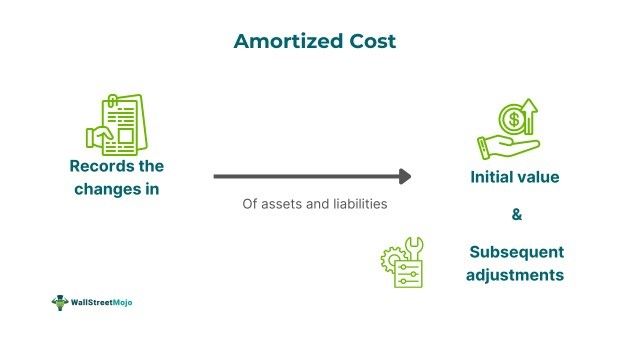
Amortized cost is an estimate of the cost involved for an asset or liability’s change in value over a period. It is a measurement method used in the field of accounting. The estimation involves the inclusion of cash flows, interest rates and the passage of time.
You are free to use this image on your website, templates, etc..
Estimation of these costs is a crucial part of financial reporting. It provides a better accurate picture of the liability or asset value in comparison to their historical costs. The values help shareholders make informed decisions based on prevailing market conditions and not on outdated values. It helps investors understand the investment’s true economic value.
Key Takeaways
- Amortized costs are an approach to calculate the value of assets and liabilities after certain adjustments to their initial investment.
- IFRS 9 amortized cost takes into account changes such as depreciation, discounts, premiums and impairments. Factors such as interest rates and transaction costs also affect the cost.
- It helps in measuring the investment worth and assessing effective interest rates and the amortized cost of the loan. The method, however, has certain limitations, such as not being able to represent fair value or assess the asset’s credit risk.
Amortized Cost Explained
Amortized cost calculates the cost and value of assets or liabilities over their expected life. It can be expressed as the principal amount or initial investment adjusted for changes in their value over a period. Since the initial cost and subsequent changes in adjustments are considered, it shows a realistic picture of the liability or asset’s worth.
The cost, hence, plays a crucial part in the calculation of the carrying value of a company’s financial instruments. Carrying values represent the total amount of an asset and the liability as recorded on the balance sheet after certain deductions. These deductions include impairment or amortization and accumulated depreciation.
Interest costs, transaction costs, premiums and discounts are some factors that affect it. There are several methods for calculating these costs, such as the straight-line method, declining balance method, units of production method, sum of production method etc.
There are certain limitations to the approach. The method lacks representation of the fair value of financial instruments. It is best suited for simple financial instruments that have straightforward items and fixed cash flows. Another limitation of the method is that it has a limited ability to assess the credit risk of financial instruments. It, however, helps the shareholders and investors through the provision of information on value to make informed decisions.
Formula
These costs can be calculated using a simple formula, as follows.
Amortized cost = business’s initial acquisition amount – principal repayment +/- amortization of discount/premium (if any) +/-foreign exchange differences (if any)- impairment losses (if any).
Examples
Let us look at some examples to understand the concept better.
Example #1 – A hypothetical example
Suppose XYZ is a company that acquired a new machinery worth $10000 and the principal repayment was $5000. There was a premium price for one of the components amounting to $2, and the impairment loss totaled $50.
Let’s look at the amortized cost calculation:
The principal repayment amount shall be deducted from the initial acquisition amount:
$10000-$5000=$5000, and after adjustment of amortization premium, we get $5002 ($5000+$2), and the impairment costs have to be reduced, and the resultant amount is $4952 ($5002-$50). This will be the price recorded in the balance sheet of XYZ.
Example #2
Suppose there is a company called ABC Ltd. The company acquires 20000 worth of bonds at a face value of $50 and a coupon rate of 6%. The company receives it at a discount of $45 per bond. Amortized cost calculation is as follows:
The face value of the bonds equals $1000000 (20000 *$50), and their purchase price is only $900000 (20000 * $45). This is an amortized price. They were supposed to enter the value of $1000000 however, they had received the bonds at a significantly lesser rate. This new addition has to be recorded. Therefore, the amortized price on the balance sheet is $900000.
Importance
Given below are some of the points that help understand the significance of these costs:
- It helps in measuring investments that are held for maturity.
- It helps in estimating the net book value of an asset where the cost of amortization is deducted from the initial acquisition cost.
- It helps the estimation of short-term receivables and payables.
- It helps in assessing the effective interest rates of loans.
- The method helps in the preservation of historical costs to reflect the changes in value over time.
- It helps in assessing the carrying value, which helps determine the long-term use of an asset.
- Estimating the value helps in accurately representing values in the balance sheet, thereby improving its credibility.
Amortized Cost Vs. Fair Value
The differences between both the concepts are given as follows:
Frequently Asked Questions (FAQs)
What is the amortized cost of a bond?
The amortized cost of a bond refers to the difference in the initial value of the purchase and the subsequent changes in the value entered into the balance sheet. This may be due to various factors such as discounts or premiums factored in.
How to calculate the amortized cost of a loan?
The amortized cost of a loan can be calculated by estimating the monthly interest, multiplying the remaining loan balance, and subtracting interest from the total payment. The calculation is based on loan principal, term and interest rates.
How to get the amortized cost of accounts receivable?
It can be evaluated and estimated using the method of effective interest rate. The method discounts future cash payments through the investment’s life to the net carrying amount of the liability or asset.
Are trade receivables measured at amortized cost?
IFRS 9 amortized cost treats the trade receivables under two conditions. It has to collect contractual cash flow, and the cash flows from assets include only principal and interest on the principal outstanding amount. They are measured at their transaction prices.