


What Is Fixed Lease Payment?
Fixed lease payments are the payments that are paid at various intervals in a lease contract. There are also payments made that change over time at predetermined amounts. These payments are required to be paid as per the lease terms. It is treated under International Financial Reporting Standards 16.
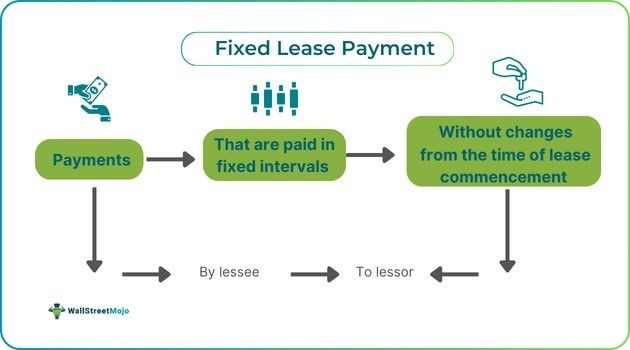
Payment through fixed terms ensures that the lessee faces no arbitrary changes and increases. It helps them keep track of the payment dates and the amounts. Failure to make fixed payments can lead to reputational damage and the liability to compensate for the loss incurred by the lessor. Fixed payments made regularly help in honoring the contractual terms.
Key Takeaways
- A fixed lease is a fixed number of predetermined payments that the lessee makes to the lessor. The payment is given as compensation for the use of the underlying asset.
- The payment is decided at the commencement of the lease and does not change after that unless specifically mentioned in the contract.
- They include “in substance fixed payments” and exclude lease incentives. The concept is treated under international financial reporting standards 16.
- The payments are different from variable payments, which tend to vary based on changes in circumstances and factors.
Fixed Lease Payment Explained.
A fixed lease payment refers to payments that exclude variable payments. These are made to the lessor as per the lease agreement by the lessee for using an underlying asset. The lease is for a predetermined term and is included in the lease liabilities at a commencement date. In other words, these payment amounts do not vary as a result of changes in circumstances that occur after the commencement date.
Fixed payments in lease contracts generally do not include any lease incentives receivable. They are made directly to the lessor for the right to use the asset and are included in the measurement of the right of use and lease liability. These payments are, hence, inclusive of in-substance fixed payments. In substance, fixed payments are those that appear to have variability but are unavoidable and hence recorded in the fixed category. The calculation of fixed payments hence includes the addition of in-substance fixed payments and the subtraction of lease incentives paid as per terms or those payable to the lessee.
Fixed payment can be an amount fixed to be paid at varied intervals or subject to changes that have to be paid over time for specific amounts. In other words, the paid amounts can be automatically changed, either incremental or decremental, after certain periods. However, the agreement has to mention this change of increase and decrease of certain percentages. Tenants who opt for fixed payments need not worry about arbitrary changes in the lease terms, they have a fixed amount to be paid at a fixed date. This helps them plan. It helps the lessee and lessor be aware of their cash flows and plan accordingly. These bring clarity in handling financial goals and help in planning for investments.
Examples
Let us look at some of the examples to understand the concept better
Example #1
Let’s take the example of Mr. Dan. Dan is a salaried employee and wants to lease a home. He had agreed with a landlord to lease their property to him. The term of the lease was for 5 years. Dan has to incur expenses of the maintenance charges and has to pay a maintenance fee. They are fixed, and the maintenance fee was agreed to be increased by $100 every year. So essentially, in the first year, let’s say he has to pay $500 as maintenance charges. For the second year, he would have to pay $600; in the third, $700; in the fourth, $800.
Similarly, he has to pay $900 as a maintenance fee in the fifth year. Even though it varies every year, it is considered fixed due to the contractual terms. It was agreed between the landlord and Dan that each additional year an increment of $100 would be added.
Example #2
Suppose Daisy plans to lease two commercial spaces to run her clothing boutique. The charges she incurs on them are as follows.
- Lease expense-$10000 for 5 years.
- Maintenance charges- $1000 a year (%5000 for 5 years)
Insurance premium-$700 a year. ($3500 for 5 years). On calculating these charges she understands that these are here fixed charges and she would incur additional charges of water and electricity bills and property taxes every year.
It shall be noted that these expenses are for one space, and she plans to take two. This is a huge expense, and hence decides to lease only one instead of two.
Fixed vs Variable Lease Payments
Given below are some of the differences between both concepts :
#1 – Concept
- Fixed lease payments are those payments that are regularly made throughout the lease term.
- Variable payments vary because of changes in circumstances or factors after the commencement date other than the passage of time.
#2 – Basis of Calculation
- Fixed payments are based on predetermined criteria that are not subject to change, at least till the term of the lease ends.
- Variable lease payments, on the other hand, may depend on certain indexes that are subject to change often.
#3 – Ease of Estimation
- Fixed payment charges are easily calculated and don’t have to be calculated repeatedly.
- Variable lease payments are subjected to frequent changes. They can both increase or decrease and make financial planning challenging.
#4 – Examples
- Fixed payments include insurance payments and maintenance charges.
- Variable lease payment charges include water and electricity bills that are given based on usage.
Frequently Asked Questions (FAQs)
What is the relationship between fixed lease payment and security deposit?
A security deposit is an amount kept by the lessor when given by the lessee as part of acquiring the right to use the property. They are a fixed amount and, once claimed, cannot be claimed after the commencement of the lease, just like the fixed payments.
What are the disadvantages of fixed lease payments?
Fixed payments cannot be reduced in cases of cash crunch unlike payments like water and electricity bills. They are inflexible. They do not reduce on introduction of new policies or market conditions. These do not consider a reduction in property values and could result in a loss.
What is the difference between the fixed lease payment contract and the ordinary lease contract?
A fixed lease payment contract has a defined period, while an ordinary lease could include variable costs and periods. Fixed lease payments are for longer terms and are fixed. Ordinary leases are flexible.