


What Is Regulatory Reporting?
Regulatory reporting refers to the process of collecting, maintaining, and analyzing details of a company’s or financial institution’s operational and financial activities. These reports are submitted to respective regulatory bodies in compliance with applicable rules and regulations. It covers financial statements, transactions, tax, risk exposure, and compliance reports.
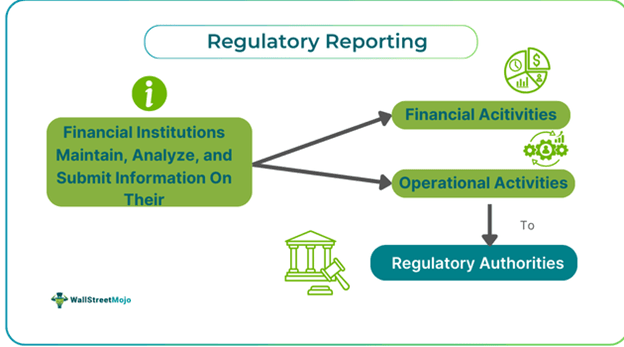
Such reporting is essential for institutions to maintain transparency with their stakeholders. It discloses their actual health and financial position. Thus, it helps firms seek a greater degree of trust and confidence from their investors, creditors, and the public. Moreover, it facilitates these institutions’ compliance with ethical and legal frameworks and mitigates potential non-compliance risks.
Key Takeaways
- Regulatory reporting is a crucial process of maintaining, analyzing, and submitting to regulatory authorities a firm’s financial, operational, and non-financial activities, especially those of financial institutions.
- It aims to ensure a higher level of accountability in risk analysis and financial reporting. Additionally, it seeks to achieve transparency in financial and operational disclosures to the respective regulatory bodies.
- The five prominent forms of reports submitted in this process are financial statements, tax, compliance, risk exposure, and transaction reports.
- It helps to achieve operational efficiency, risk management, fraud detection, strategic decision-making, securing stakeholders’ trust, and crisis management.
Regulatory Reporting Explained
Regulatory reporting is the collection, verification, and furnishing of data on the financial and operational activities of a financial institution to the regulatory authorities. It aims to foster transparency and accountability in reporting a firm’s financial health in compliance with the regulations of the central bank and other governing bodies. Moreover, the information provided helps the stakeholders or investors make informed decisions. Also, the management and the regulatory bodies can identify the potential credit, operational, and compliance risks and frame related strategies. The need for such compliance has increased the popularity of regulatory reporting roles in the finance industry.
The various norms applicable for regulatory reporting in the US:
- Public companies must report their quarterly and annual finances and operations to the Securities and Exchange Commission (SEC) according to US GAAP standards.
- The private firms have to furnish their financial statement to their investors and lenders.
- Both public and private companies have to adhere to federal and state laws.
The regulatory reporting requirements stated by the European Union include:
- Public companies should submit audited financial reports and comply with IFRS under ECB guidelines, along with regular disclosure as per MiFID II.
- The private firms have to comply with the reporting obligations under AIFMD.
- Both public and private firms must adhere to GDPR for data protection.
To report derivatives and securities transactions, companies should follow additional regulations, such as EMIR (European Market Infrastructure Regulation) and SFTR (Securities Financing Transactions Regulation).
The Hargreaves Lansdown provides access to a range of investment products and services for UK investors.
Types
These reports can be of different kinds, including:
- Transaction Reports: The firms report their transactions related to payments, settlement, and trade for regulatory compliance.
- Financial Statements: The institutions submit their financial statements to the regulatory authorities to provide an overview of their operational and financial position.
- Compliance Reports: In addition to the financials, companies must report non-financial aspects like health, safety, and environmental compliance.
- Risk Exposure Reports: These reports disclose the potential risks faced by companies in terms of their finances, markets, credit, and operations. They include a credit risk report, operational risk assessment, and market risk assessment.
- Tax Reports: Further, the institutions need to comply with the local, state, and federal tax regulations to submit information about the tax deducted from the employees’ salaries.
Examples
Financial institutions have to adhere to regulatory reporting requirements for enhanced transparency and accountability, as evidenced by the following examples:
Example #1
Suppose ABC Bank is required to conduct regulatory reporting for banks to the SEC on a quarterly and annual basis. However, in 2023, the SEC found that the bank failed to maintain sufficient capital reserve more than three times during the year, which raised financial concerns and risk. However, the bank has improved its internal control to ensure that it keeps up with the requirements of the US GAAP regulations.
Example #2
Berenberg, a high-level private bank in Europe, has partnered with regulatory technology firm Kaizen to meet its automated regulatory reporting assurance needs. The institution aims to utilize Kaizen’s ReportShield Accuracy Testing to ensure compliance with EU and UK MiFIR transaction reporting standards.
Kaizen enables comprehensive data quality testing and provides complete transparency into reporting accuracy through its Kaizen Hub platform. Further, Kaizen’s Advanced Regulatory Reconciliation service facilitates businesses’ detection of any discrepancies, such as under- or over-reporting.
Benefits
The non-financial and financial regulatory reporting are essential for complying with the legal regulations. It has the following advantages for the firms, regulatory authorities, and stakeholders:
- Operational Efficiency: The financial institutions have to report all their operational activities for achieving efficiency.
- Risk Mitigation: Such reporting is essential for eliminating the chances of non-compliance risk and legal proceedings arising from it.
- Fraud Prevention: Regular reporting facilitates firms’ avoidance of fraud by proactively detecting such activities.
- Build Stakeholders’ Trust: The institutions that report their actual financial health to the public can secure a greater level of trust and confidence from their investors and creditors.
- Strategic Decision-Making: The companies can analyze the reported data for robust regulatory compliance and better decision-making.
- Crisis Management: During a crisis, such reporting is essential for gaining clear insights to develop a crisis management strategy.
- Greater Accountability and Transparency: It facilitates companies in developing more transparency and accountability in financial management.
- Improves Market Confidence: It helps the regulatory authorities to build greater confidence and trust in the financial markets.
- Competitive Advantage: Companies that adhere to all compliance requirements can achieve a competitive edge over other firms.
Challenges
Although the institutions need to prepare and submit the regulatory reports to the authorities, there are certain limitations to it, as discussed below:
- Compliance Cost: Post-financial crisis, the institutions have to pay a higher cost for their regulatory reporting.
- Regulatory Complications: Many companies struggle with using data management and regulatory reporting software and often make human errors when entering information into such systems.
- Data Management: As financial institutions become more digital, data management has become even more difficult for these firms.
- Cyber Threats: Financial organizations maintain a large number of personal and financial records in their systems, which are often vulnerable to cybercrime and hacking.
Disclosure: This article contains affiliate links. If you sign up through these links, we may earn a small commission at no extra cost to you.
Regulatory Reporting Vs. Statutory Reporting
Although the companies have to file for both regulatory and statutory reporting, the primary differences between the two are as follows:
Frequently Asked Questions (FAQs)
Which groups impact regulatory reporting?
Such reporting is primarily concerned with the health of financial institutions like insurance companies, banks, non-banking financial corporations, investment firms, etc. It is used by regulatory and governing bodies like central banks and the Securities and Exchange Commission (SEC). Further, analysts and stakeholders can study it to gauge the financial position of these institutions.
What are US regulatory reporting expectations?
The US regulatory reporting emphasizes the following aspects of such information:
- Reporting quality, accuracy, and timely filing
- Following accountability and internal control standards
- Both manual and automated reporting are to be used
- Potential to spot discrepancies and risks
- Taking effective measures to rectify these issues
Is regulatory reporting a good career?
Starting a career in finance with a regulatory reporting analyst role can provide great exposure and learning opportunities. Individuals can understand and become proficient in areas related to credit risk, banking, financial control, operations, tax, compliance, legal risk, etc.