

Difference Between Random and Systematic Error
Where an error doesn’t have any specific pattern of occurrence, it is known as a random error which is also known as an unsystematic error and hence such errors cannot be predicted in advance like an unavoidable error, whereas a systematic error is an error that may occur due to any mistake in the instrument measuring the error or mistake in using the instrument by the experimenter and hence it is an avoidable error.
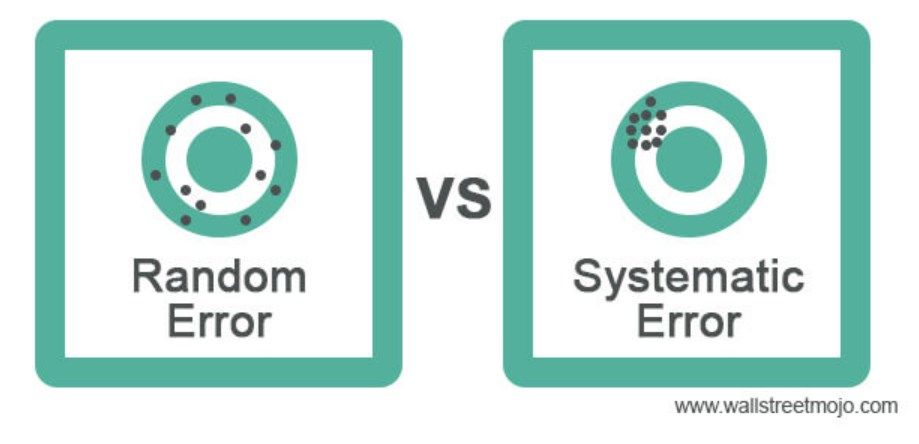
The main difference is that random errors mostly lead to fluctuations which are surrounding the true value because of the result difficulty while taking the measurements, whereas systematic errors will lead to predictable and also consistent departures from the true value because of the problems with the calibration of the equipment.
Random Vs Systematic Error Explained
The random error mostly happens because of any of the disturbances that are occurring in your surroundings, like the variation or differences in pressure, temperature, or because of the observer who might be taking the incorrect or the wrong reading. The systematic error perhaps also arises because of the apparatus’s mechanical structure.
Random errors are essential and cannot be avoided, while systematic errors can be avoided. No matter how skillful they are, scientists can’t take perfect scaling or measurements.
Systematic errors are perhaps difficult to spot, and this is because everything that you are measuring will be wrong or incorrect by the same amount, and you may perhaps not realize there is an issue at all. One should calibrate their equipment properly prior to using it, and yes, then the chances of systematic errors will be much less likely.
Irrespective of how careful one is when one is conducting experiments, there will most likely be an error called experimental error. Whether through the challenges that are inherent in it that as problems with their equipment or taking the measurements accurately or avoiding error altogether can be termed as next to impossible.
To counter the mentioned issue, scientists try to do their best to categorize those errors and quantify any uncertainty in their measurements. Finding out the variance between these errors is a vital part of learning to design it with better experiments and to try to minimize any sort of errors that do creep through.
Infographics
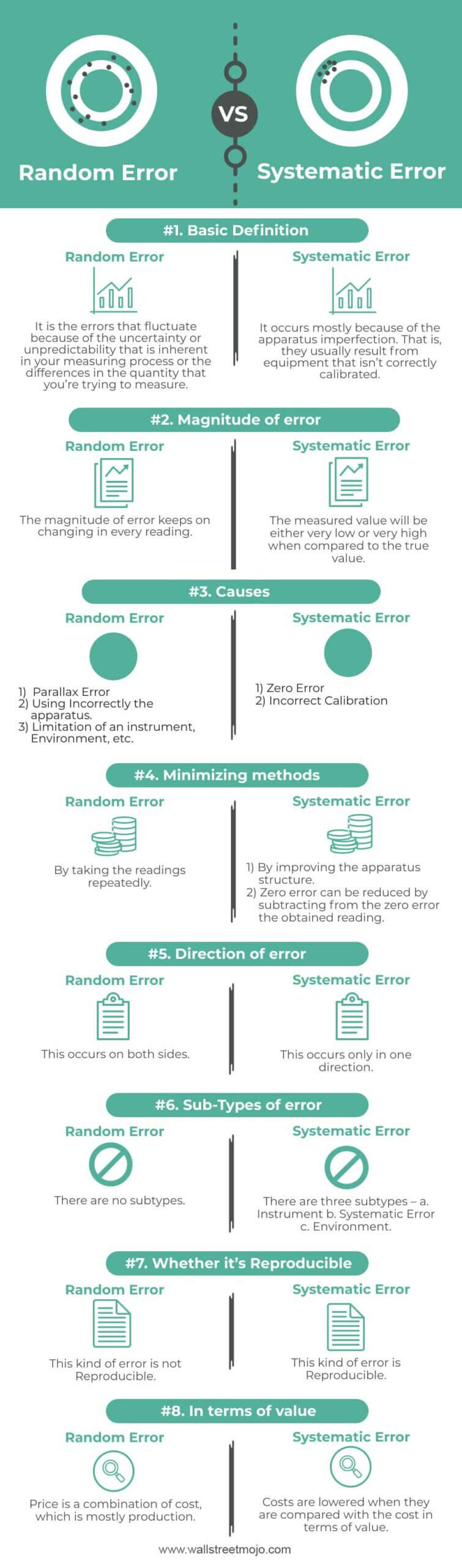
Let us understand the differences in both these types of errors with the help of the infographics below. The pointers in it shall give us a better understanding of the differences between these concepts.
Key Differences
Despite the fact that they are two fundamentally different concept, their being related sub-concepts often confuses people as to which one resembles which error. Let us understand the differences through the key differences discussed below.
- The random error defines itself as the unpredictable disturbance that occurs in your experiment by a not known source. Whereas, systematic error occurs due to the defect of the apparatus that is not built.
- The random error, as mentioned in the above table occurs in both directions, whereas the systematic error occurs only in 1 direction. Systematic errors arise due to the inbuilt fault or mistake of the apparatus; hence it always gives a similar error. The random error, as mentioned earlier, occurs because of the not known source. Therefore it occurs in any direction.
- The magnitude of systematic error will remain constant or unchanged because the defect which is present in it is inbuilt inside the apparatus, and when compared to the magnitude of the random error, it has variable.
- The 0 error and calibration of the apparatus, which is incorrect, will cause a systematic error. The random error is due to the parallax or, as stated earlier, in the above comparison table incorrectly using the apparatus.
- The random error reduces or can be minimized by taking two or more readings of the same experiment, whereas the systematic error can be minimized by carefully designing the structure of the apparatus.
- Random error is itself unique and has no specific types, whereas systematic error can be categorized into three major types, which are environment error, instrument error, and systematic error.
- The random error is not reproducible. On the other hand, the systematic error will be reproducible because the defect, as stated earlier, is inbuilt into the structure of the apparatus.
Comparative Table
Let us understand the differences of random and systematic errors through the comparison table below. The differences based on different factors of discussion with help us gain knowledge about the intricate details of both concepts.
Recommended Articles
This has been a guide to Random vs Systematic Error. Here we explain their differences along with Infographics and a comparison table. You may also have a look at the following articles –