


What Is The Prudential Regulation Authority (PRA)?
The Prudential Regulation Authority (PRA) is a regulator that forms policies for financial institutions to follow and oversee various aspects of their business. It ensures resilient, robust and safe financial services and products provided to customers of financial firms with full reliance & trust.
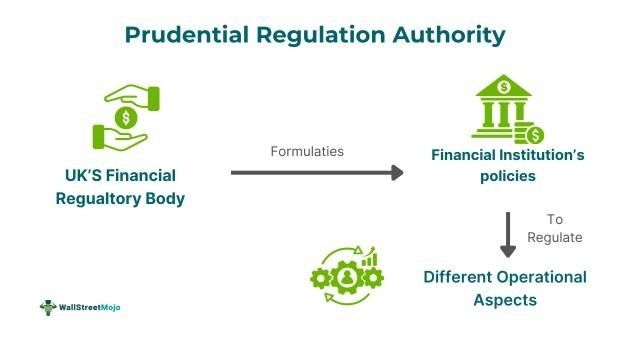
It collaborates with other regulators for financial system stability and safeguarding customer’s interests. Its actions and supervision push financial institutions for proper systems to be in place, strengthening customers’ trust in them. Hence, it supports customers in getting access to the money deposited in the bank and in an insurance policy during times of need.
Key Takeaways
- Prudential Regulation Authority (PRA) supervises financial institutions’ policies, ensuring safe, resilient, and robust financial services plus products for customers, building trust and reliance.
- It contributes to consumer confidence and policyholder protection, promotes financial company robustness, prepares firms for economic turmoil, and manages insurance holders.
- Its approach & objective focuses on ensuring capitalization, efficient risk management, financial stability, addressing major risks, and fostering trust and resilience in the financial sector through collaboration and transparency.
- It’s responsible for prudentially regulating all financial companies, while the FCA regulates the conduct of financial companies for consumer protection and market integrity.
Prudential Regulation Authority Explained.
The Prudential Regulation Authority (PRA), being part of the Bank of England, represents the regulatory body of United Kingdom financial services. It was established in 2013after the dismantling of the Financial Services Authority (FSA) with the responsibility of prudential supervising and regulation of all financial institutions, from banks, insurance, and credit unions to major investment companies. It creates benchmarks and monitors financial firms to save and make them robust.
It assesses financial institutions’ governance, capital adequacy, funding, risk management, and liquidity. It has brought down the systemic risk of the UK’s financial ecosystem. Although it does not intend to conatal all financial failures, it aims to give an orderly shape to failure without disrupting the offering of essential financial services.
PRA has a technically complex and rigorous prudential necessity from firms within its ambit. Hence, all firms must show active risk monitoring and sufficient financial backup as per the prudential regulation authority register. Otherwise, if they do not comply with the prudential requirements of PRA, then they cannot operate their business in the UK.
It has successfully maintained and extended the financial stability and resilience of markets and companies in the UK. Prudential Regulation Authority rulebook also fosters confidence in consumers and investors towards the UK’s financial sector through risk management and enforcing the greatest governance standards.
The Hargreaves Lansdown provides access to a range of investment products and services for UK investors.
Objectives And Responsibilities
Prudential Regulation Authority UK has the following objectives and responsibilities:
- PRA must ensure and promote financial companies’ robustness and safety under its watch.
- It prepares financial firms to stay adequately capitalized and liquid to remain resilient against economic turmoil.
- It manages the safety and trust of all insurance holders and depositors of more than 1500 financial institutions like insurers and banks.
- It is responsible for intervening where necessary, setting standards, and monitoring compliance to stabilize the financial sector.
- It also contributes to building consumer confidence in the financial system and resilience of the UK financially.
- It contributes to obtaining an appropriate level of policyholders’ protection.
Approach And Principles
PRA approach and principles are listed below:
- It has a judgment-based and forward-looking approach to overseeing, centered on issues and firms creating major risks.
- Its regulatory principle involves sustaining adequate capitalization by firms, encouraging efficient risk management and conserving financial stability.
- It creates and implements high benchmarks to safeguard insurance policyholders and depositors, strengthening confidence in the financial sector.
- It rectifies approaches and policies with respect to evolving market conditions and financial risks for impactful supervision and regulation.
- It also collaborates with other regulatory bodies and brings transparency and accountability to the financial sector to build trust and resilience.
Challenges And Impact
PRA faces challenges and has impacted the finance sector as listed below:
- It mandates sufficient liquidity and adequate capitalization, making financial firms more stable.
- It faces challenges ensuring compliance and setting up stringent standards in the finance sector during current evolving business models and financial environment.
- International and local firms under the prudential framework of the UK build trust amongst themselves through effective regulation of PRA.
- Many challenges come up for PRA due to its systematic approach to untested and novel business models comprising higher scrutiny and proper controls ensuring good governance and stability.
- Moreover, PRA has to go through continuous challenges during smaller bank’s simplification of regulatory needs.
Prudential Regulation Authority vs Financial Conduct Authority (FCA)
Let us use the table below to understand the difference between the two regulators:
| PRA | FCA |
|---|---|
| Responsible for prudentially regulating all financial companies. | Does regulation of the conduct of financial companies for consumer protection and market integrity? |
| Covers more than 1500 financial companies in England. | Centered around financial promotions, consumer protection through consumer credit regulation and financial companies’ behavior. |
| Ensures the stability of companies financially through enforcement of regulations and standards. | Authorized regarding consumer safety, regulating consumer credit, monitoring financial markets, and transparency. |
| Firms vital branch of the Bank of England focused on the financial robustness of companies. | Not a part of the government but stresses market integrity and fair treatment to customers. |
| The prudential regulation committee has taken all its macroprudential decisions. | Works with companies to ascertain fair results for customers and checks for legitimate companies. |
Disclosure: This article contains affiliate links. If you sign up through these links, we may earn a small commission at no extra cost to you.
Frequently Asked Questions (FAQs)
How is the prudential regulation authority funded?
PRA has its funding through charges levied on the companies it has under regulation, as per the Bank of England’s website.
What does the Australian prudential regulation authority do?
Australian PRA has the responsibility of supervising superannuation funds, insurers and banks. It does so to provide protection and robustness to these elements so that the community’s confidence and belief in the country’s financial system grows and sustains.
Who does the prudential regulation authority regulate?
The PRA regulates all the services and entities in the financial services industry like insurance companies, superannuation funds, banks, and mutual funds. As per an estimate, it regulates almost 1500 financial companies like major investment companies, credit unions, and building societies.
Who does the prudential regulation authority report to?
PRA represents a statutory authority under the government of any country. It has to report mandatorily to the parliament of the country it operates in through the treasurer. However, in England, it reports to the prudential regulation committee accountable to the British parliament for its powers of rule-making.