


What Is Proof Of Authority (PoA)?
Proof Of Authority in blockchain refers to the consensus mechanism configured to allow a group of pre-approved and authorized blockchain validators to confirm transactions. This proof of authority crypto mechanism does not involve a large number of validators, thereby preserving computational resources to a great extent. This is what makes them an energy-efficient mechanism.
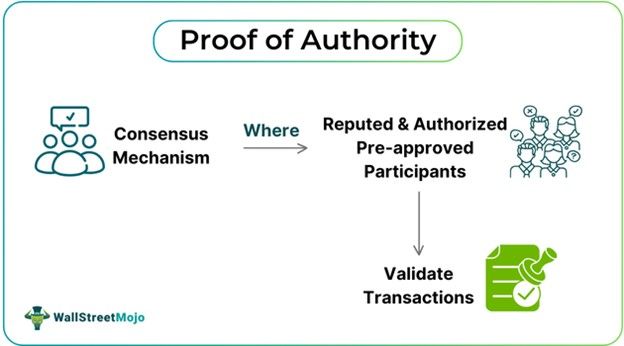
You are free to use this image on your website, templates, etc..
Presented by Ethereum’s co-founder Gavin Wood, this protocol beats the limitations of Proof of Stake (PoS) and Proof of Work (PoW). It is a more energy-efficient and more optimized version of the previous consensus mechanism ideally used in permissioned blockchains. However, it does come with its own set of pros and cons.
Key Takeaways
- Proof of authority (PoA) is a consensus engine in blockchain networks with limited pre-approved validators that consume less computational power and time, have faster transaction rates, and ensure minimum crypto attacks.
- Here, a small number of validators stake their reputation by presenting their real identities to the system. They receive rewards when a block is successfully added.
- This network is entrusted with the permissioned blockchains only. VeChain, Hyperledger Besu, Bitgert, Xodex, and Palm Network are a few of the blockchains working on this protocol.
- Another prime requirement for validators to become part of this network is risking reputation, having no criminal records, and having high moral standards, along with the ability to invest.
Proof Of Authority Explained
Proof of authority in blockchain is a mechanism where a group of actors verifies transactions present in the network. It relies on a small group of validators to perform this function. On receiving a new transaction in the network, every node becomes aware of it. The authorized validators verify it independently based on the rules specified in the proof of authority document. When a majority of validators agree, the transaction is added as a new block to the blockchain network. However, the selection of a validator for adding the block involves a separate process.
This selection is based on the reputation and identity of the validators staked in the network. At the same time, the PoA technology incorporates a predefined list of nodes with special security clearance. To become a part of this group, nodes go through a notarization process. Here, they provide a document to prove their identities and later link to their on-chain identities. Once approved, they can act as a validator of the proof of authority of the crypto blockchain. In return, they receive rewards for their validation work.
Digital reputation plays a pivotal role in the entire proof of authority consensus mechanism. It allows authentic and original identities to control the transactions in the network. Apart from the existing validators, other nodes can also participate in this protocol. However, these existing validators must vote to include additional users in the group. This process also consumes less computing power and works on decentralization. Furthermore, there is less or minimum delay in processing and verifying them. However, validators also try not to build any negative reputation throughout this journey.
Consensus Requirements
Here are some of the prime requirements for a validator to fulfill to act as part of the PoA consensus mechanism. Let us look at them in brief:
#1 – Valid identities
The first need for acting as a validator in a PoA network is to have a valid and original identity. They must verify their real identities through a formal identification process.
#2 – Reputation
The entire mechanism of the PoA blockchain depends on the reputation of the validator candidate. Actors aspiring to become validators on this network must have no criminal records and publicly display strong moral standards.
#3 – Ability to invest
Here, validator candidates must be able to invest their money and stake their identity in this network since there is a reputation involved, which is influenced by their ability to take risks and live up to their long-term commitment.
Examples
Let us look at some examples of proof of authority crypto protocol in the blockchain world:
Example #1
Suppose Samuel is searching for a database to track the food products from farm to table. Thus, he plans to implement the PoA technology through the intervention of validators. Samuel’s friend John, a crypto enthusiast and trader who has been surfing through recent developments in the crypto world, has worked as a validator on the Ethereum chain. Hence, he asks John to join as one of the validators. As per the protocols, John had to show his real identity before acting as a validator on the chain.
So, when a big order hit the firm, John, along with other actors, verified the transaction. Likewise, many more transactions went through the same process. Later, through consensus, block details are confirmed and then added to the network. In return, John received tokens as a reward for block validation and addition.
Example #2
In February 2024, the Solana Whales surprised crypto investors by making an unexpected move and joining Bitgert (BRISE). The former has been a dominant player in the crypto industry because of its robust speed and its utilization of the Proof of History (PoH) as its consensus mechanism, but the use of PoA as the consensus mechanism facilitated the delivery of 100,000 transactions per second, which was 35,000 more than the PoH.
With zero gas fees, the PoA-driven blockchain led the Solana to have an affordable network to operate on and hence it switched.
Benefits
Here are some of the top benefits of including a PoA network or working as a validator in this consensus mechanism:
#1 – Less computation power
PoA networks do not require high computational power resources to function. As the number of validators involved in verifying transactions is limited, the power used is limited. As almost no electricity is used, it is considered an eco-friendly way of handling blockchain transactions.
#2 – Consumes less energy and time
Since there is lesser computational complexity, validators can easily verify transactions, thus saving energy. Also, the efficiency of the actors increases with a drop in the time taken to fill the blocks.
#3 – Higher transaction rate
The speed of validating transactions in the PoA crypto network is also high. Since mathematical problems are not involved, the transactions are easily verifiable.
#4 – Fraudulent proof
By trusting a team of pre-approved validators, no outside factor can influence the network. Hence, the data is protected against any kind of crypto attacks.
Limitations
Although the PoA consensus mechanism has multiple benefits to offer the individuals, there are some limitations to this technology as well. Let us look at them:
#1 – Dependent on validators
This mechanism is highly dependent on the validators for most of its work. The wrong selection of validators can disrupt the chain’s security protocols.
#2 – Not suitable for public blockchains
PoA network is made only for permissioned blockchains. Hence, public or permissionless blockchains cannot deploy this consensus mechanism.
#3 – Less participation
The mechanism blocks out any non-active or non-committed validators from the network by default, reducing user participation.
#4 – Less decentralized
This network is less decentralized as the power of validation gets confined to some validators.
Proof Of Authority vs Proof Of Stake
Let us look at the difference between the two famous consensus mechanisms (PoA and PoS):
Frequently Asked Questions (FAQs)
Does Ethereum use proof of authority?
Technically, Ethereum works on the concept of proof of stake. However, OpenEthereum allows the use of PoA engines with EVM-based machines. Additionally, Ethereum also uses the PoA mechanism in its testnets like Clique and Kovan before the actual launch. It helps in faster validation of transactions at a lesser computational cost.
What is the use case of PoA?
There are multiple use cases of proof of authority consensus engines in the blockchain world. Let us look at some examples:
- JP Morgan, with the JPMCoin, has utilized this technology for audit movements and accounting purposes.
- It is helpful in supply chain management and inventory tracking.
- PoA consensus provides a strong atmosphere for the testing of features before the actual launch.
What are the common attacks in the proof of authority protocol?
Commonly, there are two attacks popular in the PoA network, which include Distributed Denial of Service (DDoS) and 51% attack. In the first case, there is massive traffic created by the fraudsters to target a specific node.