


Orderly Liquidation Value (OLV) Definition
Orderly Liquidation Value, or OLV, is the price or value at which an asset or group of assets are sold in a methodical manner, given enough time to dispose of them. The purpose of selling at OLV is to maximize the sales proceeds. The OLV figure is provided by appraisers. The asset’s fair value is another figure they provide to facilitate liquidation.
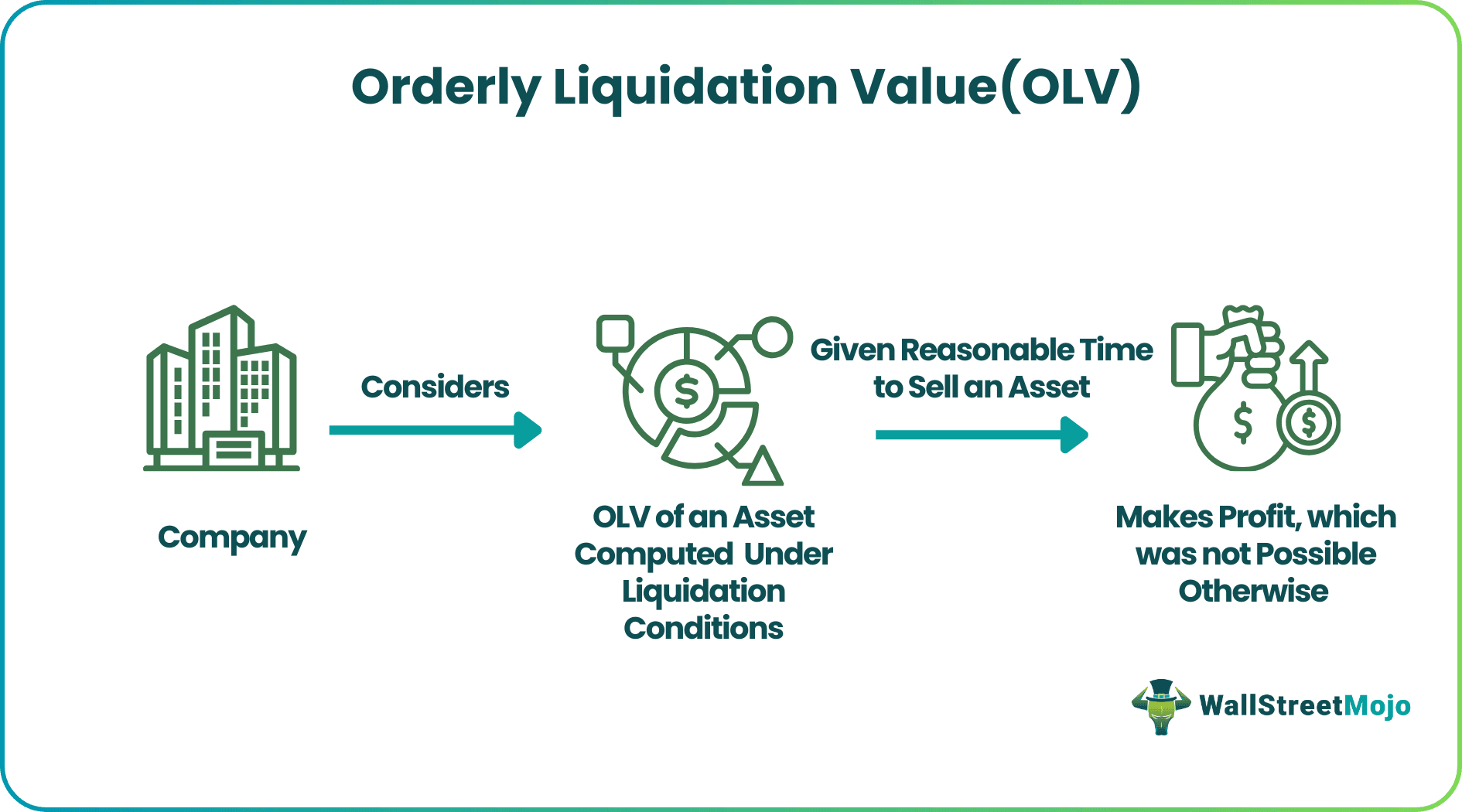
OLV plays an important role in assessing the value of an asset, especially in situations where quick asset liquidation is necessary. During orderly liquidation, assets are sold in markets where supply is limited, resulting in the generation of demand (and thus liquidity) for the assets being sold. As opposed to this, selling under pressure in a rushed manner does not return or yield the expected or desired value. Without OLV, the asset value usually declines, particularly if it is a distress sale. The absence of markets and the lack of liquidity have adverse effects on the asset in question.
Key Takeaways
- Orderly liquidation value reflects the maximum profit that can be made from the asset when it is sold in a planned manner while considering the state of the market and an appropriate selling duration.
- Understanding OLV enables business owners to make wise choices while dissolving business partnerships or handling corporate dissolutions. OLV applies in other unforeseen circumstances, too.
- Though a common method for OLV computation does not exist, market analysis and expert judgment come in handy during such computations.
- The OLV is often greater than an asset’s forced liquidation value.
- Market conditions, location, demand, and asset conditions determine the OLV.
Orderly Liquidation Value Explained
Orderly liquidation value reflects the maximum profit that can be made from the asset when it is sold in a planned manner while considering the state of the market and taking adequate time to execute the sale. As opposed to a forced liquidation scenario, OLV assumes that the sale is neither urgent nor forced, allowing for a more accurate assessment.
In terms of monetary compensation, the OLV figure falls between the fair market value and the forced liquidation value. Through OLV, a company receives more money compared to forced liquidation but less than the asset’s fair market value. It is often estimated based on the assumption that there is some time in hand—a few months at the least—to sell an asset that needs to be sold.
Market conditions, location, desirability, and the asset’s condition are all factors that determine the final OLV. The Orderly Liquidation Value (OLV) provides quick access to funds and effective asset disposal. If companies know the value, it helps management decide whether certain assets must be sold to clear debts. Understanding OLV enables business owners to make judicious choices in partnership dissolution, corporate dissolution, or other unforeseen circumstances. Another significant factor is that banks consider OLV when extending loans. Businesses that adopt OLV can improve their financial results and reduce risks in a dynamic, quickly changing business environment.
How To Calculate?
Several variables are considered while determining the orderly liquidity value, including market conditions, the asset’s demand, age and condition, and sale-related expenses. Although a single commonly accepted methodology for determining OLV is not available, companies often combine input from market analysis, evaluation techniques, and expert judgment.
The market value of tangible assets, which includes fixed and current assets, is obtained, after which all liabilities are subtracted from the total liquidation value of the assets to obtain the OLV.
Orderly Liquidation Value (OLV) formula = Market Value – Business Liabilities
Examples
Here are a few examples of OLV to facilitate further discussion.
Example #1
Let us take a hypothetical example of Dan.
Dan wants to retire and sell his manufacturing business. OLV estimation helps Dan make informed financial decisions based on the estimated value of his business. It helps him evaluate investment opportunities, assess potential loans or financing options, or determine if additional capital infusion is required to improve the company’s value before selling it.
Dan also has the option to engage a professional appraiser to arrive at the required figures. If he does, the appraiser will assess tangible assets and analyze the market and industry conditions. They will also review the sales value of Dan’s competitors, evaluate the company’s growth potential, and study debts and liabilities. Based on such estimates, Dan will be able to make the right decisions and sell the company’s assets.
Example #2
Let us assume ABC & Co. wants to sell a piece of machinery. Based on market research and appraisals, the following values have been derived.
ABC’s market value is $460 million and its liability is $50 million. Using this data, ABC & Co. arrive at the following figures:
Orderly Liquidation Value (OLV) = Market Value – Business Liabilities
i.e., $460-$50= $410 million
This price reflects the projected profit that can be made when the equipment is sold under regulated circumstances while taking the market and a reasonable period into account.
Orderly Liquidation Value vs Forced Liquidation Value
The differences between OLV and Forced Liquidation Value have been given in the table below:
Frequently Asked Questions (FAQs)
What is the net orderly liquidation value? How is it calculated?
Due to the need for a speedy transaction, assets are sold to an entity from a limited pool of potential buyers. Hence, OLV is typically lower than the asset’s fair market value. The Net Orderly Liquidation Value (NOLV) is the amount returned after deducting the expenses related to selling the asset, such as advertising, selling charges, taxes, etc. Simply put, the cost of liquidation is considered to arrive at the net orderly liquidity value.
What is the difference between orderly liquidation value and liquidation value?
The condition under which the sale occurs is the main point of difference between Orderly Liquidity Value (OLV) and liquidation value. OLV presumes a planned and orderly sale, whereas liquidation value often refers to a hurried or forced sale of assets, often for less money.
What is OLV in an appraisal?
OLV in an appraisal refers to the estimated value of an asset in the event of an orderly liquidation. It represents the value anticipated when an asset is sold under regulated circumstances, accounting for market forces and a suitable amount of time available to sell.
Recommended Articles
This article has been a guide to Orderly Liquidation Value (OLV) & its definition. We compare it with forced liquidation value, and explain how to calculate it & examples. You may also find some useful articles here –