


What Is Official Development Assistance (ODA)?
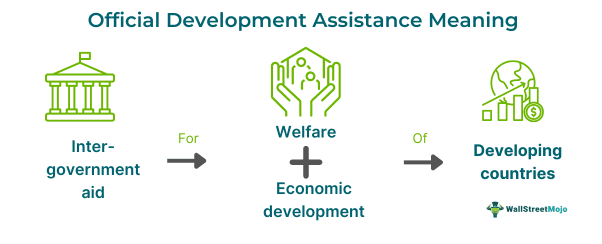
Official development assistance (ODA) is a type of intergovernmental aid that promotes the welfare and economic development of developing countries by particularly targeting these issues. It aims to facilitate these developments by using rebated credits, loans, and grants to address environmental sustainability, health, hunger, poverty, and education.
It has been foreign aid’s gold standard and the primary source of funding for ODA. Aid does not include credit or loans for defense purposes. It can be given directly from donor to recipient or through international agencies like the United Nations.
Key Takeaways
- Official development assistance (ODA) is international aid that focuses specifically on economic growth and the welfare of developing nations.
- It supports the welfare and economic growth of developing countries through rebated credits, loans, and grants to tackle issues of environmental sustainability, health, hunger, poverty, and education.
- Its two major types are – bilateral aid flowing directly from the donor country to the recipient country and multilateral aid involving donor countries donating to ODA-eligible organizations.
- Its benefits are providing funds for infrastructure, healthcare, education, environmental sustainability, humanitarian aid, economic growth, global security, cultural exchange, and attracting foreign investors in recipient nations.
Official Development Assistance Explained
Official Development Assistance (ODA) is defined as the Organization for Economic Co-operation and Development (OECD)’s special category utilized by its Development Assistance Committee (DAC) as a metric of foreign aid. It measures the material and monetary resources given to poor countries by rich countries to promote their welfare and economic development.
Their main goal has been to bring poorer nations out of poverty and rebuild their infrastructure, education, healthcare, and environmental protection. Most of the ODA comes as grants, but some of them take from soft loans with concessional rates. Earlier, the grants were under tied aid requiring the recipient to utilize exported goods from donor nations, but since it became controversial, it was restricted under DAC rules.
It attracts foreign direct investment in recipient countries since it targets infrastructure improvement, risk reduction, and the elimination of poverty and hunger. It has greatly impacted the financial world by bringing progress and economic growth to newer nations, thereby adding to globalization. As such, it has increased trade and company revenues while also improving social conditions and people’s living standards.
Types
There are two major types of ODA, as shown below:
- Bilateral Aid – Such aid directly flows from the donor country to the recipient country without any third party or institution. It comes in the form of grants and financial investment corporations.
- Multilateral Aid – These happen when donor countries donate to ODA-eligible multilateral organizations, which then forward the aid to the recipient nations. The agencies involved may be the UN, OECD, or any other designated organization for the purpose.
Official Development Assistance By Country
As per official development assistance data concerning OECD-DAC nations through the donor nations list shown below as of 2023:
| Entity | Code | Year | Net official development assistance (ODA) from OECD-DAC countries, by donor countries (millions of constant 2021 United States dollars) – DC_ODA_TOTL |
|---|---|---|---|
| Australia | AUS | 2022 | 3,081,380,000 |
| Austria | AUT | 2022 | 1,985,710,000 |
| Belgium | BEL | 2022 | 2,834,210,000 |
| Canada | CAN | 2022 | 8,907,570,000 |
| Czechia | CZE | 2022 | 977,910,000 |
| Denmark | DNK | 2022 | 2,960,000,000 |
| Finland | FIN | 2022 | 1,711,260,000 |
| France | FRA | 2022 | 19,066,970,000 |
| Germany | DEU | 2022 | 37,558,670,000 |
| Greece | GRC | 2022 | 318,220,000 |
| Hungary | HUN | 2022 | 427,780,000 |
| Iceland | ISL | 2022 | 93,380,000 |
| Ireland | IRL | 2022 | 2,599,640,000 |
| Italy | ITA | 2022 | 7,103,450,000 |
| Japan | JPN | 2022 | 20,073,650,000 |
| Lithuania | LTU | 2022 | 191,280,000 |
| Luxembourg | LUX | 2022 | 562,110,000 |
| Netherlands | NLD | 2022 | 6,879,530,000 |
| New Zealand | NZL | 2022 | 567,660,000 |
| Norway | NOR | 2022 | 4,784,040,000 |
| Poland | POL | 2022 | 3,481,950,000 |
| Portugal | PRT | 2022 | 450,220,000 |
| Slovenia | SVN | 2022 | 172,780,000 |
| South Korea | KOR | 2022 | 3,186,390,000 |
| Spain | ESP | 2022 | 4,343,000,000 |
| Sweden | SWE | 2022 | 6,050,770,000 |
| Switzerland | CHE | 2022 | 4,539,410,000 |
| United Kingdom | GBR | 2022 | 16,726,020,000 |
| United States | USA | 2022 | 51,446,360,000 |
Source: Ourworldindata
All these benefits of official development assistance for less developed countries help them in economic growth.
Examples
Let us use a few examples to understand the topic.
Example #1
An online article published on 8 November 2023 discusses the existing state of ODA. According to the World Bank, ODA reached US $211.3 in 2022, which was more than the previous year, and stood at $186 billion in 2021 because of aid concerning the Ukrainian conflict, refugee support, and COVID-19. Nonetheless, if these were excluded, then ODA would have decreased by 1.2 percentage points.
However, such an increase also could not help ODA fall short of the SDG 17.2 goal for developed economies to set aside funding to the tune of 0.7 percent of their total gross net income or GNI, necessitating an extra US $200 billion. Further, the gap in support widened as indicated by the below-par aid falling below 0.15-0.20 related to Least Developed Countries (LDCs).
Example #2
Let us assume that an imaginary country, Prospera, receives ODA from an international development organization dedicated to helping weak and developing nations. As a result, the visionary prime minister of Prospera formed a specialized committee with a team of experts to earmark funds for ODA for crucial infrastructure and community projects like rural healthcare, school buildings, and residential areas.
After one year, a detailed study was conducted to determine the utilization of funds, and it was found that ODA funds significantly enhanced the level of education, number of schools, and lesser chronic and pandemics among the population, along with better living conditions in ODA-sponsored residential buildings allotted to the extreme weaker section. As a result of these developments, the nation experienced rising economic growth, employment generation, and improved standards of living.
Benefits
It benefits the done developing nation and the donor countries alike, as listed below:
- Recipient developing nations can receive funds to invest in and develop infrastructure, healthcare, education, and other important areas.
- It assists in environmental sustainability, resolving gender equality, health issues, poverty, and hunger to achieve Sustainable Development Goals (SDGs) by recipient nations.
- In times of calamity and natural disasters, pandemics, wars, and political unrest, it helps in the delivery of humanitarian aid and disaster relief.
- It also facilitates economic growth and fosters innovations through technology, skills, and knowledge transfer.
- It acts as a major contributor towards global security and stability by reducing poverty, conflicts, and inequality in society, leading to the prevention of spillover impact on donor nations.
- It acts as a bonding factor between the donor and recipient country, encouraging cooperation and mutual understanding through cultural exchange.
- The donations help improve infrastructure, stabilize the country, reduce risk, and initiate developmental works, attracting foreign investors to invest in the donor nations.
Frequently Asked Questions (FAQs)
Was IST official development assistance?
International Space Technology or IST cannot be referred to as ODA. ODA means government aid created to promulgate the welfare of developing nations and economic development, leaving aside credits and loans given for military purposes.
What does official development assistance mean in geography?
ODA in geography can be defined as government aid granted to developing nations in African and Asian regions to anchor their social environment and economic and political growth. It is also a crucial component of international aid and is frequently used to accomplish sustainable development goals (SDGs).
What is net official development assistance?
Net ODA is the total ODA amount given minus the ODA amount that has not been programmed at the regional or country level. It also covers debt relief, non-programmable activities, and humanitarian aid.
What is official development assistance commitments?
ODS commitments can be understood as the total amount of external aid provided to developing nations as pledged to developed nations. Institutions like the OECD monitor such commitments made by foreign governments to ensure transparency and accountability.