

What Is Near-The-Money?
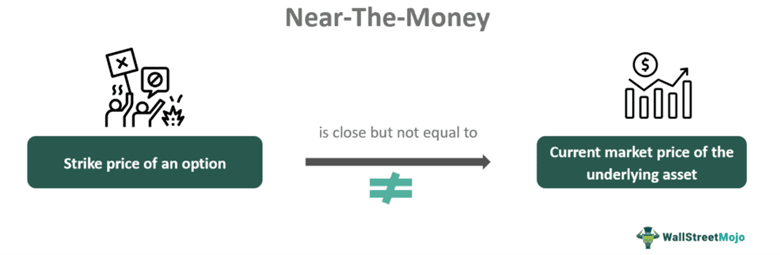
Near-the-money refers to options contracts where the price at which an entity can buy or sell the underlying asset is in significant proximity to the current market price of that asset. Such options offer traders the opportunity to profit from price movements in the underlying asset by executing suitable trading strategies while managing related risks.
Near-the-money options provide flexibility in implementing different trading strategies. Traders can combine near-the-money options with other options or underlying assets to create complex strategies tailored to their objectives. They can employ strategies like spreads, straddles, or strangles using near-the-money options to benefit from volatility or market neutrality. They enable traders to maintain a balance between risk and reward.
Key Takeaways
- Near-the-money refers to an option with a strike price that is close to the underlying asset’s current market price.
- Being near-the-money is significant because it means that if the price of the shares moves just a little bit, the options contract could become in-the-money.
- This means that the price of the shares would be favorable to exercise the options contract and potentially make a profit.
- Near-the-money options are attractive because they have the potential to become profitable if the price of the underlying asset moves in the right direction.
Near-The-Money Explained
Near-the-money in options trading outlines a situation where the strike price of an option is close to the current market price of the underlying security. The specific threshold for what is considered “close” can vary. However, typically, if the difference between the strike price and the underlying security’s price is less than 50 cents, the options contract is considered near-the-money.
It must be noted that 50 cents is a common benchmark used to define such options, but it can change based on the option and its underlying in question. For example, if the current market price of a stock is $50, a call option with a strike price of $50.50 or lower or a put option with a strike price of $49.50 or higher would be considered near-the-money. The actual threshold for what is considered near the money may also vary based on the specific market and the option exchange’s rules.
When an options contract is near-the-money, it means that the option has the potential to become profitable if the price of the underlying security moves in the desired direction. Such options have a higher chance of becoming in-the-money if the price of the underlying security reaches or surpasses the strike price during the option’s lifespan (i.e., before expiry).
Near-the-money options are often favored by traders and investors because they offer a balance between risk and reward through a higher chance of profit than Out-of-the-Money (OTM) options and by limiting time decay compared to OTMs. Also, these options tend to have lower premiums compared to options that are already deep in-the-money (strike price significantly below for calls or above for puts) because there is less intrinsic value at the time of purchase.
Examples
Let us look at near-the-money examples to understand the concept better:
Example #1
Suppose Stella, a trader, holds a call option. The details are:
- Underlying security: Starlight Inc.’s stocks
- The current market price of Starlight Inc.’s stocks: $100
- Near-the-Money call option: Strike Price of $101
- Option premium: $2.50
The call option with a strike price of $101 would be considered near-the-money since it is very close to the current market price of the underlying stock (Starlight Inc.’s stocks) at $100.
Now, let us examine how this near-the-money call option may behave under different scenarios and whether Stella can profit from it.
Scenario 1: XYZ stock price increases to $105 before the option’s expiration.
- The call option is now in-the-money because the current stock price ($105) is above the strike price ($101).
- The option holder can choose to exercise the option and buy the stock at $101, which can then be sold in the market at $105 for a $4 profit per share ($105 – $101).
- The option’s value will also increase, as it now has an intrinsic value equal to the difference between the stock price and the strike price. Those who purchased the near-the-money call option would have realized a profit from the stock’s upward movement.
Scenario 2: XYZ stock price remains at $100 until the option’s expiration.
- The call option would be considered at-the-money because the stock price is equal to the strike price.
- In this case, the option would have no intrinsic value, but it could still have some time value remaining.
- If the option expires without any changes in the stock price, Stella will lose the initial premium paid for the option ($2.50 per share). Those who purchased the near-the-money call option would have incurred a loss in this scenario.
Scenario 3: XYZ stock price decreases to $98 before the option’s expiration.
- The call option would be out-of-the-money because the stock price ($98) is below the strike price ($101).
- The option would have no intrinsic value and would only possess time value.
- If the option expires while the stock price remains below the strike price, Stella will lose the premium paid for the option ($2.50 per share). Those who purchased the near-the-money call option would have incurred a loss in this scenario as well.
It means that Stella can potentially profit from her near-the-money call option if the stock price of Starlight Inc. goes above the strike price (plus premium) before the option expires.
Example #2
Suppose Joanna, a frequent trader, thinks BioFine, a biotech company, will rise in the market soon. Hence, she bought near-the-money call options. These contracts give her the right to buy BioFine stocks at a certain strike price by expiration. She found that this deal was not too expensive and presented her with higher chances of profit. BioFine is currently priced at $50. Joanna buys call options with a strike price of $52. These call options will expire in 2 months. The option cost her $3 per share.
Joanna knows that if BioFine touches $60, she will make money. She can buy it at $52 (upon exercising the option) and sell it at $60, which is a good profit number. If she chooses so, she could sell the option for a higher price. If BioFine falls or remains intact at $50, Joanna loses the $3 she paid per option.
This illustrates Joanna’s proficiency in leveraging the near-the-money situation to make more money than under normal conditions of buying stocks.
Near-The-Money Vs. In-The-Money
While trading on stock exchanges, it is crucial to understand the precise differences between near-the-money and in-the-money to make the right decisions based on price movements. This can help traders exploit opportunities presented by the markets. In the table below, let us see the differences between the two.
Frequently Asked Questions (FAQs)
How does time decay affect the value of near-the-money options?
With passing time, options begin to near expiration. Hence, the time value constantly decays. This means an option’s overall price tends to decrease even if the price of the underlying asset remains unchanged. Due to this, near-the-money options lose value faster than other options.
Why are in-the-money options more expensive than near-the-money options?
In-the-money options are generally more expensive compared to near-the-money options due to their intrinsic value. Intrinsic value is the portion of an option’s price that is determined by the difference between the current market price of the underlying asset and the strike price of the option. This becomes more pronounced because near-the-money options have very little or almost nil intrinsic value.
Are in-the-money options better than near-the-money options?
Whether in-the-money options are better than near-the-money options depends on a trader’s specific trading objectives, risk tolerance, and market conditions. In-the-money options offer certain advantages and considerations that may align with individual goals, but they also have potential drawbacks. It is important to consider intrinsic value, the flexibility offered by a specific position, volatility conditions, etc., before making a decision.