

Top Investment Banking Interview Questions (and Answers)
Investment Banking Interview Questions and Answers is to help you learn about the investment banking interview topics. As a fresher in this field, I am sure you may have had questions about what and how to prepare for your first step in this finance world. There could be an unlimited number of questions that can be asked on investment banking topics, and since it is difficult to cover all of them here, we would be discussing a few of them which are important.
While reading through this write-up, it is suggested to actively keep answering the questions yourself before checking the correct answer. This will help develop the habit of brainstorming and answering these structured questions.
Investment Banking Interview Questions Explained
Investment Banking Interview Questions prepare one for the interviews to help them crack the interviews and enter the field of investment banking.
The interview nowadays does not have the typical questions being asked, including the basics of financial concepts. The interviewers want the candidates to think and avoid theories that everyone usually knows. Also, since these questions are technical, there would always be a correct answer, so if you don’t know a particular answer, don’t try and fake one. It is always better to confess that you don’t know.
The key to successfully answering these technical questions is to apply the concepts you’re learning and test yourself. Hope this has helped you learn some important questions and answers on investment banking topics and brings you steps closer to cracking the high-profile interviews.
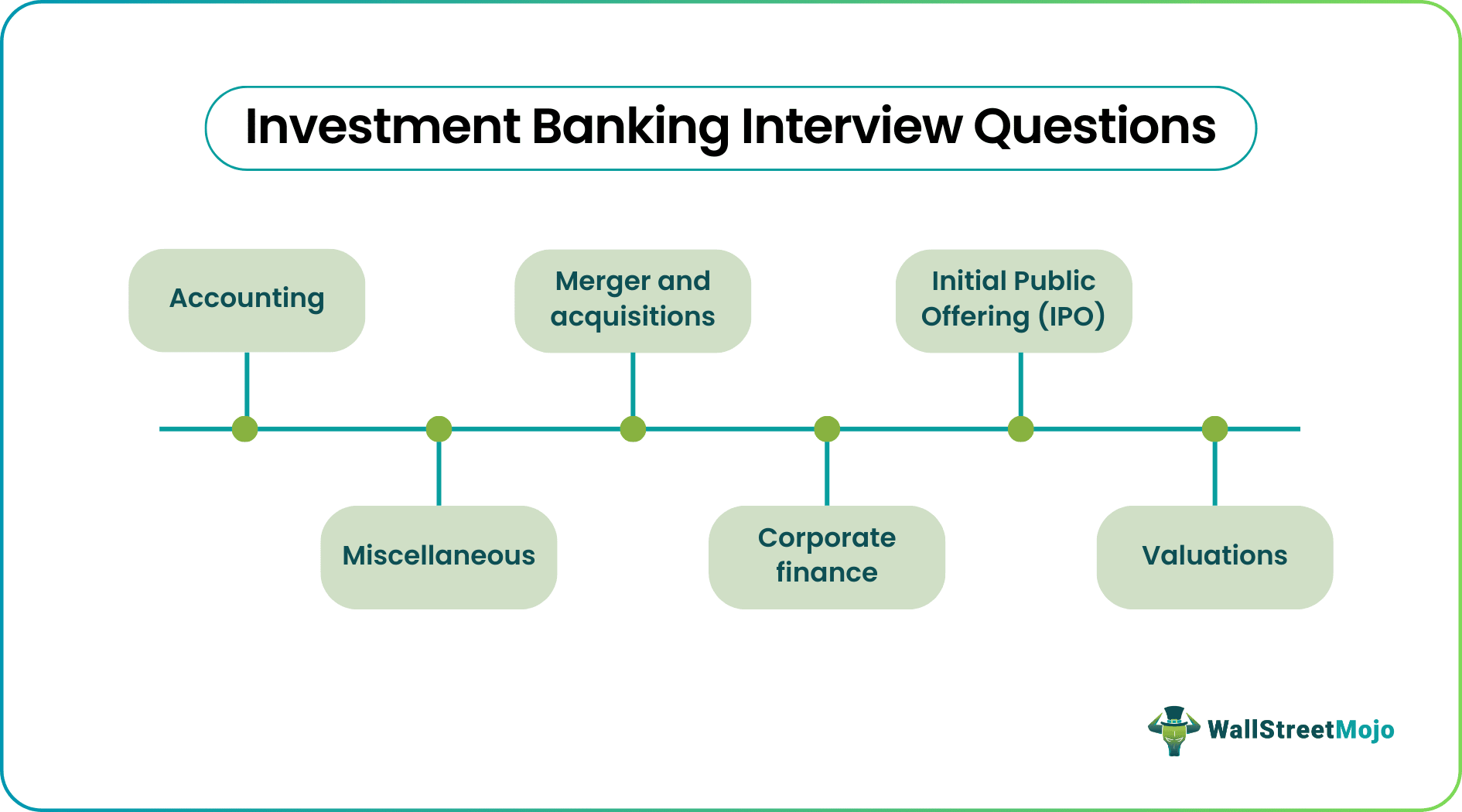
Investment Banking Interview Questions have been divided into the following six topics.
Top Interview Questions & Answers
Let us have a look at the technical questions and their types; apart from these, you would also have to prepare for the personal questions, why investment banking Interview questions, and brain teasers which are usually part of testing the candidates.
Investment Banking Interview Questions and Answers Video Explanation
#1 – Accounting
Question #1
Tell me about the three most important financial statements and their significance.
This is one of the most commonly asked investment banking interview questions.
- The three main financial statements are the Income Statement, Balance Sheet, and Cash Flow Statement. Speaking about their significance, the income statement provides the revenue and expenses of a company and shows the final net income that it has made over some time.
- The balance sheet signifies a company’s assets such as a plant, property & equipment, cash, inventory, and other resources. Similarly, it reports the liabilities, including the Shareholders’ equity, debt, and accounts payable. The balance sheet is such that the assets would always equal the Liabilities plus shareholders equity.
- Lastly, a cash flow statement reports the net change in cash. It gives the cash flow from the company’s operating, investing, and financing activities of the company.
Question #2
If you have the chance to evaluate the company’s financial viability, which statement would you choose and why?
- It would be the cash flow statement. The reason is that it provides a true picture of how much cash the business is generating in actual terms.
- Hence, the cash flows are the main thing you pay attention to while you are analyzing the business’s overall financial health.
Question #3
Let’s say that the depreciation expense goes up by $100. How would this affect the financial statements?
- Income Statement: With the depreciation expense decreasing, Operating Income would decline by $100, and assuming a 40% tax rate, Net Income would go down by $60.
- Cash Flow Statement: The Net Income at the top of the cash flow statement goes down by $60, but the $100 Depreciation a non-cash expense that gets added back, so overall Cash Flow from Operations goes up by $40. With no further changes, the overall Net Change in Cash increases by $40.
- Balance Sheet: On the asset side, because of the depreciation, the Plants, Property & Equipment go down by $100, and cash is up by $40 from the changes on the Cash Flow Statement.
Question #4
Imagine a situation where a customer pays for a mobile phone with a credit card. What would this look like under cash-basis vs. accrual accounting?
- In the case of cash-based accounting, the revenue would not be accounted for until the company charges the customer’s credit card, obtains authorization, and deposits the funds in its bank account.
- After this entry would be shown as revenue in the income statement and as cash in the balance sheet.
- As against accrual accounting, it would be shown as revenue right away. But it would not yet appear as cash on the Balance Sheet. Rather, it will be shown as Accounts Receivable.
- It would be reported as cash only after the amount is deposited in the company’s bank account.
Also, look at this detailed explanation on Cash vs Accrual Accounting.
#2 – Corporate Finance
Recommended Articles
This has been a guide to Investment Banking Interview Questions & Answers. Here, we list down the top 28 question-answers from six different finance subjects. You may also have a look at this Q&A to learn more –