


What Is Impairment Testing?
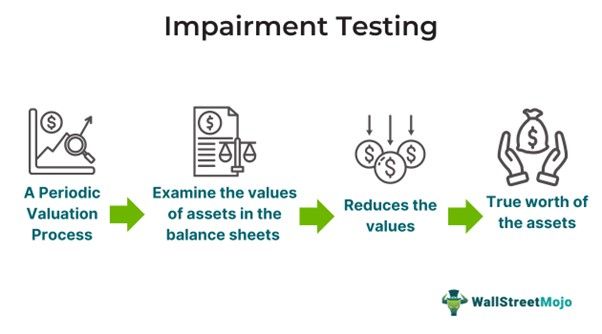
Impairment testing in accounting refers to the evaluation process used to determine whether an asset’s carrying value exceeds its recoverable amount, indicating a potential permanent reduction in its value. This applies to both intangible and fixed assets, and it ensures that assets are not overstated on a company’s financial statements, which could mislead stakeholders and investors regarding the company’s financial health.
You are free to use this image on your website, templates, etc..
Impairment testing is crucial for accurately reflecting asset values on a company’s financial statements. It is applied to both intangible and tangible assets, including goodwill, in accordance with US GAAP standards. The process involves comparing the asset’s current carrying value with its recoverable amount, which is based on factors like cash flow, total profit, and other associated benefits.
Key Takeaways
- Impairment testing assesses whether the value of a company’s asset—whether fixed or intangible—has declined below its recoverable value, leading to a permanent reduction in its carrying amount.
- The goal is to prevent overstated asset values on financial statements that could mislead investors and stakeholders about the company’s financial health.
- The process includes goodwill impairment testing for reporting units and private entities, and adjustments to the carrying amounts of indefinite-lived intangible and long-lived assets.
- Challenges include overestimation in volatile markets, incorrect modeling and budgeting, complex identification of Cash Generating Units (CGUs), geopolitical uncertainty.
Impairment Testing of Assets Explained
Impairment testing assesses whether the carrying value of an asset exceeds its recoverable amount, which is the higher of its fair value, less costs to sell, or its value in use. This process helps ensure compliance with IFRS and US GAAP standards by preventing the overstatement of assets on financial statements.
The process begins with the identification of impairment indicators, which can be external (e.g., market declines) or internal (e.g., asset obsolescence). If such indicators are present, the entity must evaluate the asset’s recoverable amount. An impairment loss must be recognized if the carrying amount exceeds the recoverable amount.
Impairment losses have significant implications for a company’s financial statements. Once recognized, the impairment loss reduces the company’s net income and equity, impacting both the income statement and balance sheet. This, in turn, affects market valuations and investor perceptions, as it may indicate financial or operational distress.
Impairment testing plays a critical role in informing investors, management, and creditors about the performance of a company’s assets. It accurately reflects the company’s economic status, allowing for informed decision-making. Financially, it promotes accountability and transparency in financial reporting, preventing asset overvaluation and offering stakeholders a realistic view of the company’s financial condition.
Process Steps
Impairment testing should be conducted systematically, following these steps:
- Adjust Carrying Amounts: First, adjust the carrying amounts of assets such as inventory, accounts receivable, accounts payable, and long-term debt as per applicable GAAP standards.
- Test Indefinite-Lived Intangible Assets: Conduct impairment testing and adjust the carrying amounts of indefinite-lived intangible assets within the asset group, following FASB ASC 350-30.
- Test Long-Lived Assets: Perform impairment testing on long-lived assets, including amortizable intangible assets and real assets, in accordance with FASB ASC 360-10.
- Goodwill Impairment Testing: Finally, conduct goodwill impairment testing at the reporting unit level (or for private entities, at the entity level), incorporating the previously mentioned assets as per FASB ASC 350-20.
These steps must be consistent with the guidelines outlined in FASB ASC 360-10-35-27, which also applies to other asset categories, ensuring proper impairment testing across long-lived assets under GAAP.
Examples
Let us use a few examples to understand the topic.
Example #1
Impairment testing affects financial statements like balance sheets and income statements by reducing asset values and lowering earnings. Impairment tests are typically done annually, but extraordinary events like the pandemic trigger additional testing. For instance, during the Great Recession of 2008, impairment losses amounted to $188 billion. Also, the COVID-19 pandemic has led finance executives to reassess asset impairment on their balance sheets. The economic impact of COVID-19 was severe, potentially causing billions in impairments.
Example #2
Let us assume that in XYZ City, a technology-based company, ABCL, acquires a mall startup business, WOWO, for $20 million. ABCL’s acquisition of the startup is strategic, as WOWO represents 5% of ABCL’s total assets. ABCL expects to generate $3 million in additional revenue by integrating WOWO’s technology. However, in the first year after the acquisition, WOWO’s performance declined, triggering the need for an impairment test.
ABCL forecasts future cash flows from WOWO’s operations and calculates a discounted cash flow of $15 million, revealing a $5 million impairment loss on goodwill. The impairment test shows that ABCL overpaid for WOWO’s acquisition. As a result, ABCL adjusts its financial statements and discloses the impairment loss to its stakeholders.
Challenges
Challenges during impairment testing include:
- Identification of Cash Generating Units (CGUs) can be complex and involves significant judgment, specifically regarding goodwill allocation.
- Fluctuations in geopolitical and economic conditions can influence impairment indicators.
- Recoverable amounts determination can be challenging because of the requirement to compare fair value less costs of disposal (FVLCD) with value in use (VIU).
- Inaccurate future cash flow assumptions cause incorrect impairment assessments.
- Incorrect allocation of corporate liabilities and assets to CGUs can result in errors during testing.
- In volatile markets, overestimating terminal value can negatively impact testing outcomes.
- Inaccurate modeling and budgeting can lead to wrong conclusions of testing.
- Using discount rates that do not accurately reflect the risks associated with a CGU can mislead testing results.
- Certain changes in market conditions add complexity to the impairment assessment process.
Frequently Asked Questions (FAQs)
How is goodwill impairment testing conducted at the reporting unit level?
Goodwill impairment testing is conducted at the reporting unit level, where goodwill is initially assigned. It involves a two-step process. In the first step, the fair value of a reporting unit is compared to its carrying amount; if the fair value exceeds the carrying amount, no impairment is needed. If not, the second step calculates the implied fair value of goodwill by subtracting the fair value of all other assets from the reporting unit’s total fair value. An impairment loss is recorded if this implied goodwill value is lower than the carrying value.
What are the methods of impairment testing?
Testing of impairment could be done using two methods below:
Qualitative assessment: First, the firms may evaluate qualitative factors pertaining to whether it is highly likely that the correct reporting unit value is lesser than its carrying amount.
Quantitative Assessment: If the qualitative assessment indicates impairment or one bypasses the qualitative assessment, the firm could compare the fair value related to the reporting unit concerning the carrying amount comprising goodwill. Furthermore, if the carrying amount exceeds the fair value, an impairment loss must be recognized.
Why is impairment testing necessary?
It ascertains that the balance sheet does not overstate the goodwill of an entity. One must conduct it annually so that changes in situations or events depict non-recoverable goodwill carrying amount.