

Hard Fork Meaning
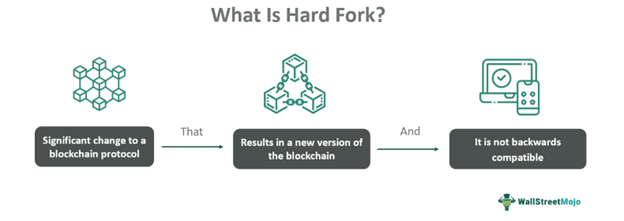
Hard fork refers to a permanent divergence from the current version of a blockchain, resulting in the creation of a new network with a distinct set of rules and protocols. It occurs due to disagreements among developers, miners, or users over the governance of the network.
The paramount importance of blockchain technology is that it allows for the creation of a new, independent network that is better equipped to address some of the critical issues faced by the original blockchain. It fosters innovation by allowing developers to experiment with new ideas, features, and technologies that were not possible under the old system.
Key Takeaways
- Hard fork is a software update that creates a new version of a cryptocurrency, resulting in a separate and independent blockchain.
- It is typically initiated when there are significant changes to the underlying protocol, such as improving security or scalability, or when there is disagreement among the community.
- It results in a new and separate cryptocurrency, while a soft fork results in a change to the existing cryptocurrency.
Hard Fork Explained
A hard fork in cryptocurrency refers to a significant change in the underlying codebase of a blockchain network that results in the creation of a new, separate blockchain that is incompatible with the previous version.
Here is an overview of the general process:
- Planning: This involves identifying the issues that need to be addressed, proposing changes to the existing network’s rules and protocols, and gaining consensus from the community.
- Implementation: Once the changes have been agreed upon, the developers will create a new version of the blockchain’s software that incorporates the proposed changes.
- Testing: Before it is implemented, it must undergo extensive testing to ensure that it is stable, secure, and free from bugs. This testing is usually carried out by developers and community members who run nodes on the network.
- Adoption: After it is tested and ready, it is time to implement it. This involves updating the software on all nodes and miners to the new version of the blockchain. Once the new version is implemented, it will start to operate as a separate and independent blockchain.
- Community response: After it is implemented, the community’s response will determine its success. Some users may choose to stick with the original blockchain, while others may switch to the new one. The market will determine the value and demand for each cryptocurrency.
Hard forks split a blockchain into two independent networks with distinct rules and cryptocurrencies, making them non-interchangeable. While some exchanges may support both, users should understand the variations and evaluate the risks and benefits before trading or holding either cryptocurrency.
Examples
Let us look at examples to understand the concept better:
Example #1
Suppose there is a cryptocurrency called CryptoX that operates on a blockchain with a block size limit of 1 MB. However, as the network grows, the transaction volume increases, and the block size limit becomes a bottleneck, causing slow transaction times and high fees.
To address this issue, the developers propose a hard fork that increases the block size limit to 2 MB. The community agrees that this change is necessary and supports the hard fork.
The developers then create a new version of the blockchain’s software that incorporates the proposed change to increase the block size limit to 2 MB. They also established a new cryptocurrency called CryptoY that operates on the new forked blockchain.
After extensive testing, the new version of the software is implemented, and the hard fork occurs. The original blockchain with CryptoX continues to operate as before, while the new blockchain with CryptoY operates with the increased block size limit.
Users who held CryptoX before the hard fork now have an equivalent amount of CryptoY on the new blockchain. However, the value and demand for each cryptocurrency may differ, and they are not interchangeable.
Some users may choose to stick with CryptoX, while others may switch to CryptoY. This may create two separate communities with different interests and goals. Over time, the market will determine the value and demand for each cryptocurrency based on user adoption, transaction volume, and other factors.
Example #2
The Chang hard fork for Cardano, slated for the second quarter of 2024, signals a pivotal moment in the blockchain’s evolution toward decentralized governance. This significant update introduces minimum-viable community-run governance, initiating a transformative process for Cardano’s ecosystem.
Central to the Chang hard fork is the establishment of delegate representatives (DReps) who will advocate for the community’s interests alongside the drafting of the Cardano Constitution through global collaboration. This shift towards decentralized governance principles not only empowers users to participate more actively but also lays the groundwork for Cardano’s future direction under community-led guidance.
Scheduled to culminate in a community-wide vote for the ratification of the Cardano Constitution, the Chang hard fork underscores Cardano’s commitment to fostering transparency and inclusivity in its governance model. Through this process, stakeholders will play a crucial role in shaping the governance framework, thereby ensuring a more democratic and resilient Cardano ecosystem.
Hard Fork Vs Soft Fork
The main differences between hard fork and soft fork are as follows:
Frequently Asked Questions (FAQs)
Does hard fork increase price?
Market sentiment plays a crucial role in determining the price of a cryptocurrency. Suppose the community is supportive of the hard fork and believes that it will lead to positive outcomes such as improved scalability or security. In that case, it may create positive market sentiment and drive up the price, but the exact outcome depends on various factors.
Are hard forks taxable?
In general, these are taxable events, as they involve the creation of a new cryptocurrency that can be sold or exchanged for other cryptocurrencies or fiat currencies. However, the tax treatment depends on the specific tax laws and regulations in your country and your circumstances.
Is a hard fork good or bad?
The impact largely depends on the context and objectives behind its implementation. While hard forks can lead to improvements such as enhanced security, scalability, or the introduction of new features, they can also cause community fragmentation and uncertainty.