


Free Margin Meaning
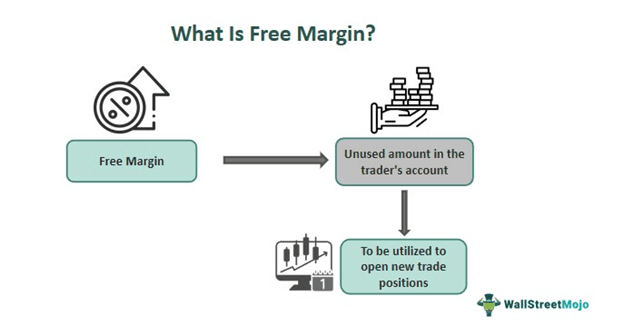
Free Margin is the unused fund in an investor’s trading account that can be used to open new trade positions and is not tied to any currently open positions that an investor or trader has taken in the market. It is calculated as the difference between equity and used margin. In simple terms, it is the amount of money left after taking a position.
You are free to use this image on your website, templates, etc..
Free margin is sometimes called usable margin because an investor can simply use it to open new positions at the same time. It is subject to moving against the investor before they receive a margin call or stop out. If it declines to zero, the investor can no longer trade or open new positions unless fresh funds are deposited.
Key Takeaways
- Free margin is the fund available in the trading account that is not tied up to any open positions, and that could be used to open new positions.
- It is calculated as the difference between equity and used margin. If it amounts to zero, no new trades can be initiated unless fresh funds are deposited.
- The free margin in Forex is used as a risk management indicator, and with constantly changing currency pair prices, the free margin also fluctuates, and the trader must monitor their margin levels.
- In case of a significant drop or negative free margin, a trader is expected to receive a stop-out call or margin call from the broker.
Free Margin in Forex Explained
Free margin is defined as the equity present in an investor’s trading account that is not reserved or tied to any currently open positions. Traders use these free margin funds to open new trades or simply withdraw back. The free margin has a strong role in the Forex market as the fluctuations in market values can affect the margin balance when derivative instruments are involved. An investor’s existing holdings, however, can move that free margin before they get a margin call.
Margins, in particular, operate differently in trading stocks and Forex. In stock trading, the investor borrows funds and pays interest on it. On the other hand, in foreign exchange markets, margins are simply deposits to cover the potential losses when large amounts of currency trading are initiated. Specifically, the free margin Forex denotes how much a currency trader can shake on their holdings before receiving a margin call. It typically happens when the margin level declines below 100%, and the trader may also receive a stop-out call at a 50% margin drop.
In the currency market, the free margin keeps on fluctuating. The currency pair prices move, and so does the free margin. A trader is responsible for monitoring their margin levels. For many traders, it also works like a risk management indicator. In Forex, there is often a high degree of leverage and wide trading hours involved, and it is complex compared to stocks and ETFs.
Many traders use Saxo Bank International to research and invest in stocks across different markets. Its features like SAXO Stocks offer access to a wide range of global equities for investors.
How To Calculate?
Given below is the equation that helps calculate the free margin:
Free Margin = Equity – Used Margin.
When an investor has profitable open positions, their equity increases, which directly means that they will have more free margin, conversely, if the investor has positions with losing money, the equity will decline, and hence, they will have less free margin.
Examples
Below are two examples that can help understand the meaning and calculation of this usable margin –
Example #1
Suppose Fiona is a new investor. She has been in the stock market for only nine months.
Currently, she has an equity of $13,500 with a used margin of $4500.
Fiona can easily calculate her free margin by putting these values into the formula.
Free margin = Equity – Free margin
= 13,500 – 4500
= 9000
Therefore, Fiona has a free margin of 9000, which she can either withdraw or use to open new trades. This example suggests that Fiona has profitable positions, which increased her equity and, simultaneously, her free margin.
Example #2
In 2021, HotForex, a global asset broker and online trading platform, announced an exclusive reward program for its clients where they would receive returns on their free margin. The offer was open to both new and existing clients. According to the scheme, the returns would be up to 3% on the free margin. The HotForex clients were allowed to join the Return on Free Margin (ROFM) program and receive daily earnings to be credited directly to their wallets.
The initiative gave clients the liberty to decide if they wished to trade with it and open new positions or withdraw the amount. The earnings were calculated from the trading account’s daily free margin, and the total return was credited to the client’s wallet monthly. With over 2.5 million live accounts globally, HotForex offers a wide range of accounts, tools, platforms, and educational resources.
Free Margin vs Margin
The difference between margin and free margin is many, given the nature or usage. Let us have a look at them in brief below –
- Margin is the fund required to open a trade, while free margin is the remaining money in the trader’s account available to open new trades.
- Margins are tied to current positions, but the free margin is not tied to any currently open positions.
- To make margin withdrawals, investors put their portfolio as collateral, but free margin can be withdrawn directly from trading accounts.
- Margin is a good faith deposit when trading Forex. On the contrary, the rest of the free margin is free money.
Disclosure: This article contains affiliate links. If you sign up through these links, we may earn a small commission at no extra cost to you.
Frequently Asked Questions (FAQs)
How to increase the free margin in Forex?
Yes, accounting fraud is a federal crime that has severe economic and legal repercussions. Executives and employees may be awarded prison time, fines, and probation. Moreover, depending on the severity of the fraud, employees might be barred from any future fiduciary roles. As a result of this white-collar federal crime, the company may be asked to compensate affected parties and pay fines that cost millions of dollars.
Can one withdraw the free margin?
Yes, the free margin amount directly denotes that the funds are currently residing in the investor’s trading account and have not been put to use. So, this fund can either be used to open new positions or is available to be withdrawn and used for other purposes.
What happens if the free margin is negative?
The free margin can decline to negative if the margin of the investor’s open trades crosses the equity threshold. In simple words, when a trader incurs losses and is left with no choice but to close the positions, this releases the margin. If not, a stop-out situation will occur.