


What Is Financial Industry Regulatory Authority (FINRA)?
The Financial Industry Regulatory Authority is a non-governmental and self-regulatory organization that curates and enforces guidelines and rules governing broker-dealer firms and registered brokers in the United States of America. It was established in 2007 as a consequence of the consolidation of the National Association of Securities Dealers (NASD) and member regulations of the New York Stock Exchange (NYSE).
You are free to use this image on your website, templates, etc..
A Financial Industry Regulatory Authority licens is highly credible as it is the largest independent regulatory authority functioning within the United States. FINRA regulates equities, securities futures, options, and corporate bonds. It also oversees close to 3,300 brokerage firms, over 625,000 registered securities representatives, and almost 150,000 branch offices.
Key Takeaways
- The Financial Industry Regulatory Authority is a private, self-regulatory (SRO), and not-for-profit organization in the United States of America. It is responsible for overseeing broker-dealer firms, investment advisors, and financial advisors.
- FINRA conducts the qualifying examination for aspiring securities professionals.
- FINRA also provides investors with resources such as BrokerCheck to safeguard their best interests against manipulative and illegal market activities.
- A common criticism of FINRA is that historical offenders often repeat their offenses, requiring stricter punishments.
Financial Industry Regulatory Authority Explained
The Financial Industry Regulatory Authority is a private American self-regulatory organization that governs and regulates exchange markets and brokerage firms. The ultimate agency that regulates the securities market in the United States, including FINRA, is the SEC (Securities and Exchange Commission).
It is the replacement of the National Association of Securities Dealers (NASD), which was operational from 1939 to 2007. In 2007, it was dissolved to ensure the market was free of the complexities and overlap of rules between NASD and NYSE. This organization was formed with the fundamental intention of safeguarding investors and ensuring that the securities market in the United States operated honestly and fairly.
The Financial Industry Regulatory Authority rules and regulatory oversight apply to all securities firms that either conduct business with the public or even arbitrate, mediate, test, and provide professional training.
Despite being a regulatory authority and governing multiple entities in the securities market, FINRA is also under the ultimate supervision and governance of the Securities and Exchange Commission (SEC). However, FINRA makes sure that brokers and other registered members maintain a certain level of professionalism.
Consequently, they conduct regular examinations and provide educational services to enhance their knowledge of the securities market’s existing and latest developments. Moreover, members or entities that do not adhere to the guidelines provided by FINRA are subject to disciplinary action.
Many traders use Saxo Bank International to research and invest in stocks across different markets. Its features like SAXO Stocks offer access to a wide range of global equities for investors.
Roles
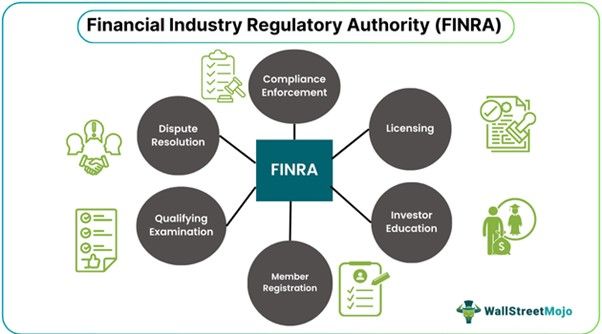
If anyone closely follows the Financial Industry Regulatory Authority news, they will find that FINRA has a multi-faceted role and they have supervision at different ends of the market. A few of the most prominent roles are:
- FINRA regulates trades in equities, securities futures and options, and corporate bonds.
- They have been bestowed the power to safeguard investors’ interests by Congress.
- FINRA supervises broker-dealer firms and brokers.
- They administer the qualification exams that securities professionals are expected to pass to sell or supervise the sale of securities.
- It also has an enforcement front. It can take disciplinary actions against registered firms or individuals who do not adhere to the norms.
- FINRA also maintains a database of brokers, financial advisors, and investment advisers from which investors can choose. The database is called the Central Registration Depository (CRD).
- The organization also has the power to ban or levy heavy fines on individuals or firms that violate the guidelines and rules outlined by them.
Compliance Requirements
To attain a Financial Industry Regulatory Authority license, a broker or a broker-dealer firm has to fulfill a few requirements. They might be complicated mediation processes or just general requirements. Some of the most critical compliance requirements are:
- Rule 2210: It addresses the contents of advertising materials and other such sales-related literature. FINRA requires firms and individuals to have a sensible bias before any recommendations are made.
- Rule 2265: It is the requirement concerning providing investment advice to clients. FINRA strictly directs firms and individuals to declare conflicts of interest, if any. Moreover, they are also required to have a system in place that has checks at different levels to avoid any instances of violation of FINRA rules.
- Rule 3310: FINRA directs firms to set up, maintain, and enforce supervision procedures in a written form. These procedures concerning their business activities must be well-circulated within the firm and communicated to all relevant parties.
- Rule 4512: All official communication with clients must be well documented. This rule requires firms and individual brokers and advisors to make such communication available to FINRA authorities upon request.
Benefits
A few benefits of FINRA are:
- The foremost benefit of firms and individual brokers and advisors following the Financial Industry Regulatory Authority rules is that the investor’s best interest is considered in policymaking and its general execution.
- FINRA’s resources, such as CRD BrokerCheck, ensure that investors rely on qualified entities for investment and finance-related services.
- Violators of FINRA rules are often awarded hefty fines or even banned, depending on the magnitude of the violation. As a result, financial crimes are significantly lower.
- Their intentions of simplifying regulations and avoiding rule overlapping were made evident through the amalgamation of NYSE and NASD’s regulatory operations into a singular organization.
- FINRA has the authority to curate new rules, enforce and administer qualifying examinations, and conduct mediation functions. Since it covers a wide array of aspects, it can ensure that all activities lead to the organization’s primary objective.
Criticism
Despite the various benefits FINRA rules bring to all market players, they have been subject to some intense criticism as well. A few of the most common criticism include:
- Senators of various jurisdictions feel that the organization needs to do more to protect investors.
- Repeat offenders have often been the subject of the Financial Industry Regulatory Authority news. According to a study, advisors and entities with records of misconduct were more likely to repeat them.
- A general perception is that FINRA and other self-regulatory Organizations (SROs) do just enough to maintain public trust. As a result, there seems to be an innate conflict of interest.
- Repeat offenders and offenders with massive violations must be weeded out, and membership must be revoked. However, no such actions are taken. As a result, multiple market players have accused them of being hypocrites.
Disclosure: This article contains affiliate links. If you sign up through these links, we may earn a small commission at no extra cost to you.
FINRA vs. SEC
The distinction between the Financial Industry Regulatory Authority rules and SEC (Securities and Exchange Commission) are:
Frequently Asked Questions (FAQs)
Is FINRA only in the US?
Yes, FINRA is a not-for-profit, self-regulating private organization in the United States that oversees broker-dealer organizations, individual brokers, investment advisors, and financial advisors. It also administers the qualifying examination for anyone who sells or supervises the sale of securities.
Who funds FINRA?
As a self-regulated organization (SRO), FINRA’s funds are secured through members and other sources. As a result, the need for government funds is eliminated. Taxpayer money is not involved in FINRA’s smooth functioning. Therefore, it is swift on its feet concerning market changes and can quickly develop technology systems to support oversight.
What are the powers of FINRA?
FINRA has the power to curate rules and guidelines for its member firms, closely monitor the market, and ensure the enforcement of federal securities laws, municipal securities, and the FINRA rulemaking board. Moreover, it can administer the examination for qualifying or disqualifying aspiring securities professionals.