


Economic Obsolescence Definition
Economic obsolescence describes the decline in the value of a property or asset owing to external reasons beyond their physical condition, such as changes in environmental regulation, market demand, or technology. It serves the primary purpose of determining the actual value of a property or asset, leading to an informed, well-balanced judgment over its usage, investment, or sale.
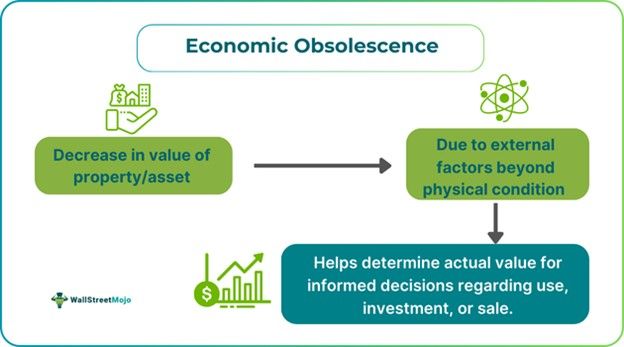
You are free to use this image on your website, templates, etc..
It also aids investors and businesses in deciding whether to continue using or dispose of assets or properties while planning to meet market changes and environmental regulatory modifications. Real estate uses it as a key tool in property value determination and appraisals. Industries dealing in heavy machinery or technology and innovation are affected by their economic obsolescence.
Key Takeaways
- Economic obsolescence is defined as the decrease in the value of a property or asset due to external factors, such as changes in environmental regulations, market demand, or technology,
- Determining the actual value of a property or asset is its primary use. It enables informed and balanced decisions regarding its usage, investment, or sale.
- This phenomenon occurs when the value of assets decreases due to external factors such as technological advancements, economic conditions, or market changes.
Economic Obsolescence In Real Estate Explained
Economic obsolescence is defined as depreciation in the value of real estate or property due to uncontrollable external circumstances. These circumstances might include a change in zoning laws, an increase in crime rate, an encroachment drive by authorities, landfill construction, or other factors. Incurable economic obsolescence has an irreversible impact on the value and status of a property.
Moreover, quantifying economic obsolescence can pose a challenge as it is influenced by external economic factors that are difficult to predict. However, real estate appraisers and market analysts employ various techniques to estimate the impact of economic obsolescence on a property’s worth. Therefore, such valuation methods can involve economic obsolescence analysis and accounting, analyzing market trends, conducting surveys, and scrutinizing data on similar properties.
Furthermore, recognizing this phenomenon is crucial for real estate investors, developers, and appraisers as it can significantly affect a property’s value. By identifying and evaluating its impact, real estate professionals can make informed decisions about the utilization, investment, or sale of a property. For instance, if a property experiences economic obsolescence, it may be more advantageous to sell it or repurpose it for a different use rather than persisting with its current operation.
Examples
Let us use a few examples to understand the topic.
Example #1
Suppose the local administration of Minnesota passed a new zoning law in the neighborhood. As a result, people with property in the neighborhood wouldn’t be able to use it for commercial purposes or undertake any new construction of buildings near the area. Thus, zoning is referred to as economic obsolescence, as the value of a property is reduced due to the law restricting its intended use.
Example #2
The Kroll news article by Mark Chaplin discusses the challenges of estimating economic obsolescence in valuation. It draws attention to how the state of the economy and market dynamics impact asset values. Chaplin highlights the need for thorough study and reliable methods for evaluating this phenomenon because of its substantial influence on financial reporting and asset valuation. The article emphasizes how critical it is to take these things into account to guarantee accurate and equitable asset appraisals.
Economic Obsolescence Vs. Functional Obsolescence
Frequently Asked Questions (FAQs)
What does economic obsolescence not result from?
Physical wear and tear or normal damage does not lead to an asset’s economic obsolescence. However, external economic factors only lead to the loss of an asset’s value, making it less useful or desirable. Economic factors could include technology development, changes in market demands, and changes in the country’s regulatory system.
How to calculate economic obsolescence?
It becomes difficult to calculate it as it depends on circumstances beyond human comprehension and complex. Nevertheless, one can do the following to calculate it:
- Find the existing market value of an asset as per its age, condition, and other factors
- Research the possible external economic factors that might affect the asset
- Determine the impact of the above factors on the value of the asset
- Now, subtract the value after considering the external economic factors from its existing value
Is economic obsolescence depreciation?
Although both negatively impact the value of an asset, they are quite different in the causes leading to them. Value depreciation arises out of age, physical deterioration, and wear and tear. However, economic obsolescence has its cause in economic factors beyond one’s control, like market demand or technological advancement.