


EBIAT Meaning
EBIAT, or earnings before interest after taxes, is a financial measure that evaluates the operating and non-operating profit before deducting interest and the cash income tax. It is expressed as the cost of goods sold and administrative and general expenses subtracted from revenue.
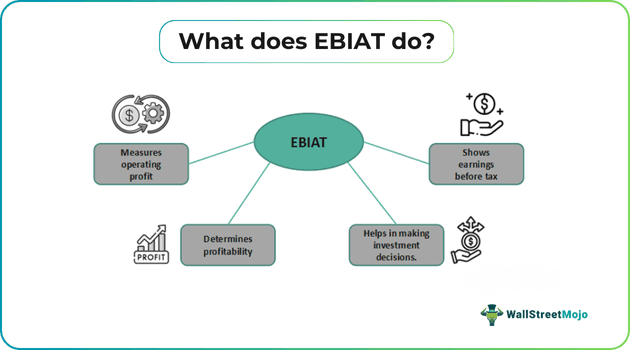
It is the amount that is gained after deducting cash taxes from earnings before interest and taxes (EBIT). The value determines a company’s profitability by accounting for income taxes while ignoring the impact of interest costs. It draws attention to the company’s operational performance.
Key Takeaways
- EBIAT, or earnings before interest after taxes, is a financial measure that evaluates the operating and non-operating profit before deducting interest and the cash income tax.
- It offers a clearer, more reliable indicator of a company’s capacity to make profits. It concentrates on earnings from core operations and considers tax liabilities.
- This metric is beneficial when comparing businesses with different tax requirements, financial leverage, and debt structures.
- It is calculated by starting with a company’s operating income and then subtracting the taxes paid.
- It excludes interest expenses. The formula for calculating EBIAT: company’s EBIT x (1 + tax rate).
EBIAT Explained
EBIAT is a financial metric used to analyze a company’s operational performance without considering its tax liabilities capital structure. It enables stakeholders, including investors and analysts, to assess an organization’s operational performance without considering its capital structure. This metric provides a clearer, more reliable indicator of a company’s profit-making capacity. It focuses on core operational earnings while also factoring in tax liabilities.
This value is regardless of changes in interest payments or debt levels. This facilitates the identification of appealing investment prospects. In addition, it allows for accurate comparisons between companies operating in the same industry. Investors and analysts can better understand the profitability that results from the company’s core business operations by studying this concept.
This metric is beneficial when comparing businesses with different tax requirements, financial leverage, and debt structures. This is because it effectively takes such things out of the equation. It allows for a more realistic evaluation of profitability and potential operational efficiency. This is often used in various financial assessments, like valuations, investment decision-making, and industry comparisons. Additionally, it can be used in computations like the EBIAT multiple or Enterprise Value. The value again aids in determining the relative worth of businesses across various industries and scales of size.
Formula
The formula for calculating EBIAT: company’s EBIT x (1 + tax rate).

NOTE: EBIT = Business Revenue – Operating Expenses + Non-Operating Income.
In addition to assessing a company’s operational performance, investors frequently examine the EBIAT ratio, which is calculated by dividing EBIAT by total sales or other relevant financial measures.
Examples
Let’s consider these examples to understand the concept better:
Example #1
Let’s consider ABC Corporation has shown an operating expense of $500,000 and revenue of $1,000,000. It also brings in $100,000 from non-operating sources. The corporation pays 25% in taxes.
Let’s first figure out EBIT (Earnings Before Interest and Taxes):
EBIT is the sum of business revenue minus operating costs. Non-operating income is added to the value. This gives:
= $1,000,000 – $500,000 + $100,000
= $600,000
The following formula can be used:
EBIAT is calculated by multiplying EBIT by (tax rate x 1).
= $600,000 x (1 – 0.25)
= $600,000 x 0.75
= $450,000
This amount reflects the company’s earnings before interest and after taxes, which shows its operational profitability following the deduction of taxes but before taking interest costs into account.
Example #2
Suppose Dan is an investor who wants to invest in a company. Dan does in-depth financial analysis to evaluate the company’s profitability and prospective profits before making investment decisions. Earnings before interest after taxes is one important measure he assesses as the metric ignores the impact of borrowing costs and concentrates on after-tax earnings.
Hence, it is a useful indicator of the operational profitability of a company. He can better understand the company’s core profitability and capacity to produce profits from its core business by considering EBIAT.
EBIAT Vs. NOPAT
Differences between both the concepts are given as follows:
EBIAT Vs. EBIT Vs. EBITDA
Differences between the three concepts are given as follows:
| Key points | EBIAT | EBIT | EBITDA |
|---|---|---|---|
| Concept | The metric refers to a company’s earnings in the absence of any debt-related tax benefits. | EBIT is the profitability metric used to calculate a company’s operational profit | Earnings before factors such as interest, taxes, depreciation, amortization, or EBITDA are business valuation indicators used to evaluate the organization’s financial health. |
| Calculation | It is computed by first deducting taxes paid from the operational income of the company and by excluding interest charges. | It is computed by subtracting the company’s operational costs and cost of goods sold from its total revenue | It is the sum of the company’s net earnings, taxes, depreciation, amortization, and interest costs is used to compute it |
| Formula | EBIT×(1−Tax Rate) | Revenue – Cost of goods sold – Operating Expenses | Net earnings + Interest + Taxes + Depreciation + Amortization |
Frequently Asked Questions (FAQs)
Can EBIAT be used to evaluate tax efficiency and overall financial health?
Yes, this metric evaluates tax efficiency by accounting for tax liabilities in core operations. It offers insights into overall financial health and operational profitability.
Does EBIAT include depreciation?
Non-cash expenses like depreciation and amortization are factored into its calculation. The amount of cash booked from revenue is not shown by the EBIAT margin.
What is the EBIAT of free cash flow?
Free cash flow is not directly related to it. A company’s free cash flow is the amount of cash it has left over. After subtracting capital expenditures and other cash outflows, taxes and interest costs, which are elements considered in this metric, have no impact on it.
Why is depreciation subtracted from EBIAT?
Depreciation is a cost that must be incurred but is not paid for in cash. As it is non-cash and an expense, it reduces the accounting profit even if it does not impact cash flow. Depreciation is accounted for in EBIAT by being subtracted.