


Document Of Title Meaning
A document of title refers to a written commercial instrument that serves as evidence of the rightful ownership or control of goods or property, transferable through delivery. Thus, the person carrying such a formal commercial document can legitimately claim possession of the respective goods or property.
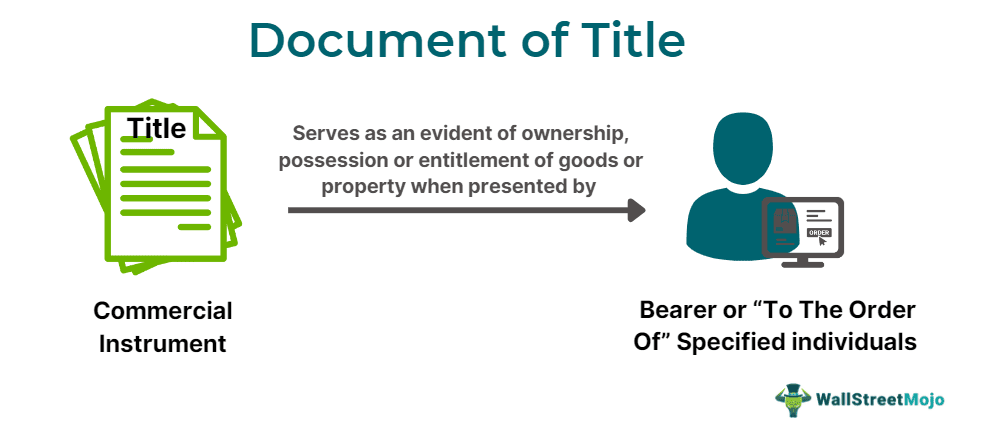
Such electronic or paper form of documents include bills of lading, delivery orders, dock receipts, dock warrants, warehouse receipts, etc. They serve as a crucial part of any overseas trade and even internal transfer of goods since they ensure greater security and convenience in handing over the consignment to its entitled owner when they present or surrender the original document.
Key Takeaways
- A document of title refers to a commercial instrument, whether on paper or electronic form, that confirms the ownership, possession, or entitlement of declared assets, goods, or property.
- Some of these are quedan, bill of lading, dock warrant, railway receipt, and delivery orders.
- It is generally a negotiable instrument whereby the goods or assets can be received or claimed by the holder or to the order of the mentioned individual upon delivery. Thus, anyone presenting the document can deliver the goods.
- It is a commonly used instrument during the cross-border transit of goods or consignments.
Document Of Title Explained
A document of title is a written paper or electronic instrument that can serve as proof of ownership of the mentioned goods, assets, or property. It is presented while the person who holds and surrenders such document is taking the consignment delivery. These can be warehouse receipts, dock receipts, dock warrants, bills of lading, railway receipts, and quedan.
Such a commercial instrument facilitates a secured transfer of goods or assets in transit to its rightful owner (i.e., the person who holds and presents the document). It ensures seamless overseas trade and effortless transportation of consignments by a third party who is unaware of the goods’ ownership. Even a share certificate serves as a document of title for ownership of shares in a company.
Some of the potential steps in the issuance of a document of title to goods are as follows:
- The issuer, i.e., the seller or bailee, creates or issues documents of titles, such as a warehouse receipt or bill of lading, while getting the consignment ready for shipment.
- The consignor transfers this commercial instrument to the consignee at the time of shipment.
- The consignment of goods or assets is shipped or transported along with a copy of such document.
- The consignee can hand over or endorse the document of title to any other party in case they want to transfer its ownership or entitlement to claim the delivery of the consignment (only for a negotiable commercial instrument).
- The person who holds the instrument and presents it at the delivery destination becomes entitled to receive the goods or assets.
- The carrier hands over the goods to the presenter of the document at the destination, who becomes legally entitled to possess or dispose of the goods.
- The bearer surrenders the document upon delivery.
However, such an arrangement is prone to forgery and duplicity. Also, in the case of a negotiable commercial instrument, there is a high chance that goods will be claimed by someone who finds a lost document or steals it from its owner. Moreover, a paper form of a document title can get easily damaged, misused, or stolen if not kept carefully.
Since most of these documents don’t name the respective owner, there is a chance of disputes or errors at the time of delivery. Indeed, different jurisdictions have different laws governing such instruments. This may complicate the cross-border transfer of goods using the documents of title.
Examples
A document of title decides who can receive, possess, or own the goods, assets, or property upon delivery. It is a widely used commercial instrument worldwide, especially in international trade. Let us find out its uses through the following examples:
Example #1
Suppose ABC Ltd., an imported cosmetics seller in New York City, placed an order for imported French perfumes with RS Fragrance Ltd. in Paris, France. RS Fragrance Ltd. ships the consignment through the carrier XYZ Carrier Co.
XYZ issues a bill of lading specifying all the relevant details about the goods in the consignment, including the quantity, value, condition, destination, etc., to RS Fragrance Ltd. RS Fragrance Ltd. then sends a copy of the document to ABC Ltd. A worker of ABC Ltd. presents this bill of lading as a document of title to the carrier authority at the destination and receives the consignment delivery.
Example #2
Suppose Mrs. Anne, living in Baytown, sends her ancestral billiards table to her daughter in Houston through railways. The carrier issues a railway receipt, which Mrs. Anne sends to her daughter online. However, Anne’s daughter lost her mobile, and the finder misused this document of title by reaching the railway station at the time of delivery. They presented the receipt to the railway authority and claimed possession of the billiards table.
Negotiable Vs. Non-Negotiable Document Of Title
There can be two different types of title documents based on their transferability, i.e., negotiable and non-negotiable. Its evidence can be differentiated as follows:
Document Of Title Vs. Document Showing Title
Although both documents are presented to prove the ownership of the assets, they are dissimilar in the following ways:
Frequently Asked Questions (FAQs)
What happens if a title document is misplaced or destroyed?
If the document is misplaced or destroyed, the holder might have to ask the issuer for a duplicate or replacement document. It often requires proof of loss and an indemnity bond to guard against future claims.
What rights do holders of documents of title have under the law?
Holders of documents of title enjoy various legal rights under commercial rules and regulations that govern the issuance, transfer, and enforcement of these documents. These rights ensure their recognition and honor in courts.
Which is not a document of title to goods?
A proforma invoice that is provided to the buyer by the seller as a bill of sale cannot be considered a document of title. Similarly, a bearer check is not a document of title; it is a negotiable financial instrument.