


What Is The Dictator Game?
The dictator game refers to a paradigm in experimental economics that is used for analyzing the prosocial preferences of humans. Here, the dictator gets some endowment, which they have to split with the recipient. Hence, the former may choose to give nothing, a particular portion or everything, to the latter.
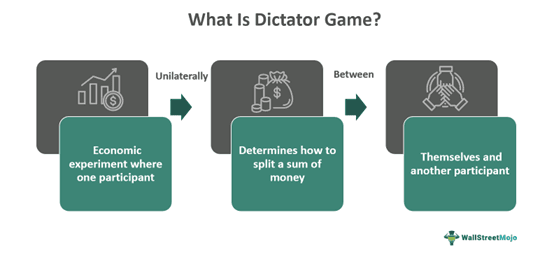
In other words, player 1, the dictator, plays an active role and holds the decision-making power, while player 2 is the passive player who doesn’t have any decision points in this game. The primary purpose of this behavioral experiment is to gauge the response of people when they encounter situations where they have to choose between self-interest and equality.
Key Takeaways
- The dictator game refers to an experiment in economics that examines people’s prosocial preferences and their choice between equality and self-interest when placed in a particular situation.
- In this game, there are two players: one is the dictator, and the other is the recipient. The dictator, who is the only decision-maker in the game, is provided with an endowment to distribute to the recipient, who is a passive player.
- The dictator can choose to give all, a portion, or nothing to the recipient.
- This hypothetical choice experiment was introduced by Daniel Kahneman, Jack L. Knetsch, and Richard H. Thaler in 1986.
Dictator Game Explained
The dictator game is a hypothetical choice experiment in economics that usually comprises two players, a dictator and a recipient. The dictator is the one who is given an endowment, i.e., a certain amount in cash to distribute it with the recipient. However, the dictator has all the decision-making capacity in this game, whereas the recipient is just a passive player whose task is to accept what the dictator offers. Hence, this experiment tests the generosity, selfishness, altruism, or fairness traits of the dictator through the analysis of the pie size they provide to the recipient from the total endowment.
Thus, the dictator game psychology is all about the trade-off between self-interest/profit-seeking and equality. We can say that there are following different choices that a dictator can make:
- Giving Nothing: If the dictator is a selfish person, they will retain all the amount for themselves and not offer anything to the recipient. Here, the dictator chooses self-interest above equality.
- Giving Something: In another case, the dictator may allow a portion of the endowment to the recipient.
- Equal Splitting: Here, the dictator can set an example of fairness and equality by distributing the money in a 50-50 ratio with the recipient.
- Giving More Than Half: The dictator may show behavioral generosity towards the recipient by offering them more than 50% of the endowment.
- Giving Everything: This is a case of altruism where the dictator keeps nothing for themselves and offers all the money to the recipient.
Types
There can be variations of the dictator game based on the structure and number of participants involved. Let us explore these variations below:
1. Standard Dictator Game: In this classic version of the dictator game, there are two players: one dictator and one recipient. The dictator has one decision point: how to split an endowment between themselves and the recipient, who has no decision-making power.
2. Variations of the Dictator Game:
- a) Role Uncertainty: In some versions, participants do not know in advance whether they will be assigned the role of dictator or recipient. This uncertainty can influence their decisions, as they may behave more generously if they think they end up in the recipient’s position.
- b) Multiple Dictators and Recipients: In more complex variations, there can be multiple dictators and recipients. However, these are not standard forms and are often designed to study specific behaviors or outcomes.
3. Role Framing:
- a) Standard Framing: Players are aware of their roles as dictator or recipient at the outset. This certainty influences their decision-making, as they know exactly what their position entails.
- b) Random Assignment: Players might be told that roles will be randomly assigned after they make their decisions. This can lead to more equitable distributions as players anticipate the possibility of being in either role.
Research suggests that both role uncertainty and the framing of the game significantly influence the level of generosity exhibited by participants. These variations help researchers understand how context and expectations shape prosocial behavior.
Examples
The dictator game has been the base for various economic studies and experiments to understand human behavior in certain situations. Given below are some instances to prove the significance of this experimental economics paradigm:
Example #1
Suppose, in a small firm with ten employees, the owner conducted a dictator game experiment to understand the behavioral generosity of the staff when given a limited amount of money and total decision-making power. He formed five teams of two employees each. In each team, one employee is the dictator, and the other is the recipient.
In the first round, the owner gave $10 to each dictator and asked them to share this money with their recipients as they wished. In the second round, he swapped the roles in each team and again gave $10 to each new dictator to split with their recipients. The results were as follows:
| Teams | Round 1 (Pie Size Dictator Gave To Recipient) | Round 2 (Pie Size Dictator Gave To Recipient) |
|---|---|---|
| 1 | $2 | $0 |
| 2 | $5 | $8 |
| 3 | $6 | $1 |
| 4 | $3 | $3 |
| 5 | $5 | $5 |
On average, the dictators shared only 38% of the endowment with their recipients, which shows their selfishness and less generous behavior towards one another.
Example #2
The researchers investigated the impact of financial incentives in dictator game experiments. They found that experimental dictators were generally less generous when the stakes involved real money compared to hypothetical scenarios. To substantiate this argument, the researchers conducted both hypothetical and real-money dictator game experiments, factoring in personality traits and cognitive ability.
The findings were summarized in a graph which indicated the following:
Individuals scoring two standard deviations above the mean in extraversion sent amounts of 1.18 standard deviations above the mean in hypothetical scenarios but 0.52 standard deviations below the mean in real-money experiments. Those who scored two standard deviations above the mean in agreeableness sent amounts of 1.58 standard deviations below the mean in hypothetical scenarios but 0.35 standard deviations above the mean in real-money experiments.
The experiment concluded that the effect of incentives on generosity varies significantly between individuals and is influenced by personality traits such as agreeableness and extraversion. Therefore, this variability necessitates the consideration of individual differences in decision-making experiments to achieve more accurate and consistent outcomes.
Dictator Game Vs. Ultimatum Game
The ultimatum and dictator games are two different economic experiments that help us understand human social psychology regarding fairness and profit-seeking motives. However, they are different from each other in the following ways:
Frequently Asked Questions (FAQs)
Who discovered the dictator game?
The invention of the dictator game economics was made in 1986 by Daniel Kahneman, Richard H. Thaler, and Jack L. Knetsch. They conducted a hypothetical choice experiment to identify whether individuals show generosity, fairness, or altruism when they hold the decision-making power.
What is the usual outcome of the dictator game?
The usual result of any standard dictator game suggests that most dictators offer between zero and half of the endowment to their recipients.
What is the third-party dictator game?
The third-party dictator game involves a third-party observer. Such a neutral participant gets an additional endowment, which they can use to reward or punish the dictator. In the case of the dictator’s selfish behavior, the third party can decrease their economic payoff; however, when the dictator behaves generously, the observer can increase their economic payoffs.
What is the difference between the trust game and the dictator game?
The trust game is a behavioral experiment that tests the trust towards an unknown individual. On the contrary, the dictator game psychology examines generosity, altruism, and fairness towards a random person.