


What Is A Coverage Trigger?
A coverage trigger refers to the exclusive event or mishap that initiates the payout to cover the insured’s loss as per the policy-related terms stated in the liability policy. The court employs various legal theories and principles to ensure that insurance coverage is applicable to a particular incident.
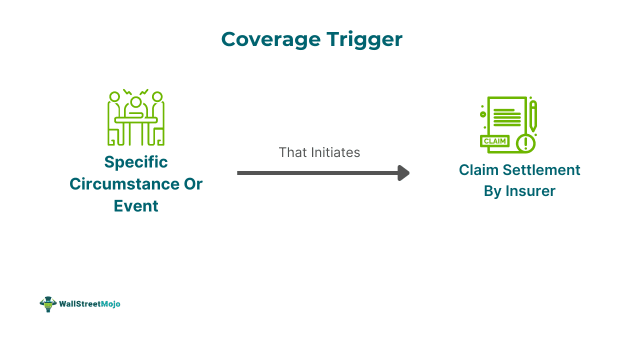
Hence, it clearly mentions the circumstance in which the insurance provider would be liable to entertain the claim in response to the liability or loss covered under the policy. Moreover, it can impact the value of insurance claims. However, the insured has to prove that the event that occurred is covered under the insurance policy.
Key Takeaways
- A coverage trigger is a circumstance that prompts the insurance provider to settle the claim, as specified in the policy language and proved by the court’s theories.
- Its three types include claims-made, occurrence, and loss-occurrence triggers. A coverage trigger signifies the occurrence of a specific event that triggers the payout of the liability to offset the insured’s loss.
- The four critical theories for such triggers are exposure, manifestation, injury-in-fact, and continuous trigger theories.
- While the claims-made trigger emphasizes the reporting of the claim within the policy period, the occurrence trigger focuses on the occurrence of the covered event.
Coverage Trigger In Insurance Explained
A coverage trigger is a concept that explains the specific event or circumstance that would result in the insurance claim being paid by the insurer for the loss of the insured. These events are stated in policy-related terms, and the court has a different set of principles and theories to consider a condition valid for claim settlement. It is proof when a case is filed for an insurance claim that, the insurer is liable to make payment only if the specified condition occurs.
However, such a clause requires the insured to prove the occurrence of the stated event. Thus, the court uses various theories to assume the liability policy application in a particular circumstance, which helps to save time, cost, and efforts otherwise consumed in proving the same. The coverage trigger by state emphasizes the use of different theories by every country’s jurisdiction. These triggers vary with the type of insurance and risk involved in it and can be categorized as follows:
- Claims-Made Trigger: This trigger is widely applied to professional liability insurance when the claim is made within the policy tenure. It emphasizes the time needed to make the claim.
- Occurrence Trigger: This applies to general insurance policies where the event occurs during the policy term, irrespective of the date when the claim is made.
- Loss Occurrence Trigger: This trigger is valid in a property insurance policy where physical damage or loss occurs to the insured within the policy period.
Theories
The following theories of coverage trigger facilitate the court to decide whether an insurance claim is valid:
- Exposure Trigger Theory: This applies when the injured party files an insurance claim after developing a health condition or injury over time. The condition or injury is caused by exposure to a specific substance, such as chemicals.
- Injury-In-Fact Theory: This theory applies when an insured’s injury is the event that activates the insurance claim.
- Manifestation Trigger Theory: This principle considers the discovery or knowledge of the damage or injury that an insured has incurred as the coverage trigger. However, the court’s verdict may differ according to the time of discovery of such a loss.
- Continuous Trigger Theory: This occurs when a combination of the above theories—exposure, manifestation, and injury-in-fact—is applicable. These theories are used to identify an injury or damage that manifests over time.
Examples
This mechanism is a critical aspect of any insurance policy. It highlights the valid event that would result in the payout of an insurance claim. Some of the relevant instances are as follows:
Example #1
Suppose ABC Construction Co. has constructed a multi-story building with 50 flats. It has taken the building insurance from XYZ Insurers from 2008 to 2023. However, a resident, Mr. Morris, files a case against ABC Construction Co. In 2022, he claimed compensation for water leakage and cracks in the walls.
The court applied the continuous trigger theory, as the problem persisted for the past 3 years, causing inconvenience and health problems to the family. Hence, the XYZ Insurers were liable to pay Mr. Morris $10,000 on behalf of ABC Construction Co.
Example #2
As per an article published on July 16, 2024, the Second Circuit Court of Appeals denied coverage for COVID-19-related business losses applied by a Connecticut-based manufacturer, Amphenol Corp. The court affirmed the lower court’s decision to dismiss Amphenol’s breach of contract claims against Factory Mutual Insurance Co. on the grounds that Amphenol failed to prove the necessary physical damage for the insurance coverage trigger.
The Connecticut Supreme Court convicted that direct physical loss of property is considered when a tangible change or loss affects its usability. Hence, the court concluded that the coronavirus particles present on the property could be cleaned or naturally suppressed over time, not causing any physical damage.
Claims-Made Vs. Occurrence Coverage Triggers
Given below are the various distinctions between the two methods:
Frequently Asked Questions (FAQs)
What is the coverage trigger for coverage B?
Commercial General Liability (CGL) insurance includes Coverage B, which can be claimed for advertising and personal injury arising from business activities, such as offenses like false arrest, libel, slander, or malicious prosecution. Additionally, it may cover non-traditional events, such as actions forced by armed mercenaries against the insured’s will or the unauthorized disclosure of confidential information.
What is a coverage trigger in Florida?
In Florida, this method is identified by the theories of exposure, manifestation, continuous trigger, and injury-in-fact. These theories apply when property damage occurs due to a covered event, initiating the insurer’s duty to indemnify under a standard CG 00 01 insurance policy.
While the Florida state courts generally adopt the manifestation theory, the Florida federal courts tend to follow the injury-in-fact theory. On the contrary, the Florida Supreme Court has yet to find a redressal to this conflict.
What is the triple trigger theory in insurance coverage trigger?
The triple trigger theory requires that insurers providing coverage from the initial exposure to harmful products, such as asbestos, must acknowledge the resulting claim. This applies from the time of exposure up to the diagnosis of a resultant injury or death.