

Difference Between Coupon and Yield
Coupon refers to the amount which is paid as the return on the investment to the holder of the bond by bond issuer which remains unaffected by the fluctuations in purchase price whereas, yield refers to the interest rate on bond that is calculated on basis of the coupon payment of the bond as well as it current market price assuming bond is held till maturity and thus changes with the change in the bond’s market price.
What is Coupon Rate?
Whenever a bondholder decides to put his money on a bond, he needs to look at certain parts that make up a bond. A bond has a face value, which is the amount the bondholder will receive at the time of maturity from the issuer of the bond. The coupon rate on the bond is calculated on the basis of the face value of the bond.
For example, suppose the face value of an XYZ bond is $1000, and the coupon payment for the bond is $20 semi-annually, then on an annual basis, the total coupon that will be received by the investor will be $40. The way the coupon rate is calculated is by dividing the annual coupon payment by the face value of the bond. In this case, the coupon rate for the bond will be $40/$1000, which is a 4% annual rate.
It can be paid quarterly, semi-annually, or yearly depending on the bond. Irrespective of the change in the price of a bond, the coupon rate will remain fixed for the life of the bond.

What is Yield to Maturity?
Yield to maturity is the effective rate of return of a bond at a particular point in time. On the basis of the coupon from the earlier example, suppose the annual coupon of the bond is $40. And the price of the bond is $1150, then the yield on the bond will be 3.5%.
Coupon vs. Yield Infographic
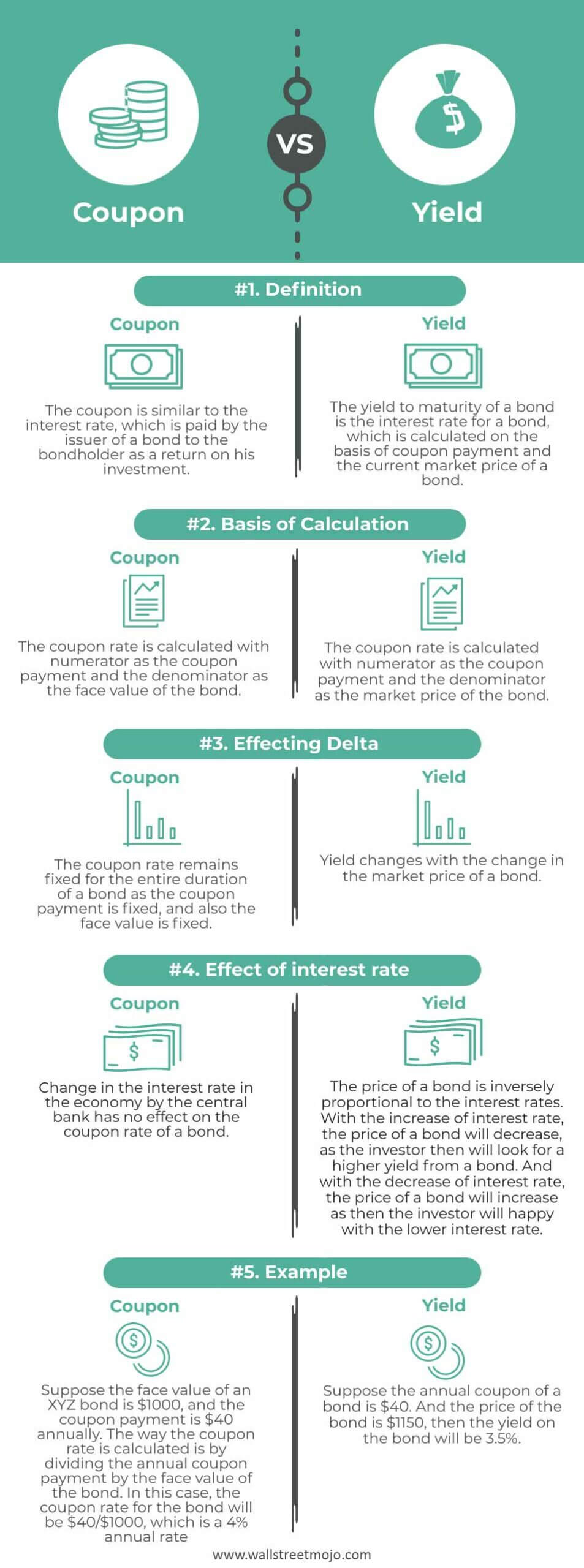
Let’s see the top differences between coupon vs. yield.
Key Differences
- For the calculation of the coupon rate, the denominator is the face value of the bond, and for the calculation of the yield of a bond, the denominator is the market price of the bond.
- The coupon rate is fixed for the entire duration of the bond as both the numerator and the denominator for the calculation of the coupon rate do not change. The yield of a bond changes with the change in the price of the bond.
- Change in the interest rate in the economy by the central bank has no effect on the coupon rate of a bond. The price of a bond is inversely proportional to the interest rates. The yield of a bond changes with the change in the interest rate in the economy.
Coupon vs. Yield Comparative Table
Final Thoughts
Coupon rates and yield are very important components of a bond for an investor in a bond. The coupon rate is paid either quarterly, semi-annually, or yearly depending on the bond. On the basis of the coupon payment and face value of the bond, the coupon rate is calculated.
The yield of the bond, on the other hand, is the interest rate on the basis of the current market price of the bond and is thus also known as the effective rate of return for a bond. The yield of a bond changes with a change in the interest rate in the economy, but the coupon rate does not have the effect of the interest rate.
Recommended Articles
This has been a guide to the Coupon vs. Yield. Here we discuss the top differences between coupon rate and yield to maturity along with infographics and a comparison table. You may also have a look at the following articles –