

Differences Between CFA and FRM
The primary difference between CFA and FRM is the topics they cover. CFA encompasses a broad range of subjects in finance like corporate finance, portfolio management, accounting, fixed income, derivatives, etc. In contrast, FRM is a specialized exam for obtaining expertise in risk management. Additionally, CFA prepares you well for careers in Investment Banking, portfolio management, financial research. At the same time, FRM is suited for those who want to make a career in risk management in banks, treasury departments, or risk assessments.
If you have to choose between the two – CFA® or FRM, which one will you take?
CFA®, or FRM, or both? That is one of the most frequently asked questions when students decide to advance their careers in Finance. Making the right choice is important because each examination takes a lot of hard work, money, and of course, a lot of time. However, it is sometimes difficult for those not aware of its key differences.
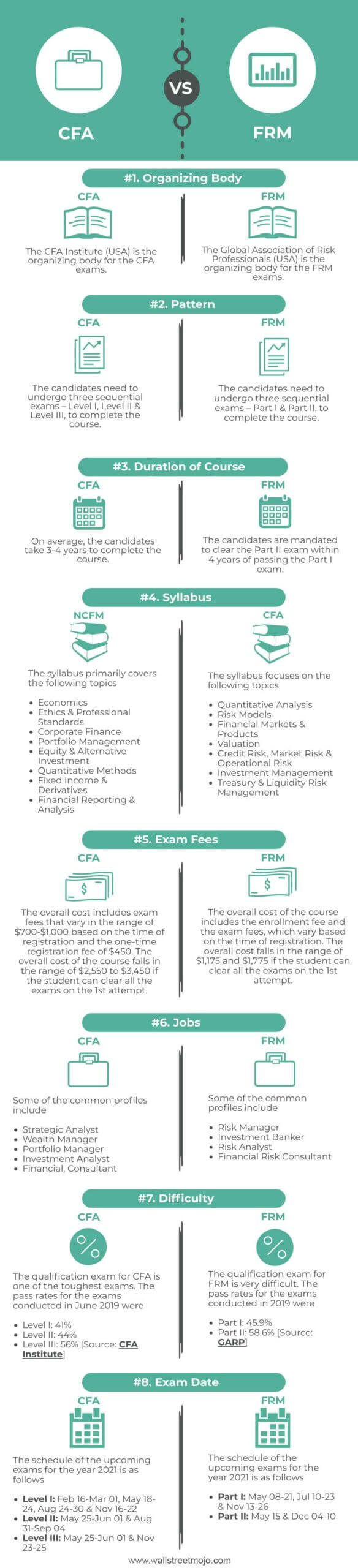
I was fortunate to pass both the CFA® and FRM exams and was lucky to go through the examinations’ course details, benefits, and nuances. In the past, I have mentored hundreds of students for the CFA® and FRM exams. So, I thought of preparing a quick guide on CFA® vs. FRM to help students make an informed choice through this blog. To show you the key differences between CFA® and FRM, I have created an infographic to help you become well-versed.

CFA vs. FRM Infographics
Reading Time: 90 seconds.
Pro Tip: CFA vs. FRM
- Broad vs. focussed – The key difference is that the CFA® curriculum covers a wide range of topics in finance. However, FRM is a specialized exam for gaining expertise in risk management.
- Job opportunities – This course is especially useful for those who want to establish a career in portfolio management, investment banking, portfolio management, or financial research. In addition, FRM opens up careers in Risk Management in banks, treasury departments, or risk assessments.
- Passing rates – Do not stress about the passing rates. Both the exams CFA® and FRM have a reasonable range of passing rates (30%-50%).
- Competition – CFA® exam has no direct competition from other providers. So, if you want to make a career in Investment Banking or portfolio management, then the choice of CFA® is obvious. On the other hand, the FRM examination has direct competition from PRM (professional risk manager). So, if you want to make a career in risk management, you are spoilt for choices as you may want to choose between the two exams – FRM or PRM. I think FRM is rather a popular examination among the two, and for a newbie, it is sensible to appear for the FRM exam first.
- Examination tips – CFA® is easier for students with an accounting background. The CFA® curriculum relies heavily on accounting fundamentals. FRM examination, on the other hand, is somewhat easier for those who have a quantitative background as the majority of foundation-level topics are maths-based.
- I have written an exhaustive post on CFA® and examination tips – Tips on passing CFA® Examination and Important CFA Dates.
- If you are confused between CFA® vs. MBA, then click here.