

Capital Lease Criteria
Capital lease criteria include the following 1) the ownership of the asset gets transferred to the lessee at the end of the period of the lease, 2) the lessee has the option to purchase the leased asset at a price below the market price of the asset at the end of the lease period, 3) that the lease period is at least 75% of the assets economic/useful life and 4) the minimum lease payment’s present value must be at least 90% of the asset’s fair value.
A capital lease is nothing but the right or Ownership of a leased asset that is transferred to the lessee, and the lessor only finances the leased assets.
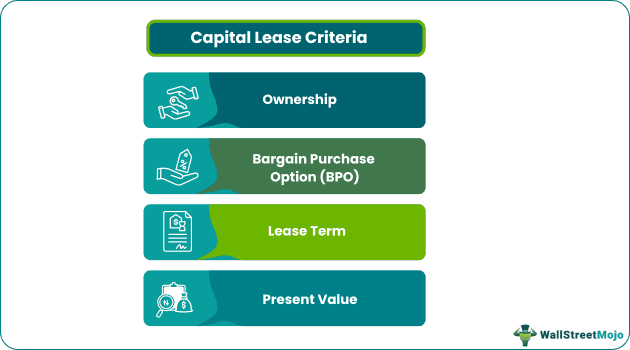
Top 4 Criteria for a Capital Lease
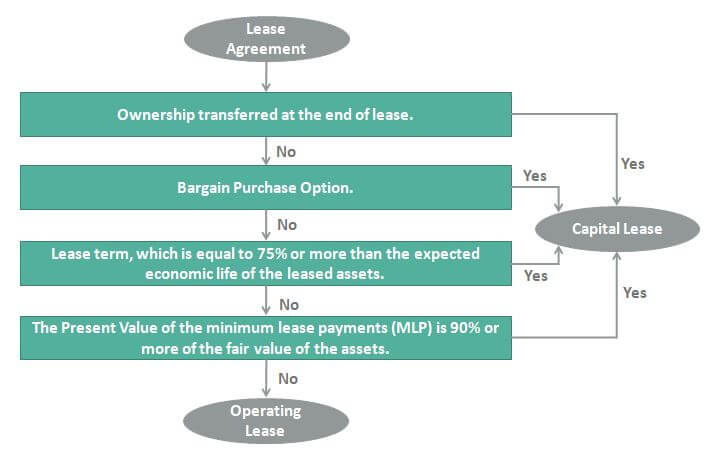
Capital Lease criteria are mainly of four types, and the lease agreement is valid only if it satisfies any of the four options –
#1 – Ownership
Ownership of a leased asset is transferred to the lessee at the end of the lease agreement. The lease agreement includes a provision that, in the end, the lease term leased assets title to be passed to the lessee.
Example
Let’s try to understand the Ownership lease through the below basic example.
Sterling Corporation signed a lease agreement for an asset for 60 Months, with the useful lifespan of an asset being ten years. Sterling Corporation agrees to pay the lessor of an asset monthly lease payment with interest as the lessor finances an asset. As per the agreement, the Lessor is ready to transfer the legal ownership of a leased asset to the lessee at the end of the agreement.
So the above lease is classified as Capital Lease as a lease agreement fulfilling the Ownership criteria.
#2 – Bargain Purchase Option (BPO)
If the lease agreement contains a bargain purchase option, the lease is called Capital Lease. The lease agreement gives a provision to the lessee to purchase the leased assets or property at a price that is expected to be considerably less than the fair value; such criteria are called a bargain purchase option.
Example
Essar limited (Lessor) and Trojan limited (Lessee) signed a leasing agreement on January 1, 2012. The term of the lease is 15 years. The lease agreement is non-cancelable and has a minimum lease payment with a value of $450,000. The lease involves using machinery with 17 years of estimated useful life and is valued at $460,000. The lease agreement provided Trojan Limited with a provision to purchase the assets for $20,000 at the end of the lease agreement.
So in the above example, the Bargain Purchase provision in a lease agreement is provided to Trojan Limited; such lease agreement is classified as a capital lease agreement.

#3 – Lease Term
If the lease agreement provides a provision of a Non-cancellable lease term, which is equal to 75% or more than the expected economic life of the leased assets, then such a leasing agreement is called a Capital Lease.
So if you look at the example explained in criteria two, it fulfills the lease term criteria, as the lease term is 15 years and the life of assets is 17 years, so please term is more than 75% of the economic life of the leased assets in the example as mentioned above.
Example
Let’s discuss one more example.
ABC limited signed a lease agreement with XYZ limited for Machinery, which has a fair value of $17,000, and ABC limited leased it for three years. In return, XYZ limited will repay the Monthly rent of $600, and the economic life span of machinery is five years; the company also charges 3% of interest over a loan of $17,000.
So in the above example, lease term is three years, and the economic life span of the leased asset is five years, so the lease term is less than 75% of the assets life span, so the above lease is called an operating lease.
#4 – Present Value
The Present Value of the minimum lease payments (MLP) is 90% or more of the fair value of the assets.
So if you take the example in criterion two, the Fair market value of an asset is $ 460,000, and the Present Value of Minimum Lease Payments is $450,000, more than 90%. Hence, the lease agreement satisfied the MLP present value criteria.
Capital Lease vs Operating Lease – Explained in Video
Capital Lease Criteria Example
- On December 1, 2010, Kelly Inc. a Laptop services and printing firm and entered in the lease agreement for a color copied with Xerox limited
- The lease agreement provided a provision for four annual payments of $100,000 starting from December 1, 2010, the inception of the lease, and each December 1 till four annual payments are completed.
- The economic or useful lifespan of a copier is estimated as six years. Before deciding to lease, Kelly Inc. considered purchasing the copier for its cash price of $479,079. If funds were borrowed to buy the copier, the interest rate would have been 10%. How should the above lease agreement be classified?
Solution:-
Now we will apply the four classifications criteria.
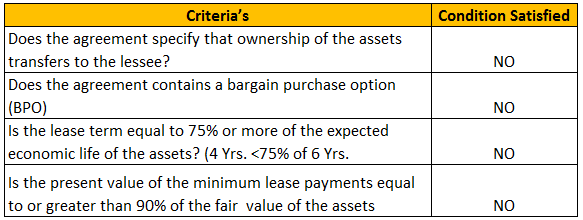
Calculation: – PV of MLP = Lease payments multiply by Present Value**
= $100,000 *3.48685
= $348,685 < 90% of $479,079
**Present Value of an annuity due of $1: n=4, i=10%
Since none of the four classifications criteria is met, this is not a capital lease agreement it is an operating lease agreement.
Now suppose if the above lease agreement provided a provision that the lease term is equal to the estimated useful life of the copier, then the transaction must be recorded by the lessee as a capital lease since it fulfills the criteria of the non-cancellable lease term is equal to 75% or more of the expected economic life of the assets.
Conclusion
So from the above explanations, it is clear that a capital lease exists only if the lease agreement meets any of the criteria mentioned above. If a lease agreement does not meet any of the criteria mentioned above, then such lease is by default called an operating lease. The above criterion is used to classify leases on the lessee’s books.
Recommended Articles
This has been a guide to Capital Lease Criteria. Here we discuss the top four criteria along with step-by-step examples and explanations. You can learn more about accounting from the following articles –