

What Is Bond Vs Loan?
The primary difference between Bonds and Loan is that bonds are the debt instruments issued by the company for raising the funds which are highly tradable in the market, i.e., a person holding the bond can sell it in the market without waiting for its maturity, whereas, the loan is an agreement between the two parties where one person borrows the money from another person which are not tradable generally in the market.
A bond is a loan used by large entities, corporations, or governments to raise capital, which they require for operating their business, and it’s done by selling IOUs to the public. The terms bond and loan are related; however, they are not the same and have specific core differences. Both are debts.
Bonds Vs Loans Explained
Bond vs loan is a very important topic of discussion in the financial market because financial institutions, corporates and individuals frequently deal with these financial instruments for various purposes. Both are used for raising funds for investment, growth, expansion, and personal development.
However, there is a lot of difference between how the method is carried out in both cases, what is the intention or objective of each and what is the end result. Both are debt instruments which puts an obligation on the party who borrows the loan or issues the bonds. The obligated party has to pay back the amount within the stipulated period after using the same for the purpose for which they are taken.
It is also to be noted that both the debt instruments mentioned above help evaluate the borrower’s financial condition and decide their creditworthiness. Investors or lenders put their money into such investment avenues only after a proper evaluation of debt repayment capacity of the borrower in both cases.
Bond Vs Loan – Explained in Video
What Is Loan?
A loan is a debt in which a money lender will lend the money, and a borrower will borrow the money. A specific time limit will be set for the repayment of the debt-money, including the interest amount and the principal amount the borrower has borrowed from that lender. This principle amount is mostly paid in installments regularly. Every installment will be called an annuity when it is a similar amount.
What Is Bond?
Bond is commonly referred to as the fixed-income securities and is one of 3 major asset classes that individual investors are usually most familiar with, along with stocks (i.e., equities) and cash equivalents. Many government and corporate bonds are publicly traded; others are traded only over-the-counter (i.e., OTC) or privately between the lender and the borrower.
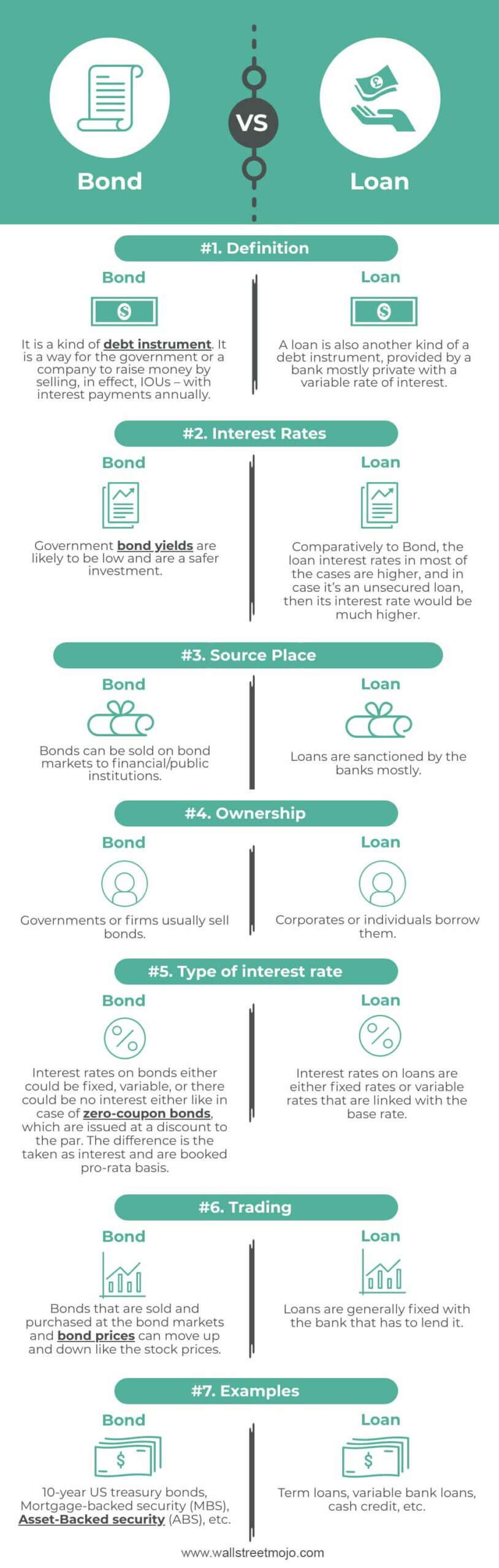
Bond Vs Loan Infographics
The infographics given below show the differences is a concise and systematic format. It helps the reader to interpret and remember the points easily.
Critical Differences
The key difference section given below highlights the important point of differences between the two topics with a lot of clarity and details. Let us study them and understand the two concepts clearly.
- The main difference is that a bond is highly tradeable. If you purchase a bond, there is usually a marketplace where you can trade it. It means you can sell the bond rather than wait for the thirty years’ end. In practice, people purchase bonds when they wish to increase their portfolio in that way. Loans tend to be agreements between borrowers and banks. Loans are generally non-tradeable, and the bank will be obliged to see out the entire term of the loan.
- In the case of repayments, bonds tend to be only repaid in full at the bond’s maturity – e.g., 10, 20, or 30 years. Banks may expect the repayment of principal and interest during the repayment period at regular intervals.
- The US and the UK Government bonds are perhaps treated as low-risk. Interest rates on government bonds are generally lower. Private loans on unsecured debt, on the other hand, are likely to attract a higher rate of interest. Corporate bonds are mostly somewhere in between – depending upon the reputation of the corporate.
- Issuing bonds give the corporates greater freedom to operate as they deem fit because it frees them from the restrictions often attached to the banks’ loans. Consider, for example, that lenders or the creditors often require corporates to agree to various limitations, such as not to issue more debt or not to make corporate acquisitions until their loans are repaid entirely.
- The rate of interest that the companies pay the bond investors is often less than the rate that they would be required to pay to obtain the loan from the bank.
- Bonds that are traded in the market do possess credit rating, which is issued by the credit rating agencies, which starts from investment grade to speculative grade, where investment-grade bonds are considered low risk and usually have low yields. In contrast, speculative bonds are considered of higher risk; hence, they are traded at higher yields to compensate the investors for the risk premium. On the contrary, a Loan doesn’t have any such concept; instead, the creditworthiness is checked by the creditor.
Comparative Table
The comparative table below shows the differences in a tabular format points them out on the basis of their interest rates, ownership, source place, the method of trading for both the cases, the type of interest rates, along with examples of each.
Recommended Articles
This article has been a guide to Bond vs. Loan. Here we discuss the top difference between Bond and Loan, infographics, and a comparison table. You may also have a look at the following articles –