


What Is Nudge Theory?
Nudge theory refers to a behavioral science term proposing that behaviors and decisions of people could be influenced predictably using small changes in the manner of choices presentation. It aims at nudging individuals towards a defined outcome or decision with the help of behavioral economics insights and cognitive psychology.
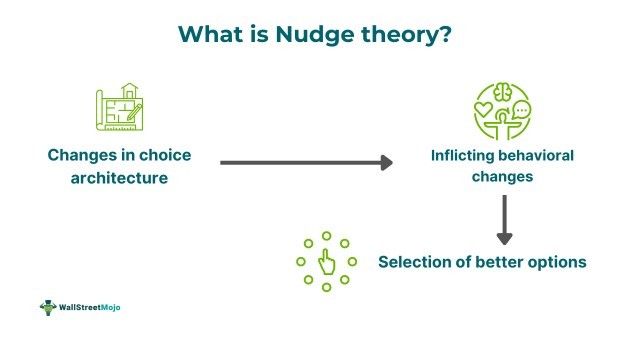
Nudge theory in psychology provides cost-effective and non-intrusive techniques to guide the decision-making and behavior of customers to businesses. They can use the nudging technique to push customers towards expected results. Nevertheless, businesses must use it in a limited manner to prevent any misuse and manipulation of consumers’ choices unethically.
Key Takeaways
- Nudge theory is a behavioral science term suggesting making small adjustments to the way choices are presented to people to influence their decisions and behaviors.
- It uses insights from cognitive psychology and behavioral economics to nudge people toward a specific choice or goal.
- It involves seven stages – clear change definition, stakeholder involvement, evidence-based justification, present as free will, active listening & collection of feedback, barrier removal, and celebrating short-term wins for ongoing adoption.
- It does not curtail individual freedom of choice while encouraging positive behaviors, but If transparency is not maintained, then it can be seen as manipulative.
Nudge Theory In Behavioral Economics Explained
Nudge theory can be stated as a behavioral economic term promoting the notion concerning choice architecture as per the book Nudge, written in 2008. Moreover, the environment has such designs which encourage decisions for better choices. It works by leveraging tendencies of human psychology like social proof and inertia. It also utilizes the tendency of people to remain firm on their pre-set selections.
It has led to the usage of influencing human behavior more ethically instead of coercing them to make decisions against their will. Thus, in a way, it has improved societal outcomes through correct guidance of individuals for making correct decisions. It has the characteristic of being easy to implement in different contexts.
Moreover, there are 7 stages of nudge theory, as briefed below, which helps in its application:
- First, define the anticipated change clearly while excluding overwhelming detail and ambiguity.
- Include stakeholders during change analysis to resolve resistance and achieve support.
- Then, utilize proof to justify transformation and form credibility.
- Try presenting the change in the form of free will to choose rather than as a mandate to express stakeholder independence.
- Actively listen and collect feedback to redefine the process of change.
- Next comes the barrier removal to transformation adoption through the provision of necessary resources and support
- Finally, celebrate every short-term victory to conserve momentum and motivate for sustained adoption.
As such, it has helped in modifying the choices presentation and simplification of sophisticated financial data. Also, the positive outcome and non-coercive technique of nudging have led financial institutions and regulators to in the application of nudge theory in their work. Now, they can apply various nudges to showcase their investment options in a much more favorable manner. Moreover, they also use it to promote ethical practices and behavior amongst financial intermediaries.
Examples
Let us use a few examples to understand the topic.
Example #1
An online article published on 14 July 2020 discusses the manner of using nudge theory inside the HR domain for fostering behavioral change at the office. Small changes having significant impacts or nudges should be in line with the outcomes and cultures of a company. Meanwhile, the member of the team of behavioral insights of the UK government sees nudge as a route to model behavior using light regulation.
They also said that nudges must be easy to opt out of, transparent, and helpful to be effective. Only then does it work to encourage people to have good behavior instead of forcing change in people. One can display the healthy food at sight level by having a comparison chart of energy comparison of neighbors. It also emphasized that HR could use nudges to create a desire to work as part of a team, stressing consistency and commitment and using societal proof.
Example #2
Let us assume that Riverdale Hospital of Old York City has decided to teach healthy and environmentally friendly habits to its staff. Hence, the owner, Jacklyn Rivera, consults an expert and finds that nudge theory would work effectively in this regard. As a result, she prepares a strategy to give daily energy usage statistics contrasting their office power consumption to that of the hospital’s average. Moreover, she also started an energy-saving friendly competition amongst the staff of the hospital.
Therefore, Riverdale Hospital was able to save 15% of energy during the first month. Further, the hospital displayed food at the switchboard level to make staff feel for waste of energy and try to save them. Meanwhile, she also pinned a green pledge board at the office and desks of staff to make them commit to green energy usage and savings.
Advantages And Disadvantages
Let us use the table below to understand the benefits and challenges associated with the theory;
| Advantages | Disadvantages |
|---|---|
| Does not curtail individual freedom of choice while encouraging positive behaviors. | If transparency is not maintained, then it can be seen as manipulative |
| Affordable to implement as compared to traditional tools of policy like regulations and taxes | Fails to address the behavioral issue at the grassroots level, leaving a void for further comprehensive policies. |
| Becomes easier and simple to execute, like providing feedback and setting defaults. | If carelessly tested and examined, then it has the potential to give wrong outcomes. |
| It has the potential to impact areas like increased organ donation rates highly. | It may lead to undue influence on individuals, curbing their right to free will. |
| Helpful in improving public health, like decreasing missed appointments of medical importance. | The effectiveness varies as per the individual differences and context. |
| Simplifies complex choices, enhancing decision-making. | Discards robust interventions due to overreliance on nudges. |
Frequently Asked Questions (FAQs)
How to use nudge theory?
It can be utilized to impact behavior by rectifying the environment of decision-making with the help of pre-set defaults and modifying the manner of attributes offered to underscore the options one wants the individuals to choose. It depends on the comprehension of the way people make choices and analyze while ingraining insight into behavioral economics and cognitive psychology.
What is the nudge theory in change management?
Change management can utilize the theory of nudging for:
- subtly influencing employees to use fresh software licenses,
- create sound productivity selections, and
- use better workflows autonomously
- be free of restrictive edicts throughout the company
It offers a cost-effective tool and non-intrusive tool to guide decisions making and behavior.
What is the nudge theory in health?
In health management, it can be used more effectively in changing behavior than straightforward enforcement or instruction. It tends to give shape to the environment to impact the possibility of selecting healthier modes.
Who created the nudge theory?
Two scholars- Richard Thaler, a behavioral economist, and Cass Sunstein, a legal scholar, wrote the famous book Nudge: Improving Decisions About Health, Wealth, and Happiness” in 2008 and popularized the theory of nudge.