


What Is Credit Transaction?
Credit transactions are types of transactions in which a customer receives goods (or services) before and makes payment later. The sole purpose of this transaction is to use the product first and then enable payment of goods at a future date.
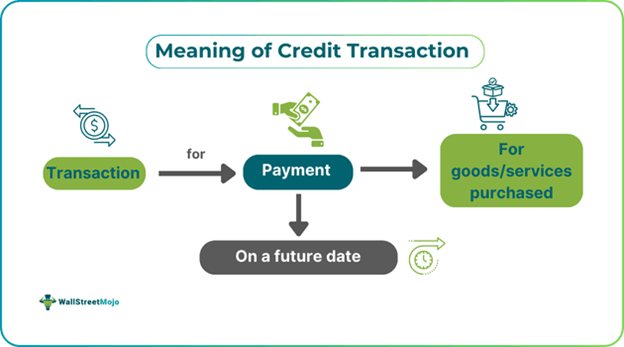
Credit transactions offer advantages for both businesses and credit card issuers. Here, the supplier may provide their goods to businesses under a hire-purchase agreement and facilitate receipt of the supplied goods in the future. As a result, customers can also experience the product without worrying about the payment. However, there are certain limitations to this transaction for the creditor.
Key Takeaways
- A credit transaction is a transaction in which one party (buyer) agrees to pay the lender (or seller) for goods and services purchased at a future date.
- It allows a credit facility for such individuals to make instant purchases and pay later via installments. These payments must end within the credit period or face interest charges.
- Such transactions also form a vital part of credit cards. Here, businesses can load their money into credit card holders’ accounts and recover from them later.
- Credit, debit, and cash transactions differ widely due to the mode of cash payment.
Credit Transaction Explained
A credit transaction is a business transaction where the payment (receipt), goods, or services do not happen on the day of purchase or sale. Instead, it happens on a future date, which can extend to weeks or months. It provides comfort for the buyer to enjoy the goods at their ease. So, if a person had bought electronic goods from a wholesaler, the former receives a credit discount on the purchase. The retailer can later make the payment within a stipulated period. However, any delay in payment after the credit period can lead to interest charges.
In businesses, consumer credit transactions occur on a usual basis. Such transactions are enabled when procuring raw materials from suppliers or selling finished goods at credit. In exchange, the creditor (business or company) may supply a bill of exchange or note receivable. It details the amount owed, credit period, and interest charges applicable, if any. Within the credit period, the buyer (of goods or services) must make the due payment to the concerned creditor (or seller). Similarly, individuals also use consumer credit transactions for personal lending to friends, family, or household needs. Here, the debtor (consumer) may repay the amount due in installments.
Furthermore, these original credit transactions are also a significant component of credit cards like Visa and Mastercard. OCTs enable fund transfers from the company’s business account to the credit card holder’s account. They experience convenience in making purchases on online channels. Also, there is no risk of losing money in this entire process. As a result, the original credit transaction is a tool for loading money and letting borrowers spend whenever needed.
Examples
Let us look at some examples of how businesses utilize the advantages of credit transactions:
Example #1
Suppose John is a business owner who sells maple juice to many customers. He has a wholesale business that allows large corporations to use his product as a raw material for other products. To date, he has maintained around 15 clients who deal in large quantities. Also, to boost his client relationships, John enables credit transactions where clients can purchase maple syrup orders and later make payments. After 20 days, most clients typically make their payments. If a payment is missed, John issues a reminder to ensure timely collection.
Example #2
According to news published in November 2024, the Bastrop County Sheriff’s Office reported many fraudulent credit and debit transactions at the hardware stores. There were multiple reports registered by people living on the outskirts pertaining to such transactions. When store employees asked for customer proof, the latter gave fake IDs, which eventually allowed them to make large purchases and steal financial information. As a result, the Sheriff advised stores to avoid over-the-phone payments for large purchases and implement in-person verification to mitigate risk to its maximum.
Difference Between Credit And Cash Transactions
The following table lists the differences between credit and cash transactions occurring in the due course of business:
Credit Vs. Debit Transactions
Let us look at the pointers that explain the differences between credit and debit transactions below the provided table:
Frequently Asked Questions (FAQs)
What is the meaning of the Fair and Accurate Credit Transactions Act?
It is a federal (the United States) law passed in November 2003 in response to the theft and credit-related fraud happening in the country related to online purchases. The FACTA allows creditors and related reporting agencies to protect consumers’ information and take relevant steps to avoid such fraud.
What is credit transaction in accounting?
In accounting, there are three definitions of a credit transaction. The primary one includes supplying goods or selling a piece of land under a contractual sale or hire purchase agreement. Likewise, it also considers leases or hiring any land in exchange for periodic payments.
Are credit transactions recorded in the cash book?
Since these transactions do not involve any movement of cash (inflows or outflows), they cannot be recorded in the cash book. The sales journal records the entries of such transactions involving credit purchases.
Who most often wins in a credit transaction?
There is a win-win situation for both buyers and sellers going for credit transactions. Borrowers get discounts and access to goods before making the actual payment. Lenders (sellers) get an opportunity to bring in strong client relationships and earn interest on delayed payments.