

What is Revenue Maximization?
Revenue Maximization is the maximization of sales of a business using measures such as advertisement, sales promotion, demos, test samples, campaign, references, etc., to increase revenue and capture higher market share in an industry. Technically, Revenue is maximized at a point where MR (Marginal Revenue) equals 0.
Key Takeaways
- Revenue maximization refers to inflating business sales using advertising, sales promotion, demos, test samples, campaigns, references, etc., to boost revenue and capture higher market share.
- One must understand that revenue is not to be increased but to maximize wealth. Without knowing at which point revenue is maximized and blind targets are fixed to maximize sales, then it will not work.
- Increased market share, brand identity creation, and economies of scale advantages are the benefits of revenue maximization.
Explanation
- Each business start-up has a vision of maximizing the wealth of shareholders. To achieve this objective, the major role is handled by Revenue. Increasing revenue leads to profit maximization and ultimately increases the wealth of shareholders. It is very difficult for any organization to increase its revenue in the modern era. It’s a customer-driven market. If a customer is cent percent satisfied, the product/service will get attention and boost revenue.
- Haphazardly company cannot increase its revenue without thinking about its shutdown/losses. It must stop when Marginal revenue from selling a single unit reaches 0. Even after the company increases its revenue, it will incur losses if the quantity sold is more than revenue maximization. It has increased revenue and maximized the revenue, keeping in mind its sustainability.
Revenue vs Income Explained in Video
Example of Revenue Maximization
Let us consider an example of a business selling Pens. It is newly launched and wants to maximize its revenue. Here is the table stating its Selling price, Quantity Sold.

Calculate the total revenue and marginal revenue.
Solution:
- Selling Price = Price at which a pen is sold (It Decreases as an increase in Qty sold)
- Qty Sold = Qty sold in the market
Now, calculate the total revenue as shown below:


- = (180-100)/(2-1)
- = 80
Similarly, calculate the other marginal revenue.
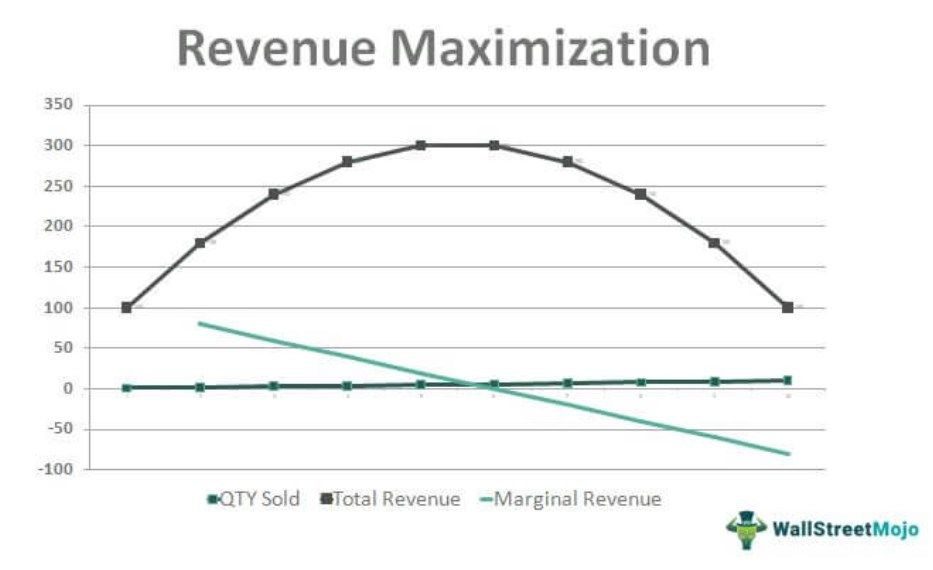
Revenue is maximized at a point where Marginal Revenue = 0
Below is the graph of Revenue maximization. The point at which Marginal Revenue is 0 is when revenue is maximized. In our case, it is when six qty is sold. Total revenue is also high at this point. After this point, even after increasing Qty Sold, Revenue will not be maximized. Marginal revenue will fall.

Benefits
It must clarify that Revenue has not just to be increased but to be Maximized to wealth maximization. Without determining a point at which revenue is maximized, if blindly targets are set to maximize Sales, things won’t go well. Benefits are listed below-
#1 – Increase in Market Share
When it’s a start-up, it is necessary to build up a strong and large customer base to have a place in the market. i.e., creation/expansion of Market share. As we saw in the above example, the price will fall as the qty sold increases. It will let a product sell at the lowest possible price and gain more customers, eventually increasing market share.
#2 – Creation of Brand Name
A good brand name can be created if products/services are sold at comparatively lower and efficient quality. It will bring loyalty to customers. Customers will retain for a longer period or till forever in some cases.
#3 – Benefit of Economies of Scale
Benefits of high qty sold can be availed which helps in increasing profitability. When a company can sell more qty at a lower price, it has the advantage of producing high qty. For example, it can fully utilize the amount paid for Fixed Costs. The fixed cost per unit decreases as the qty sold/produced increases. Rent, Admin Expense, etc., can be fully utilized.
Revenue Maximization vs Profit Maximization
Revenue Maximization
- Qty sold to a point at which MR=0
- Where MR= Marginal Revenue
- The aim is to increase the customer base and capture high market share
- It is suitable for a new entrant to a market or existing business expanding into new product line eg. Reliance Jio
- It is a long term objective
- Businesses having this strategy can take up any new opportunity in the market and take up its utmost advantage.
Profit Maximization
- Qty sold to a point at which MR=MC
- Where MR= Marginal Revenue, MC= Marginal Cost
- Aim to increase the profitability of a business
- It is suitable for an existing business whose reputation is maintained in the market and has a well-established client base who is more concerned about the better quality of product/ service and not cutting down the price.
- It is short term objective
- Business becomes rigid and has to lose a few new customers in the non-flexibility of cutting down prices.
Frequently Asked Questions (FAQs)
Under what conditions will revenue maximization lead to profit maximization?
The profit maximization rule mentions that if a firm wants to increase its profits, it must select an output level where marginal cost (MC) equals marginal revenue (MR) and the marginal cost curve is rising.
Why is revenue maximization more realistic?
Revenue maximization is realistic in the contestable market when the firm’s profit maximizes; new firms get encouraged to involve in ‘hit and run’ competition and may take market share, e.g., in supermarket competition. Thus, the statement is valid based on whether the market is accurate.
What are the consequences of revenue maximization?
First, looking for revenue maximization may be a thoughtful approach to increasing long-term profitability. Moreover, firms provide economies of scale, more notable sales, and market share through market share. Therefore, they may have a more remarkable ability to increase prices.
What is the difference between sales and revenue maximization?
Like revenue maximization, sales maximization targets boosting sales volume instead of the amount of profit or revenue. In addition, the maximum point at which sales are complete is where output is as significant. In such cases, the STC and TR curves intersect.
Recommended Articles
This has been a guide to what is revenue maximization. Here we discuss examples and benefits of revenue maximization and its differences with profit maximization. You may learn more about financing from the following articles-