

Difference Between Value and Growth Stocks
Value Stocks are stocks in which the current stock prices are different from the stock’s perceived value. With the expectation that value is realized, the stocks are invested, whereas, Growth Stocks are stocks where the increase in stock price is expected because of capital appreciation or the growth in net income.
The stocks can be divided into two types.

- On the other hand, value stocks are stocks of large organizations that have been traded below their worthy value. In simple words, value stocks are undervalued stocks for a reason. The under-valuation can be any scandal, flawed perception of the public, or any setback at the company.
- Growth stocks are stocks that can outperform any other stocks of competitors. These growth stocks can be of small, medium, or large-sized organizations. The emphasis on growth stocks is “potential.” The financial analysts give the prediction of these stocks. Due to the great operations or efficient management, these stocks are growing super-fast, faster than any competitors.
The similarity between them is that both can be beneficial for investors. For example, if investors invest in growth stocks, they can expect their money to grow faster. And if they invest in value stocks, they will get a lower price per share while buying, and when the value of the stocks increases (which will happen eventually as per the predictions of financial analysts), they will be able to sell the stocks.
But as you can guess, there’re many differences between these two types of stocks.
Do you know why people choose to invest in stock over any other instrument? It’s because stocks grow faster than the inflation rate. To mitigate the risk, the investors may choose mutual funds, ETFs, but these are culminations of stocks too.
Value vs. Growth Stocks Infographics
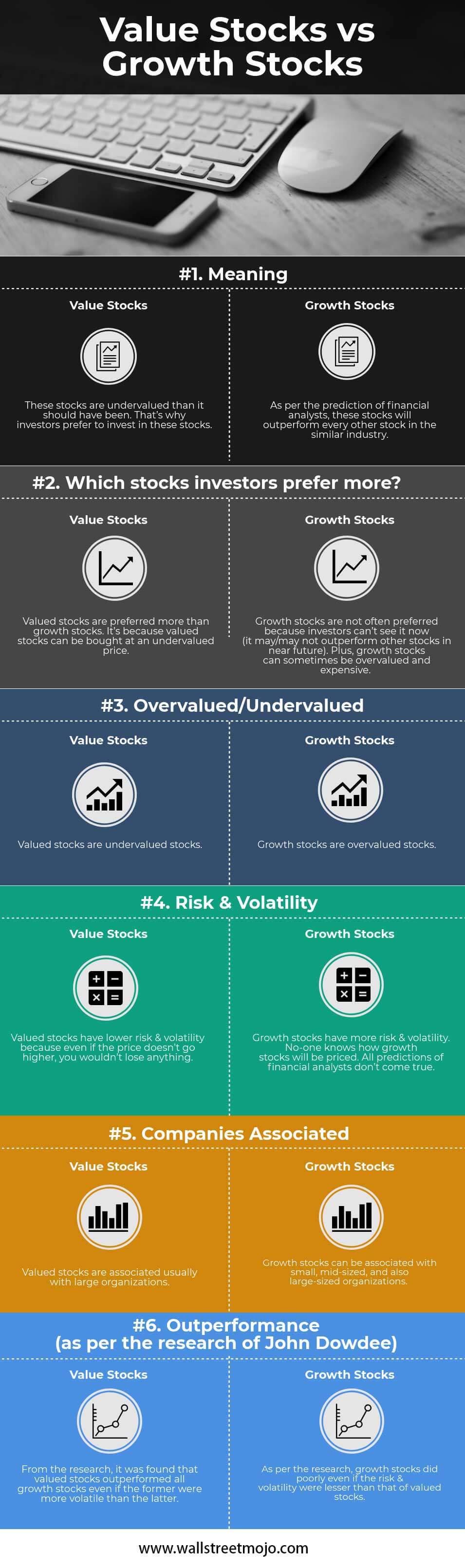
Let’s see the top differences between value stock vs. growth stock along with infographics.
Key Differences
- Valued stocks have great potential and are currently undervalued due to a scandal, a bad name, or public perception. On the other hand, growth stocks have great potential for outperforming similar stocks in a similar industry.
- If you invest in valued stocks, the risk & volatility are lower (they can be higher in a few cases). On the other hand, growth stocks have more risk & volatility (which can be lower in some instances).
- As per John Dowdle, it was found that valued stocks did exceptionally well than growth stocks from 2011 to 2013. The valued stocks in the study were more risky and volatile than the growth stocks.
- Valued stocks are undervalued stocks. That’s why investors prefer valued stocks more. Growth stocks, on the other hand, are overvalued stocks.
Video Explanation of Value vs Growth Stocks
Value vs. Growth Stock Comparative Table
Final Thoughts
Even if valued stocks are undervalued due to a scandal or bad reputation, it has more value in the investors’ eyes than the growth stocks. If we can keep two stocks in front of an experienced investor, she will pick the valued one first.
Of course, there are other factors that one needs to consider, e.g., volatility, risk, market reputation, prediction of financial analysts, historical performance, etc. But clearly, investing in valued stocks is more beneficial to investors than growth stocks.
Recommended Articles
This article is a guide to Value vs. Growth Stocks. Here we discuss the top differences between value and growth stocks and infographics and a comparison table. You may also have a look at the following articles for gaining further knowledge –